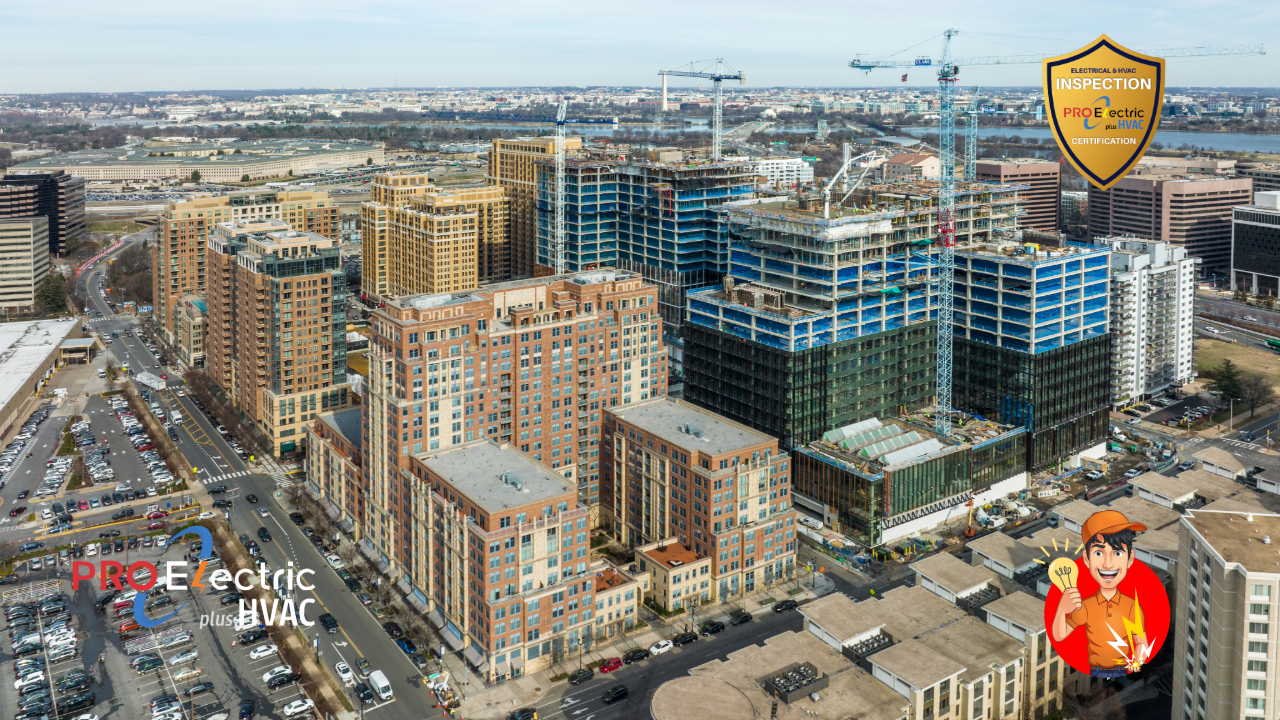
Crystal City has been rebranding as National Landing since Amazon announced its HQ2 development, and the transformation is visible everywhere — new construction, retail expansion, and an influx of tech-sector residents who arrive with electric vehicles and an expectation that charging them at home should be as straightforward as plugging in a laptop. The expectation is reasonable. The reality of Crystal City’s electrical infrastructure is considerably more complicated.
What Amazon’s HQ2 Did to Crystal City’s Resident Profile
Before Amazon, Crystal City was primarily a government contractor enclave — high-density residential buildings serving a workforce that commuted by Metro, drove modest vehicles, and did not routinely ask their building management to install 240-volt charging circuits in the garage. The Amazon effect has layered a different demographic onto the existing housing stock: higher-income technology workers, many of them early EV adopters, now occupying buildings whose electrical infrastructure was specified for the pre-Amazon resident profile. The parking garages in Crystal City’s mid-rise and high-rise residential buildings were designed for electric vehicles. They are now being asked to serve a resident population where a significant and growing percentage drives vehicles that consume 7 to 15 kilowatt-hours every night.
The Garage Panel Problem in Crystal City’s High-Rises
A Crystal City high-rise parking garage typically has a dedicated electrical service for common-area lighting, ventilation, and potentially a few convenience outlets. That service — sized for those loads — has no spare capacity for EV charging circuits. Adding a single Level 2 EV charger requires a dedicated 240-volt, 50-amp circuit from a panel that may be fully committed to its existing load. Adding 10, 20, or 50 chargers — the number that a building’s resident demand will eventually require — needs a fundamentally different approach to the garage electrical service: a service upgrade, a new subpanel, and a load-management charging network that distributes available capacity across all connected vehicles. This is not a problem an individual resident can solve alone, nor is it one building management can address without a licensed electrician with specific experience in high-density EV charging design.
What Makes Crystal City’s EV Charging Challenge Different From Suburban Installations
- Garage electrical service sized for lighting and ventilation — not EV charging loads
- Dozens to hundreds of vehicles in a single garage requiring coordinated charging capacity
- Metering complexity — individual billing for residents in a shared electrical system
- Building management approval, condo association approval, and Arlington County permits all required simultaneously
- Physical routing of conduit through finished garage structures without disrupting existing systems
- Load-sharing technology required to prevent garage service overload as charger count grows
The Load-Sharing Network: The Solution Crystal City Buildings Are Beginning to Deploy
The practical solution for Crystal City’s multi-unit residential buildings is a networked EV charging system managed by a central load controller. Rather than dedicating a fixed 50-amp circuit to each parking space — a configuration that would require a garage service upgrade of enormous scale to support full buildout — a load-sharing network dynamically allocates the available garage panel capacity across all connected chargers in real time. When 40 vehicles are plugged in overnight, each receives a proportional share of the available capacity. When some vehicles reach full charge and stop drawing power, the remaining vehicles’ charge rates increase. The result is that a garage service rated for a fraction of what full simultaneous charging would require can serve a large number of chargers without a service upgrade proportional to the charger count.
Virginia Law and What Crystal City Residents Can Demand
Virginia Code Section 55.1-1961 protects condominium unit owners’ right to install EV charging equipment in parking spaces they own or exclusively control, prohibiting HOA and condo associations from imposing unreasonable restrictions. This statute applies throughout Crystal City’s condominium buildings. A resident who owns their parking space and has been denied EV charging access without a process consistent with the statute has standing to challenge that denial through the Virginia Common Interest Community Board. Building management companies that are unfamiliar with this statute — and that issue flat denials without engaging the Virginia approval process — are creating unnecessary conflict and legal exposure that a properly structured charging approval program would eliminate.
Related Articles
What PRO Electric plus HVAC Does for Crystal City Buildings and Residents
PRO Electric plus HVAC works with both individual Crystal City residents pursuing personal EV charger approvals and building management teams developing building-wide EV charging programs. For residents, we prepare the complete technical specification — panel capacity assessment, proposed circuit routing, metering method, contractor license documentation, and Arlington County permit application — that gives building management everything it needs to evaluate and approve the request. For building management, we design and install load-sharing charging networks that scale from initial deployment to full building penetration without requiring repeated service upgrades. Every installation is permitted through Arlington County and coordinated with Dominion Energy where service modifications are required.
Serving Crystal City, Pentagon City, Rosslyn, and All of Arlington County
PRO Electric plus HVAC designs and installs EV charging solutions for Crystal City’s high-density residential buildings — from individual unit approvals to building-wide load-sharing networks with full Arlington County compliance.
Schedule a Building EV Charging Consultation
703.225.8222
Frequently Asked Questions
Why is EV charger installation difficult in Crystal City, VA buildings?
Most Crystal City buildings were not designed for EV charging. Garage electrical systems were sized for lighting and ventilation, not for high-demand charging circuits, which creates capacity and infrastructure challenges.
Can individual residents install EV chargers in condo or apartment garages?
In many cases, yes, but approval from building management or the condo association is required. Virginia law protects the right to install EV chargers in owned or controlled spaces, but the installation must meet building, safety, and permitting requirements.
What is a load-sharing EV charging system?
A load-sharing system distributes available electrical capacity across multiple EV chargers. Instead of each charger drawing full power at the same time, the system adjusts output dynamically so many vehicles can charge without overloading the building’s electrical service.
Why can’t buildings simply add one charger per parking space?
Providing a dedicated high-power circuit for every parking space would require massive electrical service upgrades. Load-sharing systems allow buildings to support many chargers without needing to increase service capacity to that level.
What approvals and permits are required for EV charging in multi-unit buildings?
EV charger installations typically require building management approval, compliance with condo or HOA rules, and an Arlington County electrical permit. In some cases, coordination with the utility company is also required for service upgrades or metering changes.
References
Virginia General Assembly. (2023). Code of Virginia § 55.1-1961: Electric vehicle charging stations in condominiums. Commonwealth of Virginia. https://law.lis.virginia.gov/vacode/55.1-1961
National Fire Protection Association. (2023). NFPA 70: National Electrical Code, 2023 edition — Article 625: Electric vehicle charging systems. National Fire Protection Association.
U.S. Department of Energy. (2024). Multi-unit dwelling EV charging: Challenges and solutions. AFDC. https://afdc.energy.gov/fuels/electricity_charging_multiunit.html
Arlington County Department of Community Planning, Housing and Development. (2024). EV charging permits for multi-unit residential buildings. Arlington County Government. https://www.arlingtonva.us/building