
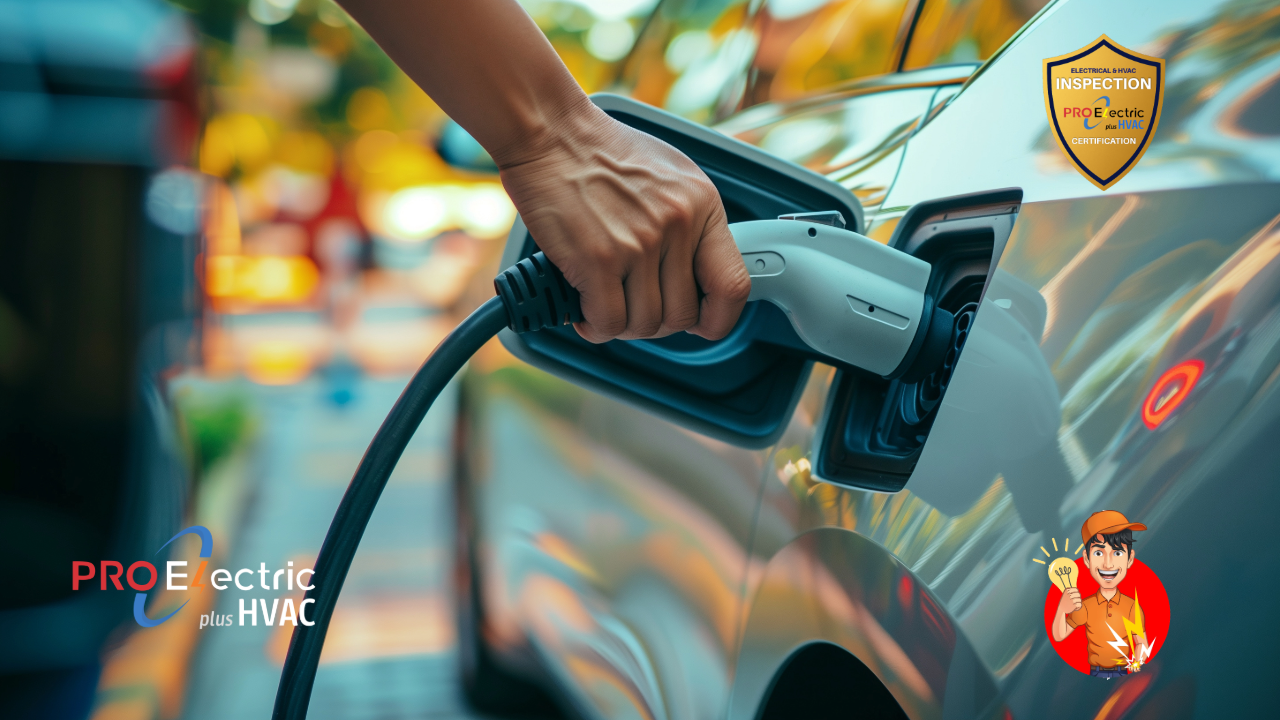
By Peter, Master Electrician | PRO Electric plus HVAC | EV Charger Installation Service
BOTTOM LINE UP FRONT (BLUF)
If you bought an EV or are planning to, the charger that came in the trunk is not what you actually want plugged into the wall. A Level 1 charger uses a regular wall outlet and adds about three to five miles of range per hour. A Level 2 charger uses a 240 volt circuit, adds twenty five to forty miles of range per hour, and is what every serious EV owner ends up installing. The job of installing one is the kind of work that looks simple from a distance and gets complicated quickly. Panel capacity, breaker space, conduit runs, NEC 625 compliance, permits, inspections, and HOA rules all come into play. This guide walks through everything a Northern Virginia homeowner should know before signing a contract.
I am Peter, a Master Electrician at PRO Electric plus HVAC. I have installed Level 2 EV chargers in every kind of Northern Virginia home, from 1700s rowhouses in Old Town Alexandria to brand new construction in Brambleton. If you want the answer for your specific home, the service page has my direct line.
Table of Contents
Level 1 vs Level 2 vs Level 3 Charging
There are three categories of EV charging, and only two of them are realistic for home installation. Level 1 uses a standard 120 volt household outlet. It draws about 12 amps and delivers somewhere between three and five miles of range per hour of charging. For a homeowner who drives twenty miles a day and parks the car at home for fourteen hours every night, Level 1 is technically enough. For anyone else, it is not. Level 1 was designed to be the option that exists when nothing else does.
Level 2 uses a 240 volt circuit, the same voltage as your electric dryer or range. Typical residential Level 2 installations are sized for 40 amps or 50 amps and deliver twenty five to forty miles of range per hour. A typical EV with a twenty mile commute can fully recharge overnight in two to three hours of Level 2 charging. Every Northern Virginia EV owner I install for ends up at Level 2.
Level 3, also called DC fast charging, uses 480 volt three phase commercial power. These are the charging stations you see along the highway. They cost tens of thousands of dollars to install, require commercial service, and are not appropriate for residential use. If anyone offers you a residential Level 3 install, walk away.
Hardwired vs Plug-In Level 2 Chargers
When you install a Level 2 charger, you choose between two configurations. Hardwired connects the charger directly to the electrical conduit with no plug or outlet between them. Plug-in uses a NEMA 14-50 receptacle that the charger plugs into. Both are code compliant when installed correctly. They have different trade-offs.
Hardwired installs are cleaner, more reliable over time, and easier to permit. The charger is permanently connected to a dedicated circuit, and there is no socket-and-plug interface to fail. Most chargers above 40 amp continuous output (50 amp circuit) must be hardwired per NEC 625.40. For an Ashburn or Reston tech-worker household with one or two Tesla or Rivian charging needs, hardwired is the standard recommendation.
Plug-in installs use a 240 volt receptacle. The advantage is portability. You can unplug the charger and take it with you, or swap chargers without rewiring. The disadvantage is that the NEMA 14-50 receptacle has become a point of failure in many real-world installations. Cheap receptacles fail under sustained 40 amp continuous current. The receptacle melts, the plug arcs, and in worst cases starts a small fire. NEC 625 has been updated multiple times to address this. The 2023 NEC requires that any plug-in EV charging installation use an industrial grade receptacle that the manufacturer specifically rates for EV charging. For most Northern Virginia homeowners, I default to hardwired unless there is a specific reason to use plug-in.
Panel Capacity and Load Calculations
This is where most EV charger installations either succeed or fail before the first hole is drilled. Adding a 50 amp circuit to your existing electrical service is not automatic. The main service panel has a fixed capacity, usually 200 amps for newer homes and 150 amps or 100 amps for older homes. Your existing loads, including the heat pump, the electric range, the water heater if electric, the dryer, the home network rack, and all the smaller circuits, already consume some of that capacity. Adding a 50 amp EV charger on top has to be done by the numbers.
A proper load calculation per NEC 220 will tell you whether your existing service can support the new EV charger. For most Northern Virginia homes built after 2000 with 200 amp service, the answer is yes. For older homes with 150 amp or 100 amp service, the answer is often no, and a main service upgrade is needed first. For homes with heat pumps, induction ranges, and already a single EV in the garage, adding a second EV charger sometimes requires a service upgrade.
There is also a newer option called load management. Smart EV chargers can monitor the main service panel and throttle their own current when other large loads are running. This lets some homes add a Level 2 charger without a panel upgrade by avoiding ever exceeding the panel’s safe continuous capacity. Load management is increasingly important for Northern Virginia homes that are already heavily loaded with heat pumps, induction ranges, and existing EVs.
NEC 625 and Code Compliance
Article 625 of the National Electrical Code covers electric vehicle charging systems. It is updated frequently as the technology matures. The key requirements every Northern Virginia EV install must meet:
- Dedicated branch circuit. The charger gets its own circuit. No sharing with other loads.
- Continuous load sizing. EV charging is a continuous load. The circuit must be sized at 125 percent of the charger’s nameplate current. A 40 amp charger needs a 50 amp circuit.
- GFCI protection. Required for receptacle outlet installations. Some hardwired installs are exempt depending on the charger’s internal protection.
- Disconnect requirements. A readily accessible disconnect within sight or lockable at the panel.
- Receptacle rating. Plug-in installs require an industrial grade receptacle that the manufacturer rates for EV charging continuous duty.
- Permit and inspection. The local AHJ (Authority Having Jurisdiction) must issue a permit and inspect the install before energization.
Every Fairfax, Loudoun, Arlington, and Prince William County jurisdiction enforces NEC 625 with the 2020 or 2023 edition depending on the locality. A licensed electrician who installs EV chargers every week knows the specific requirements for each county and how to navigate the permit process. A handyman with a YouTube video does not.
The Install Process Step by Step
Here is what a properly run Level 2 EV charger install looks like from contract to power on:
- Free site visit and load calculation. We come to the home, look at the panel, talk through where you want the charger, and run the NEC 220 load calculation. We confirm whether your existing service can support the new circuit or whether a panel upgrade is needed first.
- Charger selection and contract. We agree on the charger model, the install location, hardwired or plug-in configuration, the breaker size, and the run length. You sign a fixed price contract with no surprise charges.
- Permit application. We pull the permit with your local county or city building department. Turnaround varies by jurisdiction but typically takes one to three weeks.
- Physical installation. Most installs take four to eight hours of work. We run conduit from the panel to the charger location, install a new dedicated breaker, install the charger, and energize the circuit.
- Inspection. The county or city electrical inspector visits to verify the install meets code. We schedule the inspection and meet the inspector on site.
- Power on and walkthrough. We show you how the charger works, set up the app if applicable, and confirm the system charges your vehicle at the rated current.
Total timeline from contract to power on is typically two to four weeks for a straightforward install, or four to eight weeks if a panel upgrade is included.
Cost, Tax Credit, and Pitfalls
Typical Northern Virginia install costs:
- Basic install, charger near the panel, no panel upgrade: $1,200 to $2,000 plus the charger itself ($500 to $900 for a quality unit).
- Medium install, longer conduit run, garage or driveway location with twenty to forty foot run: $1,800 to $3,500 plus charger.
- Long run install, charger at detached garage or extended driveway location: $3,000 to $5,500 plus charger.
- Install plus 200 amp panel upgrade: add $3,000 to $5,000 to any of the above.
- Install plus 200 amp service upgrade (new meter, new service entrance cable, new panel): add $5,000 to $8,500.
Federal tax credit: The federal Alternative Fuel Vehicle Refueling Property Credit (IRS Form 8911) offers thirty percent of installation cost up to $1,000 for residential installations located in eligible census tracts. Many Northern Virginia addresses do not currently qualify because they sit outside the eligible low-income and rural tract definitions. We provide eligibility checking at no cost.
Common pitfalls I see every week:
- Cheap plug-in install with consumer-grade NEMA 14-50 receptacle that fails within the first year.
- Wrong breaker size, often undersized at 40 amp for a 40 amp charger when NEC requires 50 amp.
- No permit pulled, which voids homeowners insurance coverage for any fire or electrical incident.
- Shared circuit with another load, which violates NEC 625 dedicated branch circuit requirement.
- Improperly sized conduit, which restricts the conductors and creates heat buildup.
- Outdoor install without proper weatherproof enclosure or NEMA 4 rated charger.
Northern Virginia Service Area
PRO Electric plus HVAC installs Level 2 EV chargers throughout Fairfax, Loudoun, Arlington, and Prince William Counties. The work varies meaningfully by neighborhood. Older Vienna and Falls Church homes often need a panel upgrade. Brand new Brambleton and South Riding homes are usually ready to go. Arlington condo and townhome installs require HOA conversations. Rural Loudoun estate homes sometimes need long conduit runs to detached garages. The following neighborhood guides go deeper on the local specifics:
Fairfax County:
- EV Charger Installation in Reston, VA
- EV Charger Installation in Vienna, VA
- EV Charger Installation in Great Falls, VA
- EV Charger Installation in McLean, VA
- EV Charger Installation in Herndon, VA
- EV Charger Installation in Falls Church, VA
Loudoun County:
- EV Charger Installation in Ashburn, VA
- EV Charger Installation in Leesburg, VA
- EV Charger Installation in Middleburg, VA
- EV Charger Installation in Lansdowne, VA
- EV Charger Installation in South Riding, VA
- EV Charger Installation in Brambleton, VA
Arlington County:
- EV Charger Installation in Cherrydale, VA
- EV Charger Installation in Lyon Village, VA
- EV Charger Installation in Westover, VA
- EV Charger Installation in Ballston, VA
- EV Charger Installation in Aurora Highlands, VA
- EV Charger Installation in Clarendon, VA
Prince William County:
- EV Charger Installation in Bristow, VA
- EV Charger Installation in Manassas, VA
- EV Charger Installation in Gainesville, VA
- EV Charger Installation in Woodbridge, VA
- EV Charger Installation in Haymarket, VA
- EV Charger Installation in Lake Ridge, VA
Frequently Asked Questions
How much does an EV charger installation cost in Northern Virginia?
Most installations run between $1,200 and $3,500 for the install labor plus $500 to $900 for a quality charger. Long conduit runs and panel upgrades add to the total. We provide a free fixed price quote during the site visit.
Do I need a permit to install a Level 2 EV charger?
Yes. Every Northern Virginia jurisdiction requires a permit for new dedicated 240 volt circuits. We pull the permit and handle the inspection as part of the install.
Do I need to upgrade my electrical panel?
It depends on your existing service size, the loads currently on the panel, and the charger size. For most homes built after 2000 with 200 amp service, no upgrade is needed. For older homes with 150 amp or 100 amp service, an upgrade is often required. We run the load calculation during the free site visit.
How long does the install take?
Most physical installs take four to eight hours. Total timeline from contract to power on is two to four weeks for a straightforward install, or four to eight weeks if a panel upgrade is included.
Hardwired or plug-in, which is better?
For most Northern Virginia homes, hardwired is the better choice. It is cleaner, more reliable, and avoids the failure-prone consumer-grade NEMA 14-50 receptacles. Plug-in makes sense if you specifically want portability or plan to take the charger with you when you move.
Will my HOA allow an EV charger?
Many HOAs require approval before any exterior electrical work or visible equipment. We provide the documentation HOAs typically request including charger specifications, equipment placement, and code compliance summary. Most Northern Virginia HOAs have approved EV chargers once given proper specs.
What chargers do you install?
We install all major Level 2 charger brands including Tesla Wall Connector, ChargePoint Home Flex, Wallbox, Emporia, JuiceBox, Enphase, and Grizzl-E. We do not push specific brands. Your charger choice depends on your vehicle, your network preferences, and your budget.
Does battery backup work with my EV charger?
Yes. We frequently install EV chargers and battery backup systems together. The battery system can provide reduced rate EV charging during outages, prioritizing household essentials first. Read more in our battery backup guide.
References & Authoritative Sources
Service page: EV Charger Installation Service
Related guide: Battery Backup Power and Critical Load Panel Installation in Northern Virginia
Authoritative References (APA)
National Fire Protection Association. (2023). NFPA 70: National Electrical Code, Article 625 Electric Vehicle Power Transfer System.
SAE International. (2017). SAE J1772: SAE Surface Vehicle Recommended Practice for Electric Vehicle and Plug-in Hybrid Electric Vehicle Conductive Charge Coupler.
U.S. Department of Energy Alternative Fuels Data Center. (2024). Electric vehicle charging infrastructure: Residential charging. https://afdc.energy.gov/fuels/electricity-charging-home
Internal Revenue Service. (2024). Form 8911: Alternative Fuel Vehicle Refueling Property Credit. https://www.irs.gov/forms-pubs/about-form-8911
Ready to Get Your Level 2 Charger Installed?
If you have an EV in the garage or one on the way, the next step is a free site visit and load calculation. I would rather come out to your house and walk through the install with you in person than try to quote it over the phone. The site visit and the proposal are on me.
📞 Call 703-225-8222 or book online. PRO Electric plus HVAC is veteran owned and operated, licensed and insured in Virginia.