
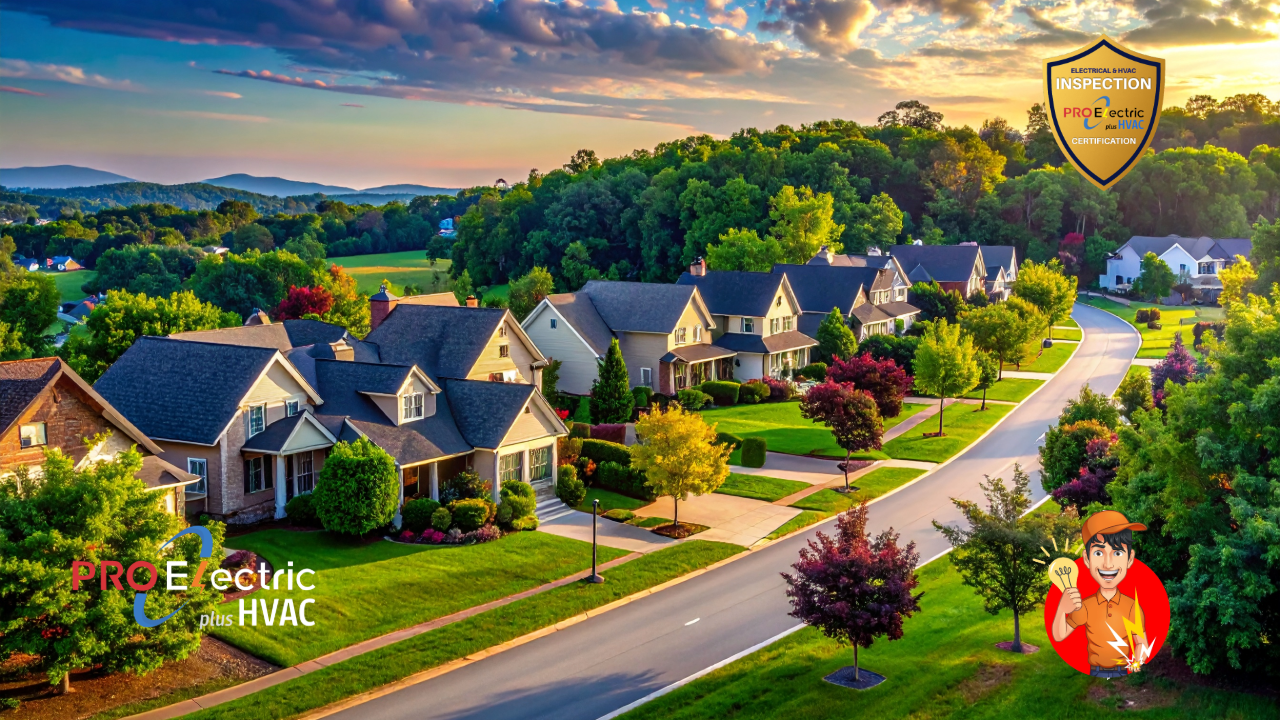
Leesburg, VA, is Loudoun County’s county seat, a community that spans 18th-century historic downtown buildings, Civil War-era residential properties, riverfront homes along the Potomac, and the aggressive suburban development that has pushed outward from the Route 7 and Route 15 corridors over the past 25 years. The AC systems serving these structures operate under meaningfully different conditions depending on where they are located. One maintenance protocol does not serve all of them equally.
Why Leesburg’s Geographic Position Creates a Unique HVAC Challenge
Leesburg sits at the boundary between Loudoun County’s dense eastern corridor — where data centers, office parks, and suburban housing create a heat island effect that elevates local summer temperatures — and its rural western terrain, where older properties sit on larger lots with more tree cover, different wind exposure, and in many cases very different construction vintages. A Leesburg AC system in a townhome adjacent to the Route 7 commercial development operates under fundamentally different thermal conditions than one serving a 200-year-old stone house in the historic district, half a mile away. The suburban system is working against heat island temperatures and may be undersized for current conditions. The historic property system is struggling with the thermal mass of foot-thick stone walls and may be facing humidity challenges that the original cooling capacity calculation never anticipated.
Historic Leesburg Properties and the AC Systems Inside Them
Leesburg’s historic district contains some of Loudoun County’s most architecturally significant residential properties — 18th and 19th-century structures whose original construction predates not just modern HVAC but the concept of mechanical cooling entirely. These properties have been retrofitted with cooling systems over the decades, ranging from sympathetically designed to aggressively pragmatic. The AC system in a Leesburg historic property may be a mini-split that was carefully integrated into the building fabric, a central system whose ductwork runs were negotiated around original structural elements, or a window unit arrangement that has been supplemented with portable equipment over successive summers. Each configuration has its own maintenance requirements and failure modes — and the technician who services a standard suburban system may not be the right choice for a historic district property with a complex HVAC history.
What AC Assessments in Leesburg Most Consistently Find
- Systems sized for original construction that have not been recalculated after additions or renovation
- Historic properties with mixed system configurations — central plus supplemental mini-split or window units
- Condenser coils heavily loaded with pollen and organic debris from Leesburg’s substantial tree canopy
- R-22 refrigerant in pre-2010 systems that are now approaching the point where recharge economics favor replacement
- Ductwork running through unconditioned attic spaces — adding heat gain that reduces delivered cooling below system capacity
- No whole-home surge protection — relevant in Leesburg’s older neighborhoods served by overhead distribution lines
The Potomac River Corridor Effect on Leesburg AC Systems
Leesburg properties near the Potomac and along the river corridor experience summer humidity conditions that differ from the county’s interior — higher overnight humidity from river evaporation, morning fog events that saturate outdoor air before the cooling season’s daily cycle begins, and the kind of persistent high dew-point conditions that make an AC system’s dehumidification function work at maximum continuous capacity for weeks at a time. A system that was sized for the county’s average summer conditions may be continuously undersized for the river corridor microclimate. The result is a home that reaches the thermostat setpoint temperature but never achieves the relative humidity reduction that makes that temperature comfortable. PRO Electric plus HVAC accounts for Leesburg’s geographic microclimate variation in every assessment and maintenance visit — rather than applying a uniform county-wide standard to conditions that vary meaningfully by location.
When Leesburg Maintenance Becomes a Replacement Conversation
A Leesburg home with an AC system more than 14 years old, R-22 refrigerant, and a repair history that includes at least one capacitor or contactor replacement is at the point where the economics of continued repair and the economics of planned replacement have converged. PRO Electric plus HVAC provides written findings reports after every Leesburg AC assessment that clearly separate what maintenance corrected, what warrants a separate repair quote, and what the system’s overall age and condition suggest about its remaining useful service life. A Leesburg homeowner who receives that report in April has the information needed to make a deliberate decision before the cooling season stresses the system to its limit.
Related Articles
Why April Is the Right Month for Leesburg AC Service
Loudoun County HVAC companies are most accessible in March, April, and early May — before the June surge in emergency calls that follows the first heat wave of the season. A Leesburg homeowner who schedules a spring maintenance visit gets a thorough visit from a technician with adequate time, same-week scheduling availability, and immediate access to replacement parts if the maintenance inspection reveals a component that needs replacement. Every week that passes from May onward reduces all three of those advantages. PRO Electric plus HVAC schedules Leesburg spring maintenance visits through April and early May for exactly this reason — the visit that prevents an emergency in July is worth significantly more to the homeowner when it is scheduled before the emergency season begins.
Serving Leesburg, Lansdowne, Ashburn, and All of Loudoun County
PRO Electric plus HVAC performs AC repair, maintenance, and honest replacement assessments for Leesburg’s diverse housing stock — from historic district properties to river corridor homes to suburban subdivisions — with written findings reports and spring scheduling that beats the July rush.
Schedule Spring AC Service
703.225.8222
Frequently Asked Questions
Why do AC systems in Leesburg perform differently depending on location?
Leesburg has varied conditions including suburban heat islands, rural properties, and river corridor humidity. These factors affect system load, efficiency, and performance, meaning one maintenance approach does not fit every home.
What challenges do historic Leesburg homes face with air conditioning?
Historic homes often have retrofitted HVAC systems that were not part of the original design. These may include a mix of central air, mini-splits, and window units, each with unique maintenance needs and limitations due to building structure.
How does humidity near the Potomac River affect AC performance?
Higher humidity levels near the river increase the demand on an AC system’s dehumidification function. Even if the home reaches the set temperature, it may still feel uncomfortable if humidity is not properly controlled.
When should a Leesburg homeowner consider replacing their AC system?
Replacement should be considered when the system is over 14 years old, uses R-22 refrigerant, and has a history of repairs. At this point, the cost of continued repairs often approaches or exceeds the value of installing a new system.
Why is spring the best time for AC maintenance in Leesburg?
Spring offers better scheduling availability, more thorough service, and immediate access to parts before peak summer demand. Early maintenance helps prevent breakdowns during the hottest months when service delays are common.
References
U.S. Department of Energy. (2024). Maintaining your air conditioner. Energy Saver. https://www.energy.gov/energysaver/maintaining-your-air-conditioner
Air Conditioning Contractors of America. (2023). ACCA Standard 4: Maintenance of residential HVAC systems. ACCA.
U.S. Environmental Protection Agency. (2024). Phaseout of ozone-depleting substances: R-22 refrigerant. EPA. https://www.epa.gov/ods-phaseout
American Society of Heating, Refrigerating and Air-Conditioning Engineers. (2022). ASHRAE Standard 55: Thermal environmental conditions for human occupancy. ASHRAE.