
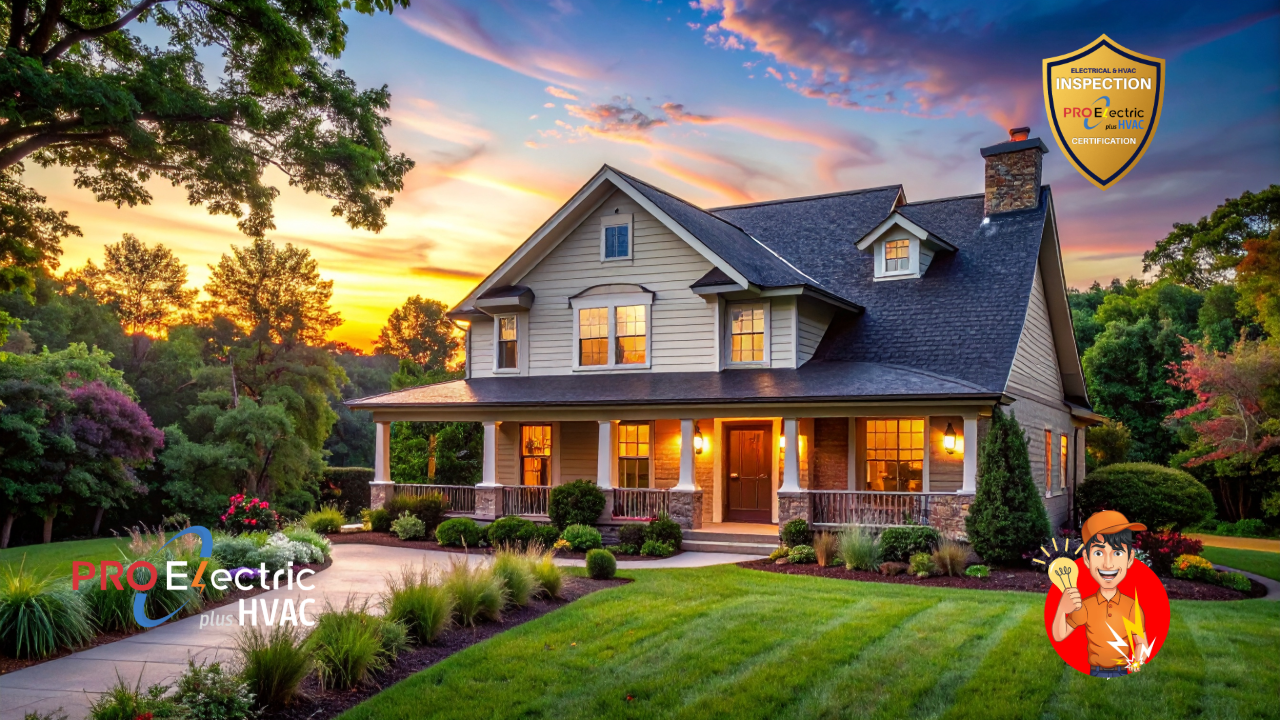
Gainesville, VA has become one of Northern Virginia’s most active new construction markets, with subdivisions along Linton Hall Road, Battlefield, and the Route 29 corridor adding hundreds of homes annually. Buyers of new construction in Gainesville are often surprised to discover that a home built in 2024 or 2025 does not automatically have the electrical infrastructure that modern smart home systems require — because building code compliance and smart home readiness are not the same thing.
What Code-Compliant Wiring Provides and What It Does Not
A production home built to Virginia Residential Code in a Gainesville subdivision has wiring that meets the minimum safety requirements for a habitable dwelling. That means appropriately sized circuits, correct breaker ratings, GFCI protection in required locations, and AFCI protection in sleeping areas and living spaces. What it does not mean is neutral wires at every switch location for smart switch compatibility, dedicated circuits for home automation control equipment, conduit in walls for future low-voltage cable management, or structured wiring hubs for whole-home audio, security, and networking distribution. Production builders wire to the standard that satisfies the inspector. They do not wire for the buyer who plans to install a Lutron lighting control system and a Savant automation controller within two years of moving in.
The Neutral Wire Gap in Gainesville’s New Homes
Smart switches — devices that replace traditional toggle switches and provide app control, scheduling, and scene programming — require a neutral wire at the switch location to power their internal electronics. The NEC has permitted switch wiring without a neutral conductor for decades, and many production builders in Gainesville continue to use this wiring method because it is simpler and slightly less expensive. The result is that a homeowner who purchases a new Gainesville home and then attempts to install smart switches throughout finds that most switch boxes contain only two conductors — no neutral — making direct smart switch installation impossible without a workaround product or a new wire run. Workaround products introduce limitations: restricted dimming range, compatibility issues with certain LED loads, and additional points of potential failure in the switch circuit.
What Gainesville New Construction Homes Frequently Lack for Smart Home Use
- Neutral conductors at switch locations throughout the home
- Dedicated 20-amp circuit for home automation control equipment rack
- Structured wiring enclosure for centralized low-voltage distribution
- Conduit in walls for future AV and data cable additions
- Adequate panel capacity for smart home loads plus EV charger addition
- Outdoor circuit infrastructure for smart exterior lighting and cameras
Why New Construction Panels in Gainesville Fill Up Faster Than Expected
Production homes in Gainesville are typically built with 200-amp panels that have 20 to 30 circuit slots. On the day of move-in, most of those slots are occupied by the circuits the builder installed. Adding a home office dedicated circuit, an EV charger, a whole-home generator transfer switch, and a smart home control rack within the first three years of occupancy — a realistic scenario for a Gainesville homeowner in 2026 — can fill a 200-amp panel to capacity faster than the builder’s specification suggested it would. A panel that reaches capacity requires a subpanel addition or a full service upgrade to accommodate any further circuits. PRO Electric plus HVAC performs a future-load assessment during smart home consultations to identify whether the existing panel can support the planned additions or whether a proactive upgrade is the smarter investment.
Working With Gainesville Builders Before Move-In: The Pre-Occupancy Opportunity
Homeowners who have not yet taken possession of a new construction home in Gainesville have a window that closes at certificate of occupancy — the ability to add conduit, circuit rough-ins, and structured wiring infrastructure while walls are still open. PRO Electric plus HVAC works directly with buyers under construction to specify and install the electrical additions that a production builder would not include in a standard build package: neutral wires at switch locations, conduit in media walls and above ceilings, additional circuit slots via a subpanel rough-in, and a structured wiring enclosure in the utility room. The cost of making these additions during framing is a fraction of what they cost once the drywall is up and the home is finished.
Related Articles
Surge Protection in Gainesville’s Smart Homes: Not an Optional Add-On
A Gainesville home equipped with smart switches, automation controllers, networked security cameras, and smart appliances contains a significant concentration of microprocessor-based electronics on every circuit in the house. A voltage surge — from a summer thunderstorm, a utility switching event, or an internal appliance fault — travels across every circuit simultaneously. A whole-home surge protector installed at the service panel is the only device that intercepts a surge at its point of entry before it reaches any of those circuits. For a smart home, this is not an optional upgrade. The cost of replacing damaged smart switches, controllers, and network equipment after a single surge event typically exceeds the cost of the surge protection that would have prevented the loss.
Dedicated Circuits for Smart Home Equipment: Why It Matters
Smart home control equipment — automation processors, AV distribution systems, and network infrastructure racks — should always be on dedicated circuits isolated from the household load. A dedicated circuit ensures that appliance cycling, motor starts, and other load variations on the household wiring do not create voltage fluctuations that reach the control equipment. It also means that if something goes wrong in the equipment rack, a single breaker addresses it without affecting the rest of the home. PRO Electric plus HVAC installs dedicated circuits for home automation infrastructure as a standard element of every smart home electrical scope in Gainesville.
Serving Gainesville, Haymarket, Bristow, and All of Prince William County
PRO Electric plus HVAC closes the gap between new construction electrical specs and smart home electrical requirements — before move-in when possible, and after with minimal disruption when the walls are already up.
Schedule a Smart Home Electrical Consultation
703.225.8222
References
National Fire Protection Association. (2023). NFPA 70: National Electrical Code, 2023 edition — Article 220 and Article 800: Load calculations and communications circuits. National Fire Protection Association.
Prince William County Building Development Services. (2024). Residential new construction electrical requirements. Prince William County Government. https://www.pwcva.gov/building
Consumer Technology Association. (2024). Smart home installation standards and best practices. CTA. https://www.cta.tech
Underwriters Laboratories. (2023). UL 1472: Solid-state dimming controls. UL Standards. https://www.ul.com/standards