
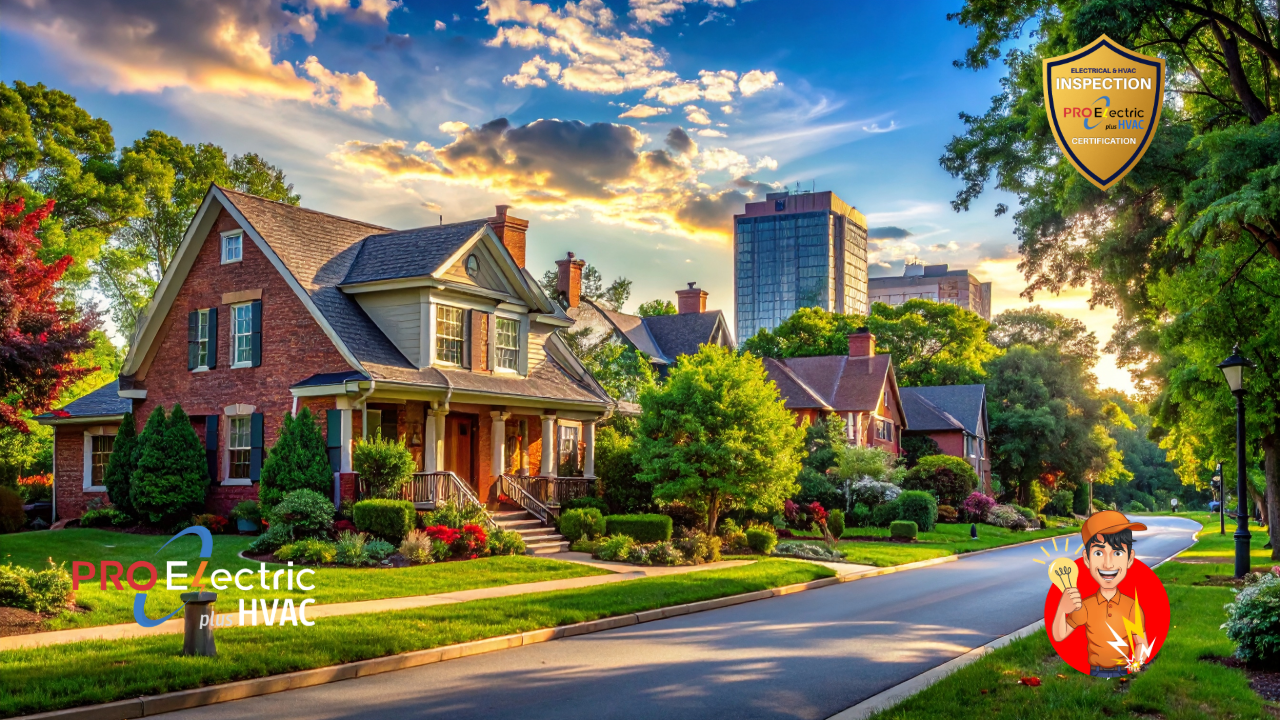
Lyon Village is the kind of neighborhood that appears in real estate listings described as “charming,” “historic,” and “sought-after.” The bungalows and foursquares along Lee Highway, Kirkwood Road, and the tree-lined side streets are genuinely beautiful — craftsmanship from the 1920s and 1930s that most modern construction cannot replicate. What those listings do not mention, and what the charm of the neighborhood conspires to make easy to overlook, is that the electrical systems inside many of those homes are approaching or have already passed their centennial. A hundred years of residential wiring is not an asset. It is a ticking question mark.
What Electrical Systems From the 1920s and 1930s Actually Contain
The original wiring in Lyon Village’s pre-war homes is knob-and-tube — individual solid copper conductors, hot and neutral run separately through ceramic knobs and tubes, without a ground conductor and without the benefit of any of the safety practices developed in the past 80 years of electrical code evolution. That wiring was designed for the electrical loads of the era: a few overhead light fixtures, a radio, and perhaps a refrigerator. Not a dishwasher, not a home office, not an air conditioning system, and certainly not an EV charger. The conductors themselves may still carry current. The rubber insulation around them has not aged as gracefully.
The Hundred-Year Insulation Problem
Rubber insulation on knob-and-tube wiring has a service life of roughly 25 to 30 years under ideal conditions — meaning that even optimistically-maintained wiring from 1935 should have had its insulation replaced twice over by now. In reality, Lyon Village homes that have not undergone comprehensive rewiring carry original insulation that is now brittle, cracked, and in many cases absent at points of contact, flexion, or thermal stress. The NEC prohibits installing insulation against knob-and-tube wiring for this reason — the insulation creates heat buildup the system was not designed to handle. Yet many Lyon Village homes have had insulation added to attics and walls over the decades by prior owners who did not know or did not care that the wiring was there. The combination of aged insulation and thermal confinement is one of the most well-documented residential fire risk factors in pre-war housing stock.
The Specific Conditions That Make Lyon Village Knob-and-Tube Urgent
- Insulation packed against conductors in attic spaces during renovations
- Splices made outside junction boxes connecting modern additions to original wiring
- Overcurrent protection upgraded to a higher amperage to stop nuisance trips from aging wire
- Original conductors with visible cracking or missing insulation at termination points
- Active knob-and-tube on circuits serving high-draw modern appliances
- No GFCI protection at wet locations on circuits that originate from original wiring
The Lyon Village Renovation Wave and Why It Makes This More Urgent
Lyon Village has experienced a sustained renovation wave over the past 15 years — additions, kitchen expansions, basement finishes, and whole-house modernizations that have turned many of its original bungalows into thoroughly 21st-century homes on the inside while preserving their pre-war character on the outside. Those renovations have created a specific electrical risk pattern: new, high-load circuits added to homes where the original wiring was not fully replaced, creating a hybrid system where modern loads and modern demand sit on top of a partial foundation of 90-year-old conductors. The electrician who rough-wired the kitchen addition may have installed perfect new wiring throughout the kitchen — and left the adjacent hallway and bedroom circuits on the knob-and-tube that was there in 1935.
Low-Impact Rewiring for Lyon Village’s Irreplaceable Interiors
The interior character of a Lyon Village bungalow — the original hardwood, the plaster walls, the Arts and Crafts woodwork — is part of what makes these properties worth the premium they command in Arlington County’s market. Rewiring these homes requires an electrician who understands that the goal is a safe, code-compliant electrical system that does not sacrifice the interior that makes the property worth preserving. PRO Electric plus HVAC uses low-impact wiring methods in Lyon Village renovations: fishing conductors through existing wall cavities, using attic and basement access to avoid wall cuts where possible, and planning conduit routes to minimize visible evidence of the work. The result is a home with a fully modern, safe electrical system and an interior that looks as it did before the work began.
Related Articles
Insurance and the Lyon Village Bungalow: A Conversation Worth Having Before It Is Required
Insurance underwriters are paying increasing attention to knob-and-tube wiring in Arlington County’s pre-war housing stock. Carriers who discover active knob-and-tube wiring during a property inspection — which often happens at policy renewal or at refinancing — may condition continued coverage on documented remediation by a licensed electrician. A Lyon Village homeowner who proactively addresses this before a renewal inquiry has far more control over the process than one who is given a 30-day remediation deadline as a condition of policy continuation. PRO Electric plus HVAC provides post-rewiring documentation specifically formatted to satisfy most Virginia insurer requirements for knob-and-tube remediation certification.
Serving Lyon Village, Clarendon, Westover, and All of Arlington County
PRO Electric plus HVAC assesses and rewires Lyon Village bungalows with the precision and care these irreplaceable homes deserve — low-impact methods, Arlington County permits, and post-remediation documentation for insurance purposes.
Schedule a Bungalow Electrical Assessment
703.225.8222
Frequently Asked Questions
Why are Lyon Village homes at higher electrical risk than newer homes?
Many Lyon Village homes were built in the 1920s and 1930s and still contain original or partially updated knob and tube wiring. These systems were designed for much lower electrical demand and now exist in homes with modern appliances, air conditioning, office equipment, and expanded renovation loads.
What is the main danger of 100 year old knob and tube wiring?
The biggest danger is the age and deterioration of the original insulation. Over time, rubber insulation becomes brittle, cracks, and falls away, especially at stress points. When that old wiring is buried under insulation or connected to modern loads, the risk of overheating and electrical failure increases significantly.
Why do renovations make old Lyon Village wiring more dangerous?
Renovations often add new circuits and new electrical demand without fully replacing the original wiring throughout the rest of the house. This creates a hybrid system where modern electrical usage depends partly on old conductors that were never intended to support today’s load profile.
Can a Lyon Village bungalow be rewired without destroying its historic interior?
Yes. A careful low impact rewiring strategy can use attic access, basement runs, conductor fishing, and selective routing to reduce wall damage and preserve original interior details. The goal is to modernize the electrical system while protecting the character of the home.
Can active knob and tube wiring affect homeowners insurance?
Yes. Insurance companies may require disclosure of active knob and tube wiring and can demand remediation as a condition of continued coverage. Addressing the issue proactively gives homeowners more control and allows them to provide documentation showing the wiring was professionally corrected.
References
National Fire Protection Association. (2023). NFPA 70: National Electrical Code, 2023 edition — Section 394: Concealed knob-and-tube wiring. National Fire Protection Association.
Arlington County Department of Community Planning, Housing and Development. (2024). Historic preservation and electrical permits in pre-war residential properties. Arlington County Government. https://www.arlingtonva.us/building
National Trust for Historic Preservation. (2023). Electrical systems in historic buildings. National Trust for Historic Preservation. https://www.savingplaces.org
Insurance Information Institute. (2024). Knob-and-tube wiring and homeowners insurance. III. https://www.iii.org