
By Peter, Master Electrician | PRO Electric plus HVAC | Electrical Panel Upgrades
BOTTOM LINE UP FRONT (BLUF)
If your Alexandria home is experiencing power failures, flickering lights, or tripping breakers, the electrical panel is almost always the root cause. Most homes built before the mid 1980s were not designed for today’s electrical demand. When the panel becomes overloaded, corroded, outdated, or mechanically worn, it does exactly what it was built to do. It trips. That is not random. That is a warning. The longer those warnings are ignored, the higher the risk of system failure, equipment damage, or fire.
Electrical Panel Failures in Alexandria, VA
What Your Home Is Trying to Tell You
By Peter, Master Electrician – PRO Electric plus HVAC
I have worked inside hundreds of electrical panels across Alexandria. Old Town rowhomes. Del Ray bungalows. Rosemont colonials. Seminary Hill townhouses. West End subdivisions.
When a homeowner calls me because the power went out or a breaker keeps tripping, they usually think the problem is random.
It is not random.
Your electrical panel does not fail without warning. It whispers first. Then it starts signaling. Eventually, it forces your attention.
Most of the time, the panel is not the victim. It is the messenger.
Let me explain what I see every week in homes in Alexandria.
The Hidden Risk Behind Older Panels
If your home was built before the mid 1980s, there is a real possibility you have a panel that was never designed for today’s electrical demands.
I regularly find:
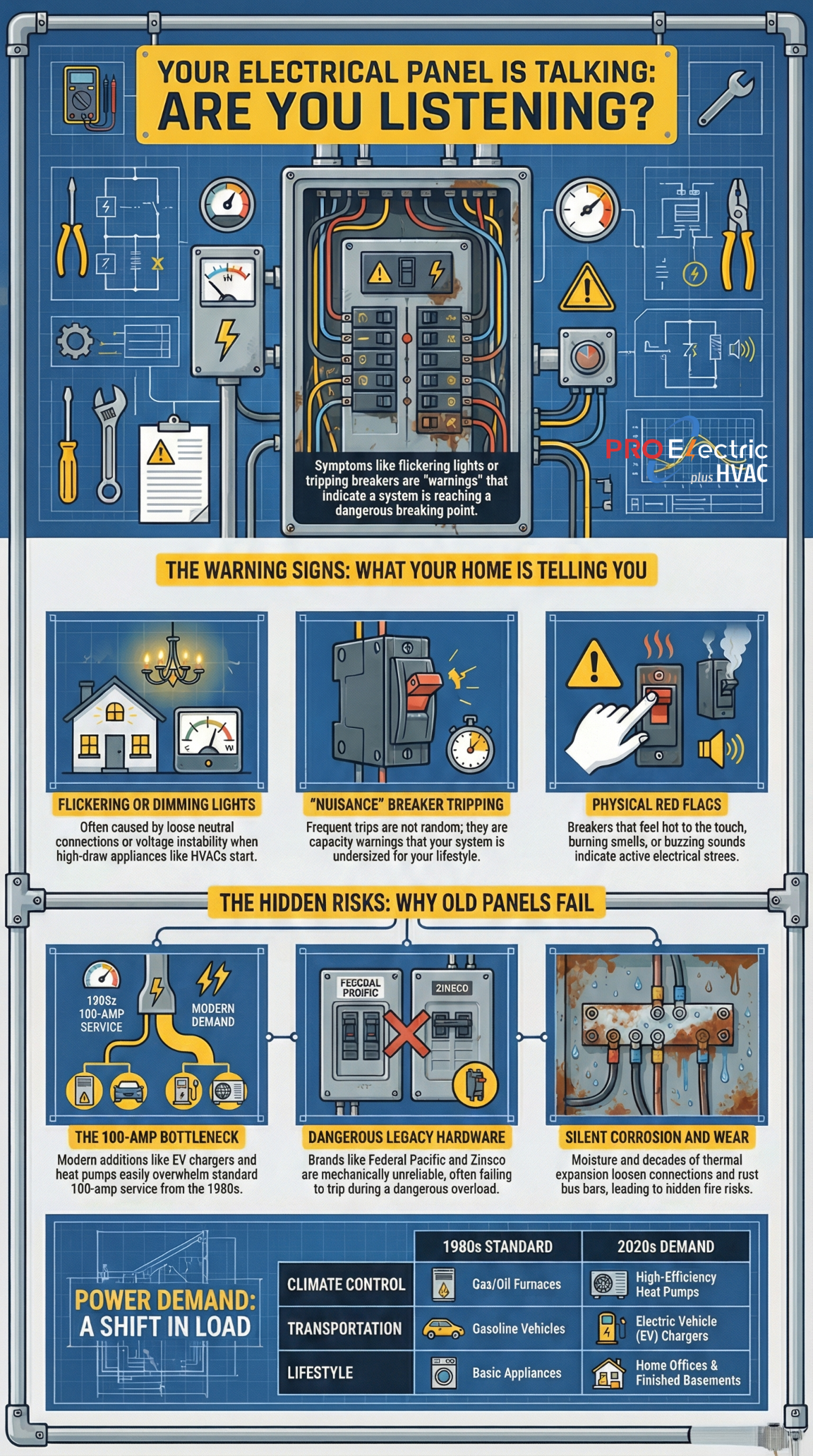
Federal Pacific Electric Stab Lok panels
Zinsco and Sylvania panels
Original 60 or 100 amp service equipment
These panels were installed decades ago when homes had far fewer electrical loads. No EV chargers. No high efficiency heat pumps. No basement apartments. No home offices running multiple screens all day.
Here is the deeper issue.
Some of these older panels are not just outdated. They are mechanically unreliable.
Federal Pacific breakers are known for failing to trip during an overload. That means the breaker stays on while the wiring overheats. You may not see anything wrong from the outside. Inside, insulation can be degrading slowly over time.
Zinsco panels have aluminum bus bars that corrode. The breaker can fuse itself to the bus. It appears secure, but the internal contact is compromised. Protection becomes unpredictable.
That is what makes these panels dangerous. They can look normal while failing silently.
The 100 Amp Panel in a 2026 Home
Many Alexandria homes still operate on 100-amp service.
Think about what your house runs today.
Central air conditioning
Heat pump systems
Electric water heater
Kitchen appliances
Washer and dryer
Home office equipment
EV charger
Lighting upgrades
Finished basement loads
A 100 amp panel was not designed for that lifestyle.
What I see in these homes is not dramatic at first.
Lights dim slightly when the HVAC starts.
The microwave and toaster together trip a breaker.
The main breaker feels warm.
You reset breakers more often than you should.
These are not inconveniences. They are capacity warnings.
When your panel consistently runs near its maximum rating, it generates heat. Heat weakens internal components. Springs inside breakers lose tension. Contacts degrade. The system becomes less stable over time.
Your panel is doing exactly what it was built to do. It is protecting you by tripping.
But it is also telling you it is undersized.
Loose Connections and the Flickering Light Mystery
One of the most common complaints in Alexandria is flickering lights.
Homeowners often assume it is the utility company. Sometimes it is. Most times, it is not.
Inside the panel, neutral connections can loosen over time. Thermal expansion and contraction causes screws to shift slightly. Oxidation builds at contact points. Resistance increases.
When resistance increases, heat follows.
That heat creates unstable voltage. That instability shows up as flickering lights or partial power loss.
I have opened panels where the neutral bar had visible discoloration from overheating. The homeowner had been living with flickering lights for months.
That flicker was a warning.
Double Taps and Creative Wiring
In renovated or flipped homes, I frequently find double tapped breakers. That is when two conductors are placed under one breaker terminal.
It is usually done because the panel ran out of space.
It may look clean. It may even function temporarily.
But mechanically, it creates uneven pressure. One wire is secured. The other may not be. Over time, vibration and heat cause the weaker connection to loosen.
Loose connections create arcing. Arcing creates heat. Heat damages insulation and breaker terminals.
This is how nuisance trips begin. This is also how larger failures start.
An overcrowded panel is a sign the system has outgrown itself.
Water and Corrosion Inside Panels
Alexandria has older homes with basement service panels. It also has outdoor meter bases exposed to weather.
I have opened panels where moisture slowly entered through service cable penetrations. Rust formed on breaker clips. Corrosion developed on the bus bar.
Corrosion increases electrical resistance. Increased resistance generates heat.
The homeowner experiences unexplained trips or sudden full power shutdowns. They assume something major failed.
In reality, the failure developed slowly over years.
Water does not destroy a panel overnight. It weakens it steadily.
Main Breakers That Are Simply Worn Out
Every breaker has a lifespan.
After decades of use, internal contacts pit and weaken. Springs lose tension. The breaker may begin tripping under loads it once handled easily.
In Seminary Hill and West End homes built in the 1970s and 1980s, I often find main breakers that are just tired.
When your entire home shuts down without a storm or a clear overload, that is often the main breaker telling you it is near the end of its mechanical life.
Aluminum Wiring Connections
Some Alexandria homes built between the mid 1960s and early 1970s used aluminum branch wiring.
Aluminum expands more than copper. That movement stresses connection points at the breaker and neutral bars.
Over time, that stress causes loosening and oxidation.
When I open these panels, I look closely at lug torque, oxidation levels, and heat discoloration.
If the connections are not properly maintained, overheating can occur at the panel itself.
This is not about fear. It is about physics.
When the Panel Becomes the Bottleneck
I see a pattern in Alexandria.
Homeowners upgrade everything except the panel.
They install high efficiency HVAC systems. They add electric vehicle charging. They convert garages. They build out basements.
But the original panel remains.
Eventually, it becomes the bottleneck.
You can only push so much current through equipment designed for a different era.
The breaker trips are not the problem. They are the symptom.
What Should Make You Pause
As a Master Electrician, these signs always make me stop and evaluate further:
Breakers that feel hot
Burning smell near the panel
Visible rust or corrosion
Frequent nuisance tripping
Lights dimming during startup loads
Crackling or buzzing sounds
Panel older than 40 years
Insurance company flagging the equipment
None of these are normal aging. They are indicators of stress or deterioration.
A Thought Worth Considering
Your electrical panel is the only line of defense between a controlled overload and a dangerous one.
When it functions properly, you never think about it.
When it begins to fail, it gives you small warnings long before a serious incident occurs.
The question is not whether your panel will age. It will.
The question is whether you will recognize the signals before they become expensive or dangerous.
I do not approach panels assuming they need to be replaced. I approach them looking for truth.
Sometimes that truth is a simple correction.
Sometimes it is a deeper conversation about capacity, safety, and long term reliability.
If you live in Alexandria and you are experiencing power interruptions, repeated breaker trips, or flickering lights, do not treat them as minor annoyances.
They are your system communicating with you.
And in my experience, it is better to listen early than respond late.
📞 Call 703-225-822 now or book online for installation guidance.
Alexandria FAQs
What are the common causes of my Alexandria home’s breakers tripping frequently?
Frequent breaker trips usually mean an overloaded circuit, too many high-power devices on one circuit, or a panel that is struggling to handle modern electrical loads. If the tripping is persistent, it’s a sign your electrical system needs inspection.
How do I know if my electrical panel in Alexandria VA is outdated or unsafe?
Panels with buzzing sounds, warm covers, rust, corrosion, or models like Federal Pacific and Zinsco are considered unsafe and often require evaluation by a licensed electrician. Updated panels meet current safety standards and handle today’s electrical demands better.
Why do lights flicker or dim when large appliances start in my home?
Flickering lights typically signal voltage fluctuations caused by overloaded circuits, loose wiring connections, or a panel nearing capacity. Multiple flickering lights throughout the house often point to panel or system issues rather than individual bulbs.
Can a weak or failing electrical panel cause complete power loss in my Alexandria house?
Yes. When the panel cannot handle the load or has failing components, it can shut down multiple circuits or the entire home. Repeated full outages indicate the panel or main breaker may need professional inspection.
Is frequent breaker tripping a fire hazard?
Repeated trips can indicate overloaded circuits or loose connections—conditions that increase heat buildup and the risk of electrical fires. Visible scorch marks or smell of burning near the panel require immediate attention.
How often should I have my electrical panel inspected in Alexandria VA?
It’s generally recommended to schedule an electrical panel inspection every three to five years, especially in older homes or if you experience recurring issues like tripping breakers or flickering lights.
What happens if my electrical panel cannot handle modern appliances or upgrades?
If your panel is undersized (for example 100 amps) for today’s HVAC systems, EV charger, and kitchen loads, you’ll see frequent trips, dimming lights, and little capacity for additional circuits. A panel upgrade is often needed.
Can environmental factors like moisture or rodents affect my electrical panel?
Yes. Moisture intrusion can corrode breakers and bus bars, and rodent damage to wiring can lead to shorts and frequent trips. Panels exposed to moisture should be evaluated promptly.
What’s the difference between a regular breaker and an AFCI breaker in residential panels?
An AFCI (Arc-Fault Circuit Interrupter) detects dangerous arcing conditions that regular breakers do not and shuts off power before an arc can cause a fire. Modern codes require AFCIs in many home circuits for enhanced safety.
Do I need a licensed electrician to fix panel problems in my Alexandria home?
Yes. Electrical panel work involves live circuits and code requirements. Licensed electricians have the training, tools, and permits needed to diagnose, repair, or upgrade panels safely and in compliance with local regulations.