
BLUF
I know when your lights flicker, breakers trip just when the air conditioner kicks in, or your heat pump seems to pull too much power it’s not just annoying, it’s your home’s electrical system telling you something more profound is wrong. In older Fairfax County homes, especially those still running 60- or 100-amp panels designed for a different era of technology, everyday modern demands from HVAC systems, heat pumps, EV chargers, and multiple electronics often exceed what the system can handle safely. These stress signals aren’t random quirks; they are early warnings that your electrical panel is struggling to keep up and may be a safety risk before a dangerous failure occurs. Many of these issues stem from common underlying causes, such as overloaded circuits, outdated breaker boxes, and inadequate capacity to meet today’s power needs, which can only be corrected by understanding precisely what’s happening behind the walls of your home and acting before serious problems emerge.
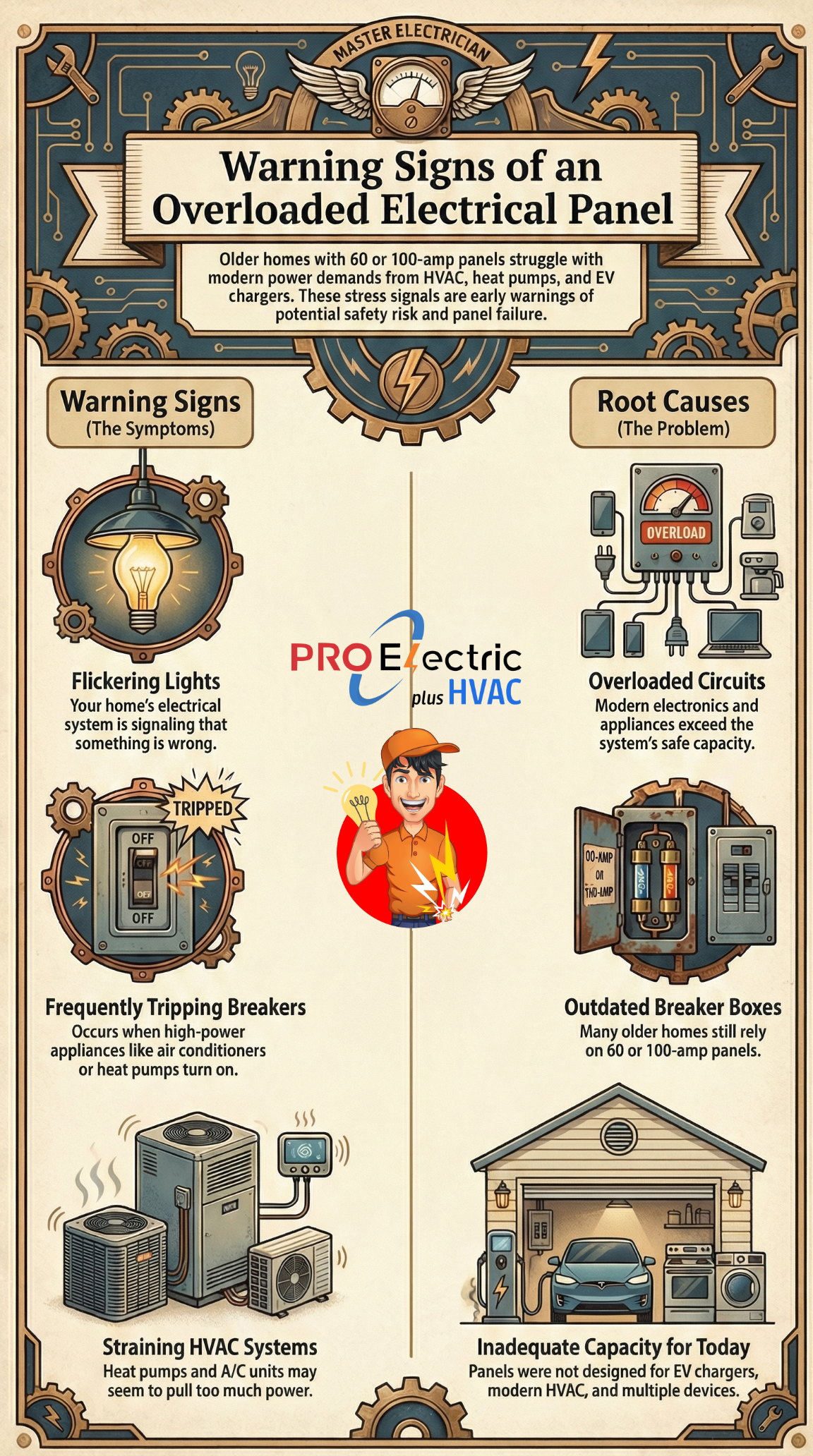
Table of Contents
- Why does my breaker trip when my AC starts?
- What does my home electrical panel actually do?
- What are the warning signs my electrical panel is failing?
- Do I need a permit to upgrade my breaker panel in Fairfax County?
- Is it dangerous to wait to replace my electrical panel?
- How do I know if I need a panel upgrade before adding an EV charger?
- 20 Frequently Asked Questions
Why does my breaker trip when my AC starts?
When I’m on the job in Fairfax County, whether it’s in Fairfax City, Burke, Annandale, Merrifield, Reston, or Oakton, one of the most common questions homeowners ask me is: “Why does my electrical system feel like it’s constantly on the edge?” The short answer is that electrical panels in older homes were never designed for the demands we place on them today. But to truly understand what’s happening in your home, you need to dig into how and why these systems were built the way they were and what’s changed.
Older Panels Were Built for a Different World
Most homes in Fairfax County built before the 1980s were constructed with 60-amp to 100-amp electrical panels. At that time, household electrical loads were relatively low: lighting, modest kitchen appliances, and maybe a single air conditioner were the biggest draws. Today’s homeowner expectations are very different. We have:
- Central air conditioning systems
- Heat pumps
- Multiple refrigerators and freezers
- Smart home devices
- Home offices with computers and monitors
- Entertainment systems
- EV chargers (even if installed later)
- Infrared Saunas
These loads add up fast much faster than what older panels were designed to handle. Electrical panels are rated for a specific amount of current, measured in amps. When more electrical demand is placed on the system than it was designed to support, the panel and its breakers are forced to respond constantly, which can lead to breakers tripping, inconsistent voltage, and stress on the wiring.
Increasing Demand Outpaces Panel Capacity
Electrical demand in a typical American home today is three times higher than back in 1980. That’s because we no longer just need electricity for lights and a few appliances we use it for comfort, convenience, and connectivity. When a panel is rated for 100 amps but your daily usage asks for closer to 200 amps, that panel is constantly operating at or above its design limit. And that’s not even considering the stress caused by peak loads, like powering a central HVAC system and microwave at the same time.
One of the most common homeowner experiences I encounter is frequently tripped breakers when running multiple appliances together. This isn’t an isolated nuisance — it’s the panel reacting to sustained overload conditions it wasn’t built to handle. Breakers are safety devices designed to shut off power when circuits exceed safe thresholds. If they trip too often, it means the electrical demand consistently exceeds what the panel safely supports.
Another frequent complaint I hear is flickering lights, especially when large appliances like air conditioners or refrigerators engage their compressors. Lights dimming briefly or flickering when a load kicks in usually indicates that the panel and service entrance wiring aren’t providing consistent voltage under load — a classic sign of an undersized or failing system.
Panels with Limited Space and Outdated Internal Design
Even if your panel isn’t overloaded at its rated amperage, many older panels don’t have enough physical space for circuits. Most older panels were built with a limited number of breaker slots, and modern lifestyle additions like dedicated circuits for kitchens, home offices, and future EV chargers require additional circuits that these panels just don’t have room for. When homeowners try to add circuits without upgrading, electricians sometimes resort to “tandem breakers” or creative configurations that exceed the panel’s intended capacity — a practice that can introduce safety issues if not done correctly and meet outdated standards.
Outdated Panel Brands and Hidden Failure Points
Another category of problems tied directly to older panels is brand and design issues. Panels from manufacturers like Federal Pacific Electric (FPE) or Zinsco — which were common in mid-century builds have a documented history of breaker failures and safety issues that can significantly increase fire risk. These breakers sometimes fail to trip during dangerous conditions, giving homeowners a false sense of security.
Older panels also may still use fuse boxes instead of circuit breakers. While fuses do provide overcurrent protection, they are less convenient and don’t offer the reset capability of breakers. Modern breakers are also designed to work with safety technologies like arc fault circuit interrupters (AFCI) and ground fault circuit interrupters (GFCI), which older systems didn’t include, meaning older panels are inherently less safe and less capable of protecting your home.
Adding Modern Appliances and Systems Adds Stress
Homeowners in Fairfax County often remodel or add new systems such as electric HVAC upgrades, larger kitchen appliances, or EV chargers — without realizing that the panel may need to be upgraded first. These additions draw significant current and further strain on older panels. Even if your system seems to handle added loads initially, the wiring and breakers can wear out prematurely, leading to more frequent trips, hotspots in the wiring, or, worse, fire hazards.
Weather, Wear, and Wiring Degradation
In some older homes, wiring insulation ages and becomes brittle, connections loosen over time, or wiring exposed in garages or basements sustains damage from environmental exposure. These conditions increase resistance and heat inside the panel, which further reduces its ability to safely carry load and increases the likelihood of tripped breakers or worse.
What This Means for You in Fairfax County
If your home in Fairfax City, Burke, Annandale, Merrifield, Reston, or Oakton was built before 1990 or if you’ve added new circuits, HVAC systems, home offices, or EV equipment, there’s a strong chance your electrical panel is operating well beyond its original design intent. That doesn’t mean it will fail tomorrow, but it does mean the system is continuously stressed and closer to failure than most homeowners realize.
In many cases, upgrading to a 200-amp panel with additional breaker spaces and modern safety features not only increases capacity but also permits installation of safety technologies that older systems lack. That upgrade often eliminates frequent breaker trips, reduces fire risk, and makes your home safer and more adaptable to future needs.
↑ Go back to Table of Contents
What does my home electrical panel actually do?
When homeowners in Fairfax County ask me, “What exactly does my electrical panel do?” they’re usually asking it because something in their home just isn’t working right — lights flicker, breakers trip, or they’re planning upgrades and want to understand how electricity is managed behind the scenes. To answer that, you need to know that your electrical panel is the central control point for every bit of electricity flowing into your home. It’s not just a metal box with switches; it’s the heart, distribution hub, and safety watchdog of your entire electrical system.
The Electrical Panel Is the Central Distribution Point
Every home has an electrical service panel, also called a breaker panel, load center, or breaker box. This panel receives electricity from the utility company and distributes it to every circuit in your house, from outlets and lights to major appliances like refrigerators, HVAC systems, and laundry equipment. Electricity flows from the utility line into the panel via the main breaker, which essentially acts as a master switch for your whole house.
[Image of residential electrical panel diagram]
Think of your panel like a traffic control center. Instead of cars, it routes electrical power through dozens of smaller “lanes” (circuits) to different parts of the house. A circuit might power your kitchen outlets, another the living room lights, and another your HVAC system. Without an appropriately sized panel, the system can’t route power efficiently or safely to all the places you expect.
Breakers Protect Your Home from Overload and Faults
Inside your panel are dozens of circuit breakers, each one a protective device for a specific circuit. A breaker’s job is to monitor the flow of electrical current. If that current becomes too high because of too many devices plugged in, a short circuit, or a wiring problem, the breaker “trips” (shuts off) to protect both the wiring and anything connected to it.
Here’s how homeowners commonly experience this:
- You plug in a powerful appliance, and something else loses power
- The breaker flips off by itself
- You reset i,t and maybe it happens again
Those situations mean the panel is responding exactly as designed, but the fact that it’s happening often means the system is doing more work than it was built for.
Circuit breakers are vastly safer and more convenient than old fuse systems. Unlike fuses, which burn out and must be replaced manually, breakers can be reset quickly when needed. That’s one reason why modern electrical standards moved away from fuses entirely in most residential installations.
Main Breaker, Bus Bars, Neutral, and Ground
To understand the panel’s function more deeply:
- Main breaker: This is like the master valve for electricity entering your home. It sets the total amperage limit the panel can handle.
- Bus bars: These are metal strips inside the panel that carry electricity from the main breaker to the individual circuit breakers.
- Neutral and ground bars: These complete the electrical circuit and provide critical safety paths for fault conditions. They help prevent shocks and protect equipment.
None of these parts does anything on its own, but together they form the system that correctly and safely distributes electrical power throughout your home.
Why This Matters to Fairfax County Homeowners
Now let’s tie this to what homeowners really ask:
“Why do breakers trip when I run the HVAC and microwave at the same time?”
This happens because the electrical panel is routing power to both circuits at once, and those circuits are drawing more current than they’re designed to handle. When the total current exceeds the panel’s or breaker’s rating, the breaker trips as your panel’s way of protecting the system.
“Why do lights flicker when the air conditioner kicks on?”
That’s because a large load like an HVAC compressor creates a temporary voltage drop while your home’s electrical panel struggles to balance power distribution across different circuits.
“Can the panel fix itself if I keep resetting the breakers?”
No. If breakers keep tripping in the same circuits, the underlying cause hasn’t changed. The panel is doing its safety job, but frequent trips indicate demand exceeds capacity or there’s a fault somewhere.
Every one of these breakdowns ties back to how your panel is designed to manage and protect the flow of electricity. Understanding this helps you see why resetting breakers doesn’t solve today’s load demands.
How Modern Homes Stress the Panel
Homes in Fairfax County weren’t originally wired for multiple high-draw systems at run simultaneously. Smart home systems, home offices, electric vehicle chargers, heat pumps, and larger kitchens make electrical distribution more complex. Each of these systems creates continuous or intermittent demand that your panel must manage. When the panel is undersized or outdated, it leads to:
- Breaker trips
- Overheated connections
- Dimming or flickering lights
- Reduced the lifespan of wiring and devices
These are not just inconveniences. They are symptoms telling you the system is operating outside its designed limits.
So What Is the Panel’s Role in My Home?
In plain language:
The electrical panel receives electricity from the utility, routes it safely throughout your home, and protects each circuit from overloads and faults.
When it can’t do that effectively because it’s outdated, undersized, or overloaded, you notice problems everywhere: lights, appliances, HVAC, and even safety systems.
Understanding this is the foundation of deciding whether your panel should be upgraded. An upgraded panel doesn’t just add more amps it improves the way electricity flows, protects your home better, and gives you capacity for today’s electrical demands.
↑ Go back to Table of Contents
What are the warning signs that my electrical panel is failing?
When I talk with homeowners across Fairfax County, whether in Fairfax City, Burke, Annandale, Merrifield, Reston, or Oakton, the same questions keep coming up:
- Why do my breakers keep tripping when the air conditioner kicks on?
- Why do my lights flicker when I start the heat pump or use the microwave?
- Is my panel failing or just overloaded?
- Do I need a permit to install an EV charger if my panel keeps tripping?
These aren’t random, isolated issues. They’re symptoms of an electrical system that’s telling you something isn’t right. Understanding these early warning signs is key to avoiding bigger problems down the road.
Frequent Breaker Trips and Overloaded Circuits
One of the most common and apparent signs that your electrical panel is under stress is frequent breaker trips. When a breaker trips repeatedly, especially when more than one appliance runs at once, it means your panel is struggling to handle the current demand. Breakers aren’t malfunctioning; they’re doing their job by shutting off a circuit that’s drawing too much power. But when this happens frequently, it means the panel or the circuits connected to it are not designed for your home’s current electrical load.
This happens often when:
- Your HVAC or heat pump starts up at the same time the microwave and laundry are running
- You plug in an EV charger without a dedicated circuit or adequate capacity
- You try to run high-draw appliances on older wiring or a panel that’s too small
It’s especially common when older homes try to support modern devices without first upgrading the panel.
Flickering or Dimming Lights
Another frequent sign I see in Fairfax homes is dimming or flickering lights, particularly when heavy loads come online, such as an air conditioner or oven. This is caused by a temporary voltage drop when the electrical system is strained. Modern HVAC systems and heat pumps require a significant surge of power when they start up, and older panels with limited capacity can’t manage these surges smoothly. The result is lights that dim, flicker, or blink, not because the lights are faulty, but because the panel is struggling to balance the load.
Homeowners often ask, “Is that normal or a sign of danger?” Flickering lights might seem minor, but they usually signal that the panel and possibly the wiring cannot deliver consistent, stable power under load.
Buzzing Noises and Warm Panel Surfaces
Another early warning sign is unusual noises or heat coming from your electrical panel. If your panel buzzes, hums, or feels warm to the touch that’s not normal. It indicates internal stress inside the panel, which can come from loose connections, corroded parts, or overloaded circuits. These issues can accelerate wear and lead to more serious failures if not caught early. Electrical panels should be cool and quiet. Heat and noise are red flags that something inside the panel or connected circuits isn’t working as it should.
Old Wiring, Aging Panels, and Hazardous Brands
Another thing I check when I’m called to inspect a home is the panel brand and age. Many older homes in Fairfax still have panels more than 25 years old, and some even have brands like Federal Pacific or Zinsco, which are known for safety issues and breaker failures. Panels that old may not trip breakers reliably — meaning they can fail to protect your home when circuits overload.
Homes with outdated panels often show multiple warning signs:
- Breaker trips that seem random or inconsistent
- Panels that are physically worn, rusted, or warm
- Circuits that don’t seem balanced across phases
- Limited slot space for dedicated circuits
These signs aren’t just inconveniences; they are indicators that systems are operating beyond their safe limits.
Warning Signs Related to HVAC, Heat Pumps, and AC Systems
Modern HVAC systems and heat pumps are heavy power consumers, especially during seasonal extremes. When your panel is undersized:
- The HVAC system may cause breakers to trip more frequently
- Heat pumps may draw more current than older wiring can safely support
- Air conditioners running during a heat wave may overload a panel that wasn’t designed for continuous high draw
These systems can immediately highlight weaknesses in your panel because they operate continuously at extreme temperatures rather than in short bursts.
If your panel trips when the HVAC kicks on, but it never used to do that, it means the demand now exceeds the capacity the panel was built to handle.
EV Chargers and Dedicated Circuit Needs
Installing an EV charger at home can be a great convenience, but it significantly increases electrical demand. For a Level 2 charger, which is popular for residential use, you generally need a dedicated 240V circuit. In Fairfax County, installing that circuit and connecting it to your panel requires a residential electrical permit through the Land Development Services (PLUS) system.
If your panel is already strained, adding an EV charger without first evaluating your panel’s capacity can lead to:
- Repeated breaker trips
- Overloaded circuits
- Increased heat inside the panel
- Potential failed inspections if wiring isn’t up to code
Even though Fairfax County may currently waive permit fees for EV charging stations, you still need the permit and must schedule an inspection to ensure safety and code compliance.
Furthermore, the panel upgrade itself, if needed, must be permitted. If your panel is overrun by HVAC, AC, EV charger load, or other demand increases, a panel upgrade permit is required and inspectors will check that the upgrade meets all residential electrical and NEC requirements.
Mechanical and HVAC Permit Intersections
The electrical panel doesn’t work in isolation. When you upgrade your HVAC system, heat pump, or air conditioner, you’re often adding a high-draw device. In Fairfax County, even though mechanical permits cover the HVAC equipment, electrical permits are required for the circuits and wiring that power these systems. If the new HVAC demand exceeds your current panel’s capacity, you’ll likely need a panel upgrade permit as part of the electrical work to supply power safely.
Inspectors will check load calculations, breaker sizing, grounding, bonding, and panel space to ensure the electrical infrastructure can safely support the installed HVAC system.
Why These Early Signs Matter
Each of these warning signs — breaker trips, flickering lights, buzzing panels, inadequate space, and high-demand systems like HVAC and EV chargers — is the electrical system’s way of communicating stress before a major failure occurs. Ignoring them doesn’t make the problem go away; it increases the risk of:
- Electrical fires
- Unexpected shutdowns
- Damage to appliances and HVAC systems
- Failed inspections during remodeling or sales
- Insurance complications
The sooner these early warning signs are recognized and addressed through proper diagnosis, permitted upgrades, and professional installation the better your home’s safety, comfort, and electrical reliability will be.
↑ Go back to Table of Contents
Do I need a permit to upgrade my breaker panel in Fairfax County?
When homeowners in Fairfax County ask, “Do I need a permit for this electrical or HVAC work?”, the answer is almost always yes if you’re adding new circuits, replacing panels, or installing major systems. Knowing why permits matter and what inspectors check can help you avoid surprises, pass inspections the first time, and keep your home safe and compliant.
Fairfax County defines permitting requirements through its Land Development Services (LDS) department. Every residential electrical and mechanical change that alters wiring, adds circuits, or connects new equipment must be permitted so the county can inspect the work and ensure it meets current safety codes.
When Is a Residential Electrical Permit Required?
In Fairfax County, a residential electrical permit is required when you install, replace, or relocate electrical equipment or wiring that affects your service. This includes:
- Replacing or upgrading your main electrical panel
- Adding new circuits or subpanels
- Installing a dedicated circuit for HVAC, heat pump or AC equipment
- Wiring for electric vehicle chargers
- Any work that changes the existing electrical distribution system
Simply replacing a light fixture or outlet in the exact location typically does not require a permit. But running a new breaker or adding a new load circuit does.
This requirement exists because these changes affect how electricity flows in your home, and improperly sized wiring or unsafe connections can increase fire risk, shock risk, and code violations.
Permits for HVAC, AC, and Heat Pump Installations
When you replace or install HVAC systems, heat pumps, or air conditioners, you are actually triggering two separate permit tracks in Fairfax County:
- Mechanical Permit: For the HVAC equipment itself (furnace, condenser, heat pump).
- Electrical Permit: For the wiring and circuits that power the equipment.
Even if the mechanical side has its own permit, the electrical components that supply and control the system must be permitted and inspected separately because they connect directly to your panel and your home’s electrical infrastructure. Without proper permits and inspections, your system may operate unsafely or be rejected during a home sale inspection.
Moreover, the inspector will look at:
- The load calculation to ensure the panel and wiring can safely handle the new system
- The breaker size and type for the HVAC or heat pump circuit
- The conductor sizing and terminations
- Proper grounding and bonding
- Whether the system meets the current National Electrical Code (NEC) and Fairfax County amendments
This inspection occurs before you close up walls or bury wiring. You typically schedule one or more inspection steps: rough-in, mechanical hookup, and then final inspection when everything is complete.
Upgrading a Panel or Adding Circuits: Permits Are Mandatory
If you’re upgrading your electrical panel, for example, going from a 100-amp service to a 200-amp service, a residential electrical permit is required. This isn’t optional, even if you’re hiring a professional electrician. Inspectors must verify that the installation meets code for:
- Service size and grounding systems
- Clearances and accessibility
- Panel location and working space
- Breaker and bus bar configurations
- Coordination with HVAC or new loads (like heat pumps or EV chargers)
Panel upgrades are one of the most common reasons homeowners get pulled into permitting issues, because many people think panel work is “behind the scenes” and not subject to county review. But the panel is critical to the safety of every electrical circuit in your house, and Fairfax County inspectors will check it thoroughly.
What About EV Chargers and Renewables?
Installing an electric vehicle (EV) charger at your home usually requires a residential electrical permit, even if the county has temporarily waived fees for EV charger permits, such as under the pilot program known as Charge Up Fairfax. The permit still needs to be issued and inspected to ensure the charger is wired and connected safely.
Essential points about EV charger permits:
- You do not need to replace your entire panel to install an EV charger unless the panel doesn’t have the capacity or breaker spaces required.
- Stand-alone Level 1 chargers that plug into an existing outlet usually don’t require a permit if no new wiring or breaker is added.
- Level 2 hard-wired chargers (240V circuits) and their dedicated wiring do require a permit and inspection.
- And even though Fairfax County has waived permit fees for EV chargers through at least October 31, 2025, the permit and inspection requirement still exists.
Inspectors will check not just the charger installation, but also whether your panel and service can safely support the added EV load. If they find deficiencies, they will require corrections to meet electrical codes.
Why Inspections Matter
Permits are only half the story; the other half is inspections. Getting a permit isn’t just paperwork; it means that county inspectors will come physically check the work at key stages:
- Rough-in inspection after wiring is installed but before drywall is closed
- Equipment inspection after components are set
- Final inspection when everything is complete
They check that wiring is correctly sized, breakers are appropriately installed, circuits are grounded, and all work conforms to the latest Virginia and NEC codes.
If something doesn’t pass inspection for example, a panel is installed too close to water pipes, or HVAC wiring doesn’t meet conduit requirements you’ll need to correct it and schedule a re-inspection before the project can be signed off as complete.
Consequences of Skipping Permits
Failing to obtain the correct permits and inspections can have serious consequences:
- Stop work orders from Fairfax County
- Fines or legal action for unpermitted work
- Complications when selling your home
- Denied insurance claims if a fire or failure is traced to unpermitted electrical work
- Unsafe systems that pose fire and shock hazards
Permits aren’t just red tape they are the county’s way of protecting your family and investment.
Making the Permit Process Easier
Fairfax County uses the PLUS online portal to submit applications, pay fees, upload documents, and track your permit status, whether it’s for electrical, mechanical, or combined work. This system helps you stay organized and informed throughout the process.
Licensed electricians often handle the entire permit process for you, ensuring that plans and load calculations meet county standards, that applications are complete, and that inspections are scheduled at the right time.
What This Means for Your Home
Whether you are upgrading your electrical panel, installing a new heat pump, upgrading your AC, or wiring an EV charger, Fairfax County requires permits and inspections for all work that affects electrical service and circuits. Understanding the permit process helps you avoid delays, rework, and compliance issues and ensures your home systems operate safely and reliably.
↑ Go back to Table of Contents
Is it dangerous to wait to replace my electrical panel?
When a homeowner in Fairfax County, whether in Fairfax City, Burke, Annandale, Merrifield, Reston, or Oakton, repeatedly says “I’ll wait until next year to fix this,” it often turns out to be the moment where inconvenience becomes a safety hazard and a budget problem. Delaying necessary electrical and HVAC upgrades doesn’t make the problems go away; it amplifies them. The consequences show up in safety, comfort, cost, efficiency, and even in your ability to sell your home later. Let’s break down why putting off these critical upgrades is one of the biggest mistakes a homeowner can make.
More Frequent Breaker Trips and Power Interruptions
One of the earliest signs of a stressed electrical panel is repeated, worsening breaker trips. Breakers are designed to shut off circuits to protect your home when electricity demand exceeds what the system can safely handle. If your panel is undersized or outdated, circuits will trip more often as you add high-demand devices like:
- HVAC systems
- Central AC units
- Heat pumps
- EV chargers
- High-output kitchen appliances
Ignoring this pattern doesn’t fix it it means your system continues operating beyond safe design limits. Over time, frequent outages not only disrupt daily life but also stress your wiring and connected devices.
Increased Fire Risk and Safety Hazards
Older electrical panels and overloaded circuits are a leading cause of residential electrical fires. An outdated panel may overheat due to excessive loads or worn internal components, and older breaker mechanisms may fail to trip when they should. This creates conditions where wiring and connections can slowly degrade, eventually sparking or igniting behind walls where you can’t see it. These fires can start quietly and spread quickly before anyone notices.
Delayed upgrades leave your home vulnerable because you’re ignoring the very system that is supposed to protect you. A proactive panel upgrade early on reduces this risk by ensuring your system can safely handle your actual electrical demand.
Damage to Appliances, HVAC, and System Components
Another consequence of delayed action is damage to sensitive equipment. Electrical surges, voltage fluctuations, and repeated overloads don’t just affect your panel they travel through your wiring and into your appliances and systems. This stress can shorten the lifespan of:
- Refrigerators and dishwashers
- HVAC compressors
- Furnaces and heat pumps
- Computers and TVs
- EV charger electronics
Modern appliances contain sensitive electronics that don’t tolerate unstable power well. Over time, these stresses cause wear, leading to costly repairs or premature replacements. This is why relying on frequent breaker resets isn’t just inconvenient; it hides ongoing damage being done on the inside.
Higher Energy Costs and Lower Efficiency
Stressed electrical panels and systems operate less efficiently. Older panels without modern safety and control features can contribute to uneven voltage distribution, which means appliances and HVAC systems are not running at their optimal efficiency. Increased resistance from overheated wiring and overloaded circuits also wastes energy. In addition:
- HVAC systems work harder if the voltage is unstable
- AC units cycle inefficiently
- Heat pumps lose capacity when the electrical feed is unreliable
Delaying fixes means higher energy bills and more wear and tear on your comfort systems, ultimately costing you more money over time.
Poor Indoor Comfort and Air Quality
Some of the things you might notice first, such as inconsistent cooling or heating, are symptoms of underlying electrical issues. When an HVAC system doesn’t get steady, adequate power, it may:
- Fail to reach thermostat settings
- Short cycle frequently
- Blow lukewarm or uneven air
- Strain components like compressors or motors
Over time, this not only reduces comfort during Virginia’s hot summers and cold winters but can also worsen indoor air quality, causing uneven airflow and increased moisture buildup in ductwork. That moisture encourages mold growth and reduces the efficiency of filtration systems.
Insurance, Inspection, and Home Sale Complications
Another long-term consequence of delaying necessary electrical upgrades is the increased risk of insurance and resale. Many homeowners don’t realize this until it’s too late:
- Insurance providers may deny claims if a fire or damage is traced back to an outdated panel or uncorrected overload conditions.
- Home inspections often flag outdated or undersized panels, potentially delaying or derailing a sale.
- Buyers may demand panel upgrades as a condition of purchase, costing you time and money.
- Financing or refinancing may require systems to meet current electrical safety codes.
So what feels like “I can wait until later” can morph into “this issue is holding up my sale or costing tens of thousands in closing negotiations.”
Challenges with Adding New Systems Like EV Chargers
One of the most frequent homeowner questions I hear, especially in Fairfax County, where EV adoption is growing, is “Can I install an EV charger without upgrading my panel?” The honest answer is: you may need a panel upgrade first because the charger adds a new continuous load that older panels often can’t safely support.
Delaying panel upgrades until after you buy an EV charger doesn’t eliminate the problem it just delays it until you’re stuck with an unsafe installation, failing inspection, or recurring breaker trips.
Summary: Delaying Makes Problems Worse
Putting off electrical panel and system upgrades might seem like a money-saving move at first, but it usually costs far more in the long run. The risks include:
- Increased fire hazards and safety issues
- Damage to appliances and major home systems
- Higher energy costs and reduced comfort
- Insurance claim and resale complications
- Inability to properly support HVAC, heat pumps, or EV chargers
The warning signs you’ve already been noticing, lights that flicker, breakers that trip, and HVAC that falters, are your system signaling that delay is no longer a safe option.
Upgrading sooner gives you a safer, more efficient, and more reliable home while avoiding escalating costs and hazards. That’s why waiting until next season often becomes a much bigger problem next year.
↑ Go back to Table of Contents
How do I know if I need a panel upgrade before adding an EV charger?
Deciding when to upgrade your home’s electrical system isn’t just about whether something feels old or annoying. It’s about matching your home’s electrical capacity with how your family actually uses power, and knowing when your system is no longer safe or reliable. In Fairfax County, this decision affects your everyday life, your safety, and your ability to add or upgrade major systems like HVAC, heat pumps, air conditioning, and EV chargers. Let’s break down the decision into practical steps you can use as a homeowner.
Step One: Understand Your Current Electrical Load and Usage Patterns
Your first step is to evaluate how your home uses electricity today. Ask yourself questions like:
- Do breakers trip often, especially when multiple appliances are running at once?
- Do lights flicker when HVAC, AC, or heat pumps start up?
- Have you added high-demand electronics, EV chargers, or home office equipment?
- Are you planning renovations or new systems that require dedicated circuits?
These everyday homeowner observations are not random; they are established signs that your panel and electrical service may be near or past capacity. Frequent breaker trips and flickering lights strongly suggest that your panel is struggling to handle the current demand and may need upgrading. If you experience these patterns regularly, your electrical panel is likely operating at or beyond its practical capacity.
Step Two: Evaluate the Age and Condition of Your Current Panel
Most residential electrical panels serve homes safely for about 20 to 30 years, which means if your panel is older than 25 years, it’s probably nearing the end of its useful life. Over time, internal connections wear, breakers become less reliable, and capacity needs change as you add more electrical devices.
Even if your panel seems functional, panels that old may not meet modern safety standards or support more advanced safety features like AFCIs or GFCIs without an upgrade, planning an upgrade based on age, not just failure, is a proactive way to protect your home.
Step Three: Look for Real Warning Signs That a Panel Upgrade Is Needed
There are several clear warning signs that your panel may need replacing soon:
- Frequent breaker trips: This is one of the strongest indicators that your panel is overloaded.
- Flickering or dimming lights with appliance use: A panel that cannot handle load changes is likely undersized.
- Visible panel damage or corrosion: Rust, scorch marks, and discoloration are safety hazards.
- Outdated panel types like fuse boxes: Fuse boxes are outdated technology and not ideal for modern electrical loads.
- Plans to add high-demand systems like EV chargers or heat pumps: These often require more capacity than older panels provide.
These signs do more than justify an upgrade — they help you time the upgrade before a safety issue or major failure occurs.
Step Four: Match Your Plans to Electrical Capacity
If you’re planning to install or upgrade:
- Heat pumps or high-efficiency HVAC systems
- Central air conditioning
- EV chargers with dedicated circuits
- Modern kitchen appliances
- Home office or workshop tools
You need an electrical system that can safely support these loads. Modern systems and EV chargers often require dedicated circuits and higher amperage — something an older panel might not provide without an upgrade.
In Fairfax County, this planning is part of the permit process. An upgrade will often be required if an inspector determines your current panel cannot support the planned load — particularly when new equipment is installed or altered.
Step Five: Understand Fairfax County Permits and Inspections
When you decide to upgrade your panel or add significant electrical systems, a residential electrical permit is required in Fairfax County before you begin work. Residential permits are required for new service, new electrical equipment, and replacement of electrical equipment, including panels and EV charger circuits.
This means the decision to upgrade isn’t just technical — it must align with county code compliance. You will need:
- A permit application for panel upgrades or new circuits
- A load calculation to prove the system can support the new demand
- Inspections at key stages of work
Understanding this timeline helps you schedule the job so you’re not left waiting on county reviews or corrections after work is done.
Step Six: Decide on the Right Upgrade and Budget
Once you’ve identified that an upgrade is needed, the next question becomes what level of upgrade makes sense. Panels typically are rated in amperage — common residential upgrades go from older 100 amps to 200 amps, which allows:
- More circuits
- Room for EV chargers
- Capacity for heat pumps and high-efficiency HVAC
- Better safety features and redundancy
Upgrading your panel also provides flexibility for future improvements, helping avoid repeated work and cost. Modernized panels deliver improved safety, better load distribution, and peace of mind.
Budgeting includes:
- Labor and permit costs
- Panel and breaker equipment
- Potential upgrades to the service entrance or meter box
- Coordination with HVAC or EV charger installations
Planning gives you control over costs and timing and prevents emergencies that often carry higher labor and material costs.
Step Seven: Consult a Licensed Professional Early
Electrical work, especially panel upgrades, involves licensed professionals for safety and code compliance. Local electricians can:
- Conduct a load assessment to determine panel capacity
- Advise what amperage and panel configuration you need
- Handle permit submission and inspection coordination
- Ensure the work complies with Fairfax County and NEC requirements
Bringing in a professional early helps you make a confident decision rather than guessing whether an upgrade is necessary. It also ensures that the job is done correctly and safely.
Summary
Deciding when to upgrade your electrical panel is a combination of observing early warning signs, understanding your current and planned electrical demand, complying with Fairfax County permitting requirements, and aligning timelines and budgets with your family’s needs.
Start by looking at:
- How often do circuits trip or malfunction
- Whether your panel is old or outdated
- What future upgrades does your home need
- How compliance and code requirements affect your project
When you take these steps, you make the decision not just based on how your system feels, but how it performs and how it will support your home now and in the future. Upgrading before a failure occurs protects your home, improves safety, and prepares it for modern electrical demands.

Peter
Master Electrician & HVAC Heat Pump Technician
20 Frequently Asked Questions
1. Why does my circuit breaker trip when the heat pump starts in my Fairfax County home?
Breakers trip when too much current flows through a circuit at once. Heat pumps and other large systems, such as HVAC or AC units, draw a lot of power when they start up. If your panel or the circuit isn’t big enough for that load, the breaker will shut off to protect the wiring and devices.
2. What are the main causes of electrical panel overload in older Fairfax homes?
Older homes often have electrical panels designed for smaller loads. Today’s electronics, HVAC systems, and EV chargers demand more power than older panels were built to handle. That mismatch causes overload conditions that can lead to frequent breaker trips and other problems.
3. How can I tell if my electrical panel is too small for my household needs?
If breakers trip often, lights flicker when big appliances run, outlets feel warm, or you don’t have space for new circuits, your panel might not be large enough for your current or future needs. Those are typical signs that older panels are undersized.
4. What do flickering lights mean in terms of panel problems?
Flickering lights usually happen when the panel isn’t handling electrical demand smoothly. When big loads like HVAC or kitchen appliances turn on at the same time, voltage can dip briefly, causing lights to flicker. It’s not just annoying — it can show your panel is struggling to keep up.
5. Do older homes in Fairfax City have unique issues with electrical service panels?
Yes. Many older homes in Fairfax City and surrounding neighborhoods were built with panels that were adequate decades ago but now struggle with modern loads. Homes that still use fuse boxes or very old breaker panels are especially likely to experience overload issues.
6. Why might breakers trip when running the AC and kitchen appliances at the same time?
Running multiple high-draw appliances together can exceed the capacity of an older panel’s circuits. The breaker trips to prevent overheating or damage. If this happens often, it may indicate your system needs an upgrade.
7. Does having an EV charger installed make my panel upgrade necessary?
It can. Residential EV chargers, especially Level 2 units, require a dedicated 240-volt circuit. If your panel doesn’t have enough capacity or space for that circuit safely, an upgrade will likely be necessary before installation.
8. What exactly does an electrical panel do in my house?
Your electrical panel receives power from your utility and distributes it to every room and appliance. It also holds circuit breakers that stop current flow when a circuit is overloaded, protecting your home from overheating or fires.
9. How do I know if my panel is outdated or failing internally?
Signs include frequent breaker trips, buzzing sounds, warm panel surfaces, corrosion, and lack of space for new circuits. Older panels may also be fuse boxes, which are largely outdated and don’t offer modern safety protections.
10. Are buzzing sounds from the electrical panel a serious issue?
Yes. Buzzing or humming can indicate loose connections, overloaded circuits, or stressed internal components. These issues can lead to more serious problems if not addressed by a professional.
11. Do I need a Fairfax County permit to upgrade my electrical panel?
Yes. Fairfax County requires a residential electrical permit for panel replacements or upgrades, as well as for new circuits and outlets, to make sure work meets safety and code standards.
12. When is a permit required to install circuits for HVAC or a heat pump?
A permit is required whenever new circuits or wiring are installed, such as for HVAC, heat pumps, or any significant electrical load. This ensures the work is inspected for safety and compliance.
13. Is an electrical permit required for a residential EV charger installation in Fairfax County?
Yes. Any new dedicated circuit installed for an EV charger requires an electrical permit, even if specific permit fees are currently waived for EV chargers.
14. What happens during a panel upgrade inspection in Fairfax County?
Inspectors check that the new panel meets code for capacity, proper breaker sizing, wiring connections, grounding and bonding, and that it’s safely installed in accordance with current residential electrical standards.
15. Can I install an EV charger without pulling a permit?
If you are plugging a Level 1 charger into an existing receptacle with no new wiring, a permit usually isn’t needed. A dedicated 240-volt circuit, however, always requires a residential electrical permit.
16. What are the risks of delaying an electrical panel upgrade?
Delaying upgrades can lead to more frequent circuit failures, weakened safety devices, potential damage to appliances and systems, and higher risk of electrical hazards like fires.
17. How does an overloaded panel affect my HVAC system’s performance?
An overloaded panel can cause HVAC and heat pumps to operate less efficiently or trip breakers at peak demand, leading to uneven heating or cooling and more stress on those systems.
18. Will upgrading my panel improve energy efficiency in my home?
While a panel upgrade doesn’t directly save energy, it improves how electricity is distributed and reduces unnecessary trips or voltage drops, which can make appliances and HVAC systems operate more smoothly and efficiently.
19. Can an insurance claim be denied because of unpermitted electrical work?
Insurance companies may deny claims if damage results from unpermitted or unsafe electrical work, because inspections and codes are in place to verify safe installation.
20. When should I hire a licensed electrician for panel evaluation?
You should hire a professional when breakers trip often, lights flicker, outlets are warm, or you’re planning additions like EV chargers or new HVAC systems that could exceed your current panel’s capacity.