
By Peter, Master Electrician | PRO Electric plus HVAC | Electrical Panel Upgrades
BOTTOM LINE UP FRONT (BLUF)
Most power failures in aging Fairfax County homes stem from electrical loads that outgrew the original panel and service, plus loose or corroded connections that cause unstable voltage and sudden shutdowns. If you see flickering lights, partial outages, or a main breaker that trips more than once, treat it as a system problem, not a one-breaker problem. The right fix starts with a licensed load calculation and a full inspection of the panel, neutral, meter base, and main connections so you can stop repeat outages and protect your home.
I work in Fairfax County homes built long before modern electrical load became normal. New HVAC, bigger kitchens, home offices, and EV charging push older panels and older service equipment past their limit. Power failures then show up as tripped breakers, partial outages, flickering, or full shutdown at the main.
What power failure looks like in an aging home
Full outage
The whole home goes dark. The main breaker trips, the service connection fails, or the utility feed drops.
Partial outage
Some rooms lose power. Others stay on. A loose neutral or failing connection often sits behind this pattern.
Single circuit outage
One area dies, often with a working breaker. A failed receptacle connection, a loose splice, or a worn breaker often drives it.
Top power failure causes I find in older Fairfax County homes
-
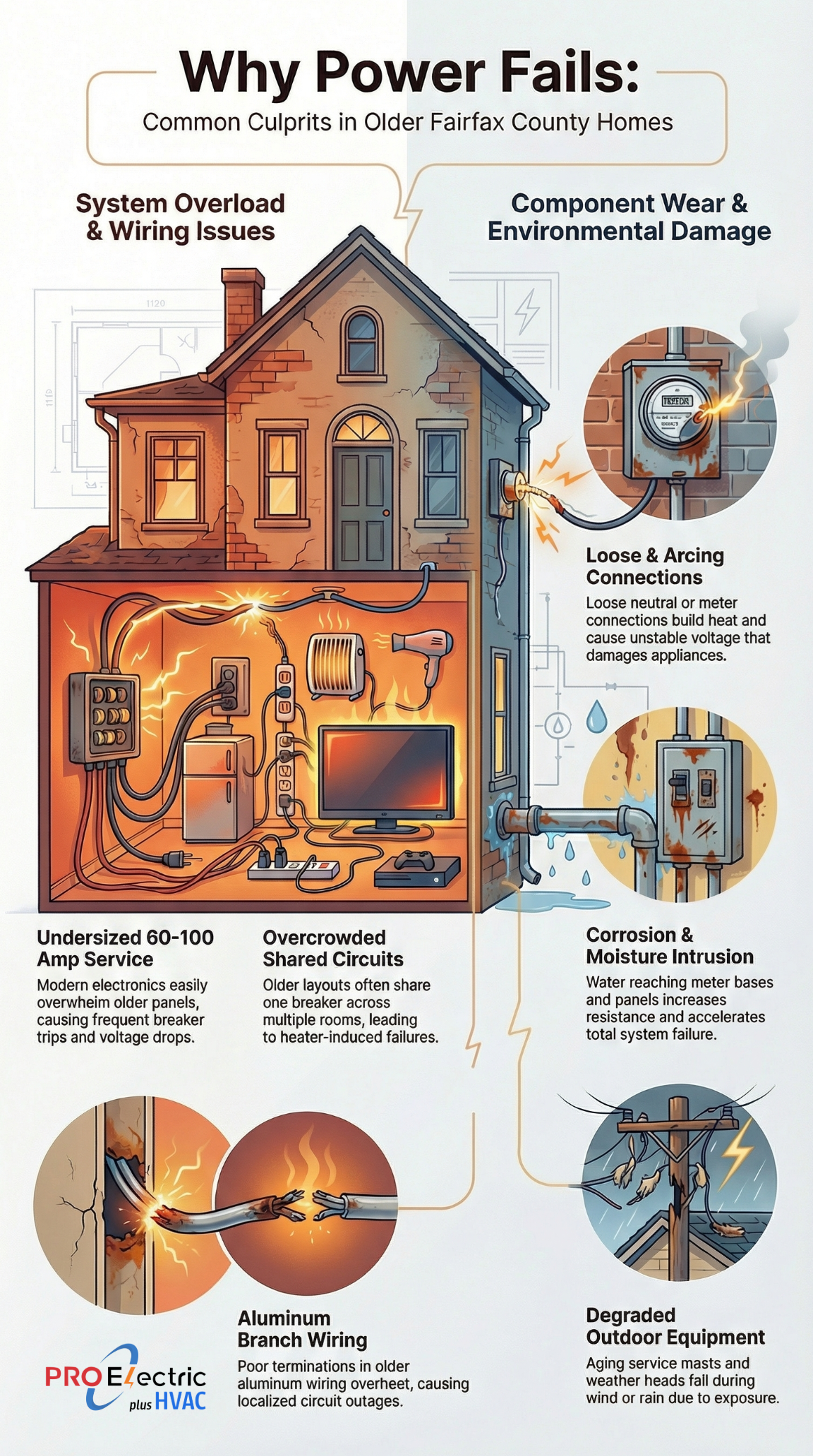
Overloaded panel and undersized service
Older homes often run 60 amp or 100 amp service with too few circuits. Modern living overloads the system. Breakers trip. The main trips. Voltage drops under load. -
Loose neutral connection
A loose neutral creates unstable voltage. Lights brighten, then dim. Electronics reset. Some circuits drop while others stay on. This issue damages appliances fast. -
Loose service connections at the meter or main lugs
Connections loosen over time. Heat builds at the point of contact. Power cuts in and out when a large load starts, like HVAC or a dryer. -
Corrosion and moisture intrusion
Moisture reaches outdoor meter bases, older conduit runs, and basement panels. Corrosion increases resistance. Heat rises. Breakers trip. Connections fail. -
Worn breakers and damaged bus connections
Breakers wear out. Panel bus stabs pit or loosen. You get random trips, hot breakers, or a breaker that fails to hold under normal load. -
Too many rooms on one circuit
Older layouts share one breaker across several rooms. Add space heaters, hair dryers, kitchen appliances, and the circuit trips. -
Unsafe past changes inside the panel
I see double tapped breakers, oversized breakers, crowded neutrals, and sloppy terminations. These shortcuts raise heat and failure risk. -
Aluminum branch wiring connection failures in older housing stock
Some older homes have aluminum branch wiring. Poor terminations overheat. Circuits fail. Outages repeat until someone corrects every connection the right way. -
Backstabbed receptacles and failing device connections
A worn receptacle connection kills a room or half a room. The breaker stays on. The circuit opens at the failed device. -
Aging outdoor equipment feeding the home
Older disconnects, older service masts, and older weather heads degrade. Wind and water exposure accelerates failure at the worst time.
Fairfax County towns, communities, and neighborhoods where I see these patterns most
Fairfax County includes three incorporated towns
Clifton, Herndon, Vienna.
Inside the Beltway and close in older subdivisions
Annandale, Bailey’s Crossroads, Seven Corners, Lincolnia, Lake Barcroft, Idylwood, Mantua, Merrifield, Dunn Loring, Woodburn, West Falls Church.
Springfield and Burke clusters
Springfield, North Springfield, West Springfield, Burke, Burke Centre, Kings Park, Kings Park West, Ravensworth, Newington, Newington Forest, South Run.
Tysons and McLean area
Tysons, McLean, Pimmit Hills, Wolf Trap, Great Falls.
Route 1 and South Alexandria areas
Hollin Hills, Franconia, Groveton, Hybla Valley, Huntington, Belle Haven, Mount Vernon, Fort Hunt, Rose Hill, Hayfield, Kingstowne, Waynewood.
Western Fairfax growth areas
Centreville, Chantilly, Franklin Farm, Greenbriar, Fair Oaks, Fair Lakes, Oakton, Fairfax Station, Lorton, Laurel Hill.
What I want you to do when power fails in an older home
-
Look outside
If neighbors are dark, the utility feed likely failed. Report the outage to your utility. -
Check the main and the panel
If the main trips, reset once after you reduce load. Turn off large loads first. If it trips again, stop and call an electrician. -
Check GFCI devices
If one bathroom, garage, kitchen, or exterior area died, reset the GFCI outlets on that circuit. -
Pay attention to flicker across the whole house
Whole house flicker points to service or neutral problems. Turn off sensitive electronics and schedule an inspection fast. -
Take heat, buzzing, or burning smell seriously
Turn off the main breaker and call for service.
How I prevent repeat outages in Fairfax County homes
I start with a load calculation based on how you live today. I inspect the panel, service conductors, meter base condition, grounding, and bonding. I then fix the root issue.
Common fixes include
Panel replacement when the equipment is worn or unsafe
Service capacity upgrade when load exceeds the service rating
Dedicated circuits for kitchen, laundry, HVAC, and office loads
Connection correction and proper torquing at all terminations
Whole home surge protection to reduce damage from spikes and instability
Cleaner circuit mapping so troubleshooting is fast and safe
I am Peter, Master Electrician at PRO Electric plus HVAC. I serve Fairfax County, Arlington County, Loudoun County, and Prince William County. I inspect the full system, document the load, pull permits when required, and leave you with a clear plan that prevents repeat failures.
📞 Call 703-225-8222 now or book online.
Fairfax County, VA FAQs
What causes frequent power outages in older homes in Fairfax County VA
The most common causes are overloaded electrical panels, loose service connections, failing breakers, moisture corrosion, and loose neutrals that create unstable voltage.
Why do lights flicker in an older Fairfax County home when the HVAC starts
Flickering often happens from voltage drop caused by an overloaded panel, loose connections at the service or panel, or an undersized electrical service.
What does partial power loss mean in a Fairfax County house
Partial power loss often points to a loose neutral, a failing breaker, a loose splice, or a damaged connection that cuts power to part of the home while other circuits still run.
Can an outdated electrical panel cause power failures in Fairfax County VA
Yes. Older panels can run out of breaker space, overheat at connections, and fail under modern electrical load, leading to repeated trips and shutdowns.
Who should I call for panel and electrical load problems in Fairfax County VA
Call a licensed electrician who can perform a load calculation, inspect the service and panel connections, and provide a safe upgrade plan with permits and inspection.
🔗 Related reading: Power failures in Fairfax County homes are one of many warning signs that an electrical system is approaching failure. For the full picture — covering aging panels, smoke detector wiring, blown circuits, voltage problems, and EV charger capacity across all four Northern Virginia counties — read our cornerstone guide: signs your Fairfax County electrical system is failing.