By Peter, Master Electrician | PRO Electric plus HVAC | Electrical Panel Upgrades & Whole-Home Electrical Safety
⚡ Bottom Line Up Front (BLUF)
Northern Virginia’s housing stock spans more than a century of construction. Homes in Fairfax, Loudoun, Arlington, and Prince William Counties were built in waves — post-war bungalows, 1960s colonials, 1980s subdivisions, and 1990s new-construction communities. What they share is an electrical infrastructure that was never designed for how people live today.
If your home is showing any of the signs in this guide — a panel that trips constantly, hardwired smoke detectors that go dead, circuits that cannot handle a second appliance, or an electrical system that refuses to support an EV charger — do not wait for a crisis. These are not random annoyances. They are a failing electrical system telling you it has reached its limit.
Call PRO Electric plus HVAC: (703) 225-8222. We serve every community in all four counties, and we respond fast.
📋 What You’ll Find in This Guide
- Why Northern Virginia Homes Are Electrically Vulnerable
- Aging Electrical Panels: The Silent Fire Risk in Your Utility Room
- Hardwired Smoke Detectors Going Silent: The Life Safety Problem Nobody Talks About
- Blown Circuits and Tripped Breakers: When Your Panel Waves the White Flag
- Power Outages, Flickering Lights, and Dangerous Voltage Swings
- When Your Home Can’t Handle an EV Charger
- Warning Signs Most Homeowners Miss Until It’s Too Late
- Your Action Plan: What to Do Right Now
- Frequently Asked Questions
- Summary
- References (APA)
🔗 If any of the signs in this guide are happening right now (smoke from the panel, repeated breaker trips that will not reset, sparking outlets, or burning smell), do not wait for a scheduled visit. Our 24/7 Northern Virginia emergency electrical and HVAC service responds the same night. Call 703.225.8222.
Chapter 1: Why Northern Virginia Homes Are Electrically Vulnerable
Walk through almost any neighborhood in Fairfax County — through Annandale, Springfield, Chantilly, Burke, or Centreville — and what you see on the outside does not tell the whole story. The brick facades look solid, the yards are trim, and the HVAC units are relatively new. But inside those utility rooms and basements, electrical panels installed during the Kennedy and Johnson administrations are still running the show. The same is true in McLean, Reston, Vienna, Oakton, Fairfax City, Falls Church, Herndon, Clifton, Lorton, Fort Hunt, Franconia, Kingstowne, Newington, Hybla Valley, Dunn Loring, Fairfax Station, Mount Vernon, Lake Ridge, and West Springfield.
In Loudoun County, the story shifts. Leesburg and Purcellville carry the oldest housing stock, but the rapid suburban boom of the late 1990s and early 2000s brought waves of new construction into Ashburn, Sterling, Brambleton, Broadlands, South Riding, Stone Ridge, Lansdowne, and One Loudoun. Those homes are now approaching 20 to 25 years old — the age when original electrical components begin to show fatigue. Hamilton, Round Hill, Lovettsville, Hillsboro, Middleburg, Bluemont, and Aldie carry homes even older than that, many with mid-century panels that have been grandfathered through multiple ownership changes without a single electrician ever opening the cover.
Arlington County is the most electrically diverse geography in all of Northern Virginia. Lyon Village bungalows from the 1940s sit less than two miles from Ballston condominiums finished in 2015. Cherrydale colonials, Aurora Highlands ranchers, Rosslyn high-rises, Clarendon walk-ups, Shirlington apartments, Pentagon City towers, Nauck bungalows, Buckingham garden apartments, Virginia Square condos, Courthouse townhomes, and Waycroft-Woodlawn single-family homes were each built under different electrical codes and to different load assumptions. None of those assumptions account for EV chargers, home offices with server-grade hardware, or modern 5-ton heat pump systems.
In Prince William County, Woodbridge, Dale City, Lake Ridge, and Montclair contain tens of thousands of homes built between the late 1960s and mid-1980s, all running on original electrical infrastructure. Dumfries, Occoquan, and Quantico have historic homes with wiring that predates many of today’s electricians. Gainesville, Haymarket, Bristow, Nokesville, Triangle, Independent Hill, Linton Hall, Brentsville, Catharpin, and Sudley have seen massive growth but carry aging panels in their earliest-built communities. Manassas City and Manassas Park, as independent jurisdictions, enforce their own permit requirements, and both cities are filled with homes where the panel has not been touched since the original certificate of occupancy was issued.
💡 Why This Matters Right Now: Northern Virginia’s housing market moves fast. Homes change hands, get renovated, and receive new appliances without anyone opening the electrical panel and asking whether it can handle the new load. County after county, that oversight is catching up with homeowners. Electrical fires, tripped breakers during summer peaks, and failed EV charger installations are the visible result — but the underlying cause almost always traces back to a panel that should have been replaced years ago.
The National Electrical Code (NEC) updates roughly every three years, and what was legal and safe in 1975 is often neither today. Every county in Northern Virginia has adopted recent code editions, but those adoptions apply only to new construction and permitted work. Millions of square feet of existing homes continue to run on pre-code panels and wiring that regulators cannot touch until a permit is pulled.
The result is a hidden vulnerability that does not announce itself until something fails. For a deeper look at county-specific panel problems, read our companion guide: Problems I See With Old Electrical Panels in Northern Virginia Homes.
Chapter 2: Aging Electrical Panels — The Silent Fire Risk in Your Utility Room
The electrical panel is the most important piece of safety equipment in your home. It controls every circuit, contains every overcurrent protection device, and sets the maximum capacity your home can safely draw at any moment. When a panel ages past its design life — or when it was manufactured with known defects — every circuit connected to it carries elevated risk.
⚠️ The Three Panels That Should Come Out Immediately
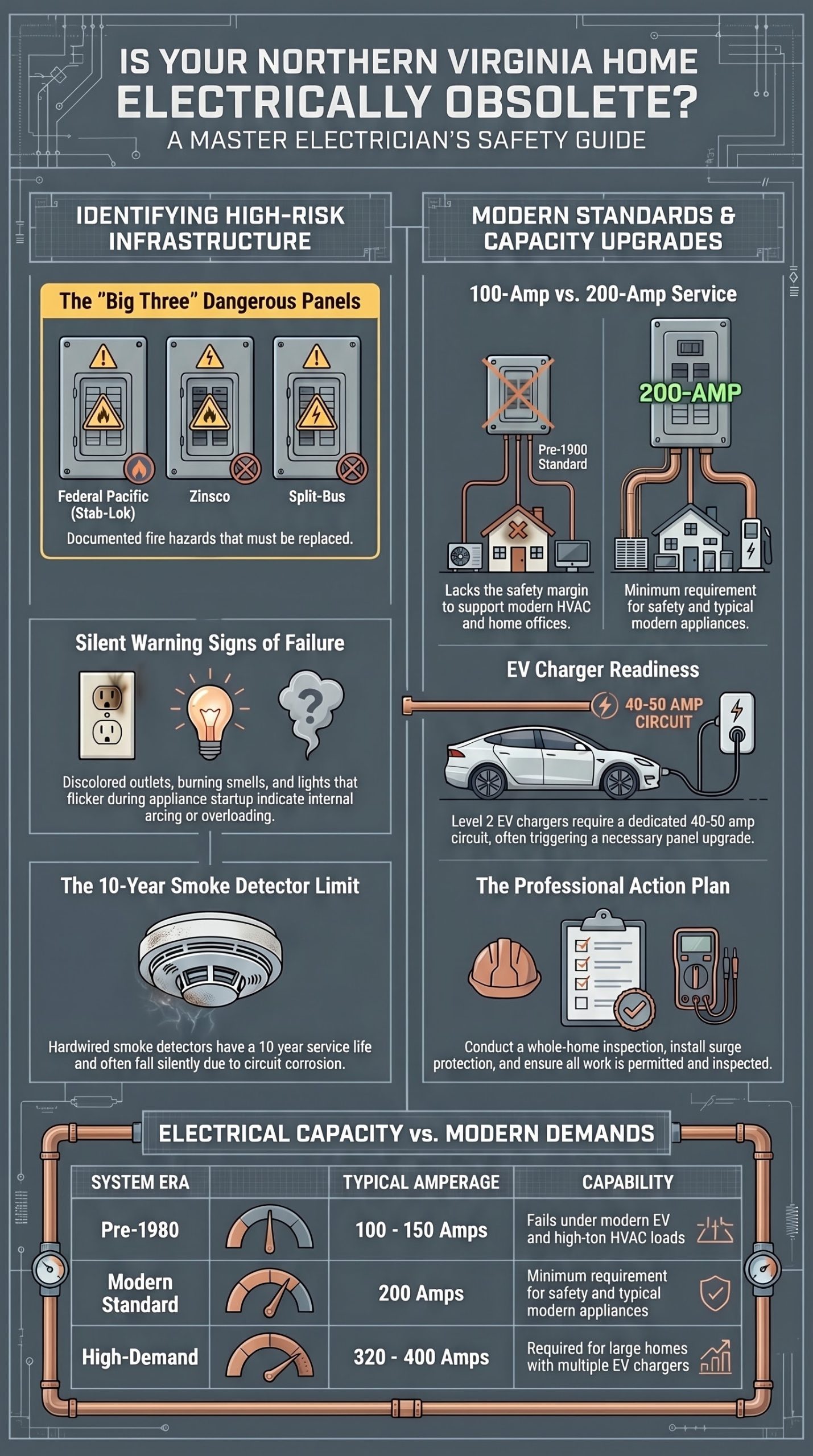
Federal Pacific Electric (Stab-Lok): Found in thousands of Fairfax County homes built between 1955 and 1983, these panels have breakers that frequently fail to trip under overload — a known fire risk documented in multiple federal investigations. Homes in Annandale, Springfield, and Falls Church are especially likely to have them.
Zinsco / GTE-Sylvania: Common in 1960s and 1970s homes across Arlington, Prince William, and parts of Loudoun, these panels suffer from breakers that weld themselves to the bus bar over time and lose the ability to trip. When a Zinsco breaker can’t trip, it can’t stop a fire.
Split-Bus Panels: Popular through the 1960s into the early 1980s, split-bus panels lack a single main breaker, meaning you cannot shut off the entire panel with one switch. Fire departments across Northern Virginia consistently cite them as a serious hazard. Our dedicated guide covers this in full: Split Bus Panel Replacement in Northern Virginia.
Beyond these three known-bad brands, any panel that is 40 or more years old warrants a professional inspection regardless of manufacturer. Internal bus bars corrode. Breaker mechanisms wear out. Insulation on the wiring connected to the panel dries, cracks, and flakes. A breaker that reads 20 amps on its face does not necessarily protect to 20 amps once it has been tripping and resetting for three decades.
The second issue is capacity. A 100-amp service panel — standard in nearly every home built before 1980 — was designed for an era when a family’s biggest electrical load was a window air conditioner and an electric range. Today that same panel may be asked to support a 3-ton heat pump, a home office with a server and multiple monitors, a whole-home generator transfer switch, and an EV charger. The math does not work.
Modern homes need at minimum a 200-amp service, and many homes with EV chargers or large HVAC systems need 320-amp or 400-amp service. If your home still runs on a 100-amp or 150-amp panel, every appliance you add is eroding the safety margin that protects you from a wiring fire.
🔍 Signs Your Panel Is Aging Badly: Rust or moisture inside the panel enclosure; a burning or hot-metal smell near the box; breakers that feel hot to the touch; breakers that won’t stay reset; visible scorching or discoloration around any breaker; a panel that is completely full with no open slots; double-tapped breakers (two wires under a single breaker terminal); and any panel that uses fuses instead of breakers. If you see more than one of these, stop reading and call us now.
Our full county-specific panel guide covers permit requirements, what to expect from a panel replacement, and how to prepare for a Dominion Energy service upgrade: Northern Virginia Electrical Panel Safety Guide. For Arlington specifically, see: Arlington County’s Two Electrical Panel Problems Depending on When Your Home Was Built.
Chapter 3: Hardwired Smoke Detectors Going Silent — The Life Safety Problem Nobody Talks About
Hardwired smoke detectors are one of the most important features in any home. Unlike battery-only units, a properly functioning hardwired system keeps every detector connected on a shared circuit, so when one alarm activates, all of them do. That interconnection is what gives your family enough time to get out.
But here is what most homeowners do not know: hardwired smoke detectors have a rated service life of ten years. Most detectors carry this information right on their label, and the National Fire Protection Association (NFPA) recommends replacing them on that schedule. Homes across all four Northern Virginia counties that have not been recently renovated may have original detectors from the 1990s or early 2000s — units that have not worked properly in years.
🚨 How Wiring Problems Cause Hardwired Detectors to Fail
Hardwired smoke detectors run on a dedicated circuit. When wiring on that circuit corrodes, develops a loose connection, or is damaged by pests, moisture, or heat, the detectors can lose power silently. They may flash a reassuring green LED while drawing no actual current and offering no actual protection. In older homes with aluminum branch-circuit wiring — common across Northern Virginia homes from the late 1960s through the 1970s — loose connections at the detector junction box are a persistent problem. The detectors appear to work until they don’t.
A second failure mode involves the interconnect wire — the third conductor in a three-wire hardwired circuit that allows all units to communicate. Corrosion, a loose connection, or a wiring fault on the interconnect line breaks the chain. You may have detectors that individually function but will never trigger the others in a fire. You think you have a whole-house system. You do not.
In older homes where the smoke detector circuit was wired into a general lighting circuit — a code violation in most recent NEC editions — a dedicated circuit may need to be added as part of the repair. In Leesburg, Purcellville, Dumfries, Occoquan, and the historic cores of other Northern Virginia communities, this situation is common enough that we see it on nearly every older home inspection we do.
The fix requires a licensed electrician to trace and test the circuit, confirm proper voltage at each junction box, inspect and re-terminate any suspect connections, and replace detectors that have aged past their service life.
Are Your Smoke Detectors Actually Working?
If your hardwired smoke detectors are more than 10 years old, or if the circuit has never been inspected, you may have a system that provides false confidence. Let a Master Electrician test the circuit and verify your life safety protection.
Chapter 4: Blown Circuits and Tripped Breakers — When Your Panel Waves the White Flag
Every breaker has one job: to trip — intentionally break the circuit — when the current running through the wire it protects gets dangerously high. This protects the wiring from overheating and causing a fire. A breaker that trips occasionally under genuine overload is doing exactly what it is supposed to do. A breaker that trips repeatedly on normal loads is telling you something more serious is wrong.
The most common scenario I see across Fairfax County homes in Centreville, Oakton, and West Springfield, and across Prince William County communities in Dale City and Lake Ridge, involves the kitchen or HVAC circuit. A homeowner replaces an old refrigerator with a newer model that draws more startup current. Their new AC system is a slightly higher tonnage than the old one. The breaker starts tripping once a week, then twice, then every time the unit kicks on. At some point — and this is the dangerous part — the homeowner starts holding the breaker handle in the ON position while the appliance starts, or worse, replaces a 15-amp breaker with a 20-amp one to stop the tripping. This removes the only protection the wiring had.
⚠️ Five Reasons a Breaker Keeps Tripping (From Most to Least Urgent)
- Overloaded circuit: Too many devices drawing more amps than the breaker is rated for. Fixable by redistributing loads or adding circuits.
- Short circuit: A hot wire touching a neutral wire somewhere in the system causes an immediate high-current fault. This is a fire hazard until resolved.
- Ground fault: Current leaking to ground through an unintended path. GFCI protection exists for exactly this reason in wet areas.
- Worn-out breaker: After years of tripping and resetting, the internal mechanism weakens and begins tripping at loads well below its rating. The breaker needs replacement.
- Undersized panel: The total connected load exceeds what the panel’s main breaker can support. This is the root cause in many Northern Virginia homes where 100-amp service is being pushed hard.
If the breakers in your home are tripping more often than they used to, the cause is almost always one of the five scenarios above. Our companion guide walks through each in detail and explains what to try before calling an electrician: Why Your Circuit Breaker Keeps Tripping (and How to Fix It).
In Chantilly homes with basement workshops, a frequent culprit is exactly what it sounds like: a tablesaw, a space heater, and a battery charger all plugged into outlets on the same 20-amp circuit. The circuit was never designed for that kind of cumulative draw. Our dedicated article on this specific pattern explains exactly what happens and how to fix it: Chantilly Basement Workshops and the Subpanel Overload Recipe.
Double-tapped breakers — two separate circuit wires landed on a single breaker terminal — are another common finding in older panels across Falls Church, Annandale, Lorton, and throughout Loudoun County’s older communities in Leesburg and Purcellville. Unless the breaker is specifically rated for two conductors (most are not), a double-tap is a code violation and a fire hazard. The second wire can arc internally at the breaker terminal, generating heat that the breaker itself will never detect or trip for.
A related issue we see in older Northern Virginia panels is mismatched breakers, where breakers from one manufacturer have been installed in a panel rated for another. They fit physically, but they do not always trip at the rating stamped on the handle. Full breakdown: The Dangers of Mismatched Circuit Breakers in Your Electrical Panel.
For a detailed breakdown of what panel problems are causing circuits to fail in Fairfax County specifically: What Electrical Panel Problems Are Causing Circuits to Fail in My Fairfax County Home?
Chapter 5: Power Outages, Flickering Lights, and Dangerous Voltage Swings
Not every power problem comes from the utility company. When lights flicker inside your home while nothing changes outside — no storm, no neighborhood-wide outage, no Dominion Energy alert — the problem is in your home. Flickering lights are one of the most underrated warning signs of a failing electrical system because they are easy to dismiss as a bulb problem or a utility quirk.
The real causes are often more serious. A loose connection at the main service entrance — where Dominion’s lines connect to your home’s meter and panel — creates a high-resistance point in the circuit. Every time a large load like an HVAC compressor or a refrigerator starts, the voltage briefly sags at that weak connection and the lights dip. Over time, a loose main service connection can arc, char the insulation on the service entrance cable, and start a fire in the wall or attic where the cable runs.
🚨 The Lost Neutral: A Full Electrical Emergency
A failing neutral connection at the main panel or service entrance can produce a dangerous phenomenon called a “lost neutral.” When this happens, the 120-volt legs in your home become unbalanced. Devices on one leg may see 80 volts while devices on the other see 160 volts or more. The low-voltage leg sees appliances struggle and motors run hot. The high-voltage leg can destroy electronics, burn out appliance motors, and damage HVAC compressors in seconds. If lights in one part of your home are extremely bright while lights elsewhere are dim, call an electrician immediately. Do not wait.
Power surges are another category of internal electrical system failure. Northern Virginia’s summer thunderstorm season is one of the most electrically active in the country. Lightning strikes send thousands of volts through utility lines into your home’s panel. A healthy panel with a whole-home surge protector absorbs and redirects that energy. A failing panel with a corroded bus bar distributes that surge into every circuit before any protective device has time to react.
Homes in Great Falls, McLean, and Reston — areas with heavy tree canopy and more direct lightning exposure — see this more than most. But it is a genuine concern from Leesburg and Purcellville all the way south to Triangle and Quantico. Our full guide covers what you can and cannot protect against: Lightning, Snow, and Surges: Northern Virginia’s Electrical Risks.
Frequent localized outages — where your home loses power but your neighbors do not — are another red flag. This can indicate a failing main breaker, a damaged service entrance cable, or a deteriorated connection at the meter base. These are not DIY repairs. They require a licensed electrician and, in most cases, coordination with Dominion Energy for a brief service disconnect.
A particularly common Northern Virginia scenario is partial power loss, where one half of the home retains power while the other goes dark. The cause is usually a broken neutral, a failed main lug, or a damaged service drop. Two companion guides cover this in depth: Troubleshooting Half of House Losing Power and Top 50 Reasons You Might Lose Power at Home.
If you have heard hissing, crackling, or buzzing from an outlet, switch, or the panel itself, the cause is active arcing. This is a fire risk in progress, not a deferred issue. Our guide explains what arcing sounds like, why it happens, and the safe response: Understanding Power Arcing in Home Electrical Systems.
Power surges also degrade circuit breakers over time, often invisibly. A breaker that has weathered repeated surges may trip at loads well below its rating, or worse, fail to trip when it should. Companion read: What Impact Do Power Surges Have on Circuit Breakers.
Chapter 6: When Your Home Can’t Handle an EV Charger — What That Tells You About Your Electrical System
Electric vehicles are no longer a niche product in Northern Virginia. From Ashburn and South Riding to Woodbridge and McLean, EV adoption is accelerating. Every new EV owner eventually wants the same thing: a Level 2 home charger that adds 20 to 30 miles of range per hour rather than the 3 to 4 miles per hour that a standard 120-volt outlet provides.
A Level 2 charger requires a dedicated 240-volt, 40- to 50-amp circuit — roughly the same electrical demand as a central air conditioning unit. Here is what I see regularly across all four counties: homeowners who purchase an EV, buy a Level 2 charger, and then call an electrician only to be told that their panel cannot safely support the new circuit. The panel is full. Or it is already running near total load capacity. Or it needs replacement before any new circuit can safely be added.
⚡ What Electricians Find When They Open Older Northern Virginia Panels for EV Charger Work
- 100-amp service panels with no available slots and no headroom for a 40-amp circuit
- Split-bus panels that lack a single main breaker and cannot be safely upgraded
- Double-tapped breakers on existing high-load circuits
- Federal Pacific or Zinsco panels that should be replaced regardless of the EV charger project
- Undersized service entrance cables that cannot carry 200-amp service even if a new panel is installed
- No load management capacity, meaning no smart way to throttle the EV charger when other loads peak
In many cases, the EV charger project becomes the trigger for a long-overdue panel upgrade. That is not a bad outcome — it means the homeowner ends up with a safer, more capable electrical system. But it does mean the project costs more than a simple charger installation, and it takes longer.
Fairfax County has periodically offered permit fee waivers for EV charger installations, and Virginia offers residential EV charging tax credits. Prince William, Arlington, and Loudoun Counties each have their own permitting processes for new 240-volt circuits. All four counties require a permit for any new circuit or panel upgrade. Working with a licensed electrician who knows local inspectors — as PRO Electric plus HVAC does — makes the process significantly smoother.
For the full picture on EV charger installation in Northern Virginia, including cost ranges, panel upgrade requirements, and permitting steps: Detailed Guide to EV Charger Installation in Northern Virginia and Simple FAQs: Home EV Chargers in Northern Virginia.
Ready to Add an EV Charger? Start With a Panel Assessment.
Before you buy a charger or schedule an installation, let PRO Electric plus HVAC assess your panel capacity and service amperage. We will tell you exactly what your home needs — and what it will cost — before any work begins.
Chapter 7: Warning Signs Most Homeowners Miss Until It’s Too Late
Beyond the major failure modes covered in earlier chapters, there are quieter warning signs that rarely make themselves obvious until something goes wrong. Most homeowners learn about them from a home inspector during a sale, from a contractor who opens a wall during renovation, or from a licensed electrician who spots them while doing something else. Here is what to look for in your own home.
🔎 10 Warning Signs of a Failing Electrical System
- Outlets or switch plates that are warm or hot to the touch — a sign of a loose connection or an overloaded circuit generating heat inside the wall.
- A burning smell that appears and disappears — almost always a wiring problem. Insulation burning off a wire carrying more current than it was designed for gives off a distinctive smell. Treat it as an emergency.
- Outlets that have stopped working — particularly in kitchens and bathrooms, where a tripped GFCI outlet upstream may be killing downstream outlets. In other rooms, dead outlets can indicate a damaged circuit wire.
- Lights that dim when you start an appliance — small voltage sag when a motor starts is normal. Noticeable, consistent dimming suggests an undersized circuit or a weak connection.
- Discolored or charred outlet and switch covers — visible evidence of past arcing. The arcing that caused that discoloration may be ongoing inside the wall.
- Two-prong outlets throughout the home — these indicate the home lacks a grounded wiring system. Modern appliances that need a three-prong outlet are being used with adapters that remove ground protection entirely.
- Aluminum branch-circuit wiring — common in homes built from the mid-1960s through the 1970s across Fairfax, Loudoun, and Prince William Counties. Aluminum expands and contracts more than copper, loosening connections over time and creating arcing hazards. Proper remediation requires CO/ALR-rated devices or copper pigtailing at every connection point.
- Knob-and-tube wiring in the attic or basement — primarily found in Arlington’s oldest homes and in the historic communities of Occoquan, Clifton, Middleburg, and parts of Leesburg. Knob-and-tube has no ground conductor and cannot safely power modern loads. Insulating over it — as many attic insulation contractors do without checking — creates a serious fire hazard.
- Backstabbed outlets and switches — receptacles wired by pushing conductors into spring-clip holes on the back rather than securing them under screw terminals. These connections fail over time and are responsible for a disproportionate number of residential electrical fires.
- No AFCI or GFCI protection on required circuits — current NEC editions require Arc Fault Circuit Interrupter (AFCI) protection in all living spaces and GFCI protection in all wet locations. Older homes have neither, leaving them without the two most powerful electrical fire and shock prevention tools available.
For a deeper read on the full set of fire-related electrical risks in Northern Virginia homes, our comprehensive guide expands on the 10 warning signs above and adds 40 more, organized by severity and remediation cost: 50 Electrical Fire Hazards: A Comprehensive Guide for Homeowners.
On the GFCI side specifically, an outlet that trips and will not reset is one of the most common service calls we receive in basements, garages, kitchens, and outdoor circuits across all four counties. Most causes are diagnosable in under an hour. Full troubleshooting walkthrough: GFCI Outlet Keeps Tripping? Causes and How to Fix It.
Each of these issues is fixable. None of them require a full home rewire in most cases. What they require is a licensed electrician with the expertise to diagnose the specific problem and recommend the right repair — not a general handyman, not a DIY fix, and not a neighbor who used to do electrical work. In all four Northern Virginia counties, electrical work on any circuit requires a permit and inspection. That requirement exists because the inspector is your last line of defense before a wiring problem becomes a house fire.
For specific information on what home inspectors find in Northern Virginia real estate transactions, including electrical issues that most frequently require repairs before closing: What Home Inspections Expose in Northern Virginia Real Estate.
Chapter 8: Your Action Plan — What to Do Right Now
If you have made it through this guide and recognize two or more of the warning signs in your own home, the next step is not to wait and see. An electrical system does not get better on its own. Loose connections get looser. Aging insulation gets drier. A panel that trips twice a month trips four times a month the following year. The trajectory of a failing electrical system always runs in one direction.
✅ Your Northern Virginia Electrical Safety Action Plan
- Schedule a whole-home electrical inspection with a licensed Master Electrician. This is not a casual walk-through. It includes a load calculation, a panel inspection with the cover removed, a review of branch circuits, and an assessment of smoke detector and GFCI/AFCI coverage. Budget two to three hours for a thorough inspection.
- Find out exactly what panel you have. If you have a Federal Pacific Stab-Lok, a Zinsco, or a split-bus panel, plan to replace it. No amount of breaker swapping or load redistribution makes these panels safe for the long term.
- Ask about your service amperage. If your home is on 100-amp or 150-amp service and you run central HVAC, a home office, and want an EV charger, you almost certainly need a service upgrade to 200 amps. In many cases the Dominion Energy service upgrade can be bundled with a panel replacement to minimize cost and downtime.
- Test every hardwired smoke detector properly. Not just the button test — that only tests the alarm horn, not the sensing element. If any detector is more than 10 years old (check the date on the back), replace it. Have the circuit inspected if any detector fails to receive power.
- Pull permits for all electrical work. Every county in Northern Virginia requires permits for electrical panel work, new circuits, and service upgrades. Never let an electrician skip the permit. The county inspection that follows protects you, your insurance coverage, and your home’s resale value.
- Install whole-home surge protection. This is a single device installed at the panel that costs a fraction of what a single damaged appliance costs to replace. It is especially important across Northern Virginia where summer thunderstorm surges are a regular event.
- Address GFCI and AFCI gaps proactively. Even if your jurisdiction does not require retroactive installation, adding GFCI protection to kitchens, bathrooms, garages, and outdoor circuits — and AFCI protection to bedroom and living area circuits — is the single most cost-effective electrical safety upgrade available for most older homes.
For homeowners in Fairfax County specifically, our guide on Exterior Emergency Shut-Off Requirements in Fairfax County covers a code requirement that many homeowners do not know about but that can result in a failed inspection or insurance complications. For homes in the middle of renovation in any of the four counties, our Building Permits Guide for Fairfax County Home Renovations covers what triggers an electrical inspection and what to expect from the county process.
If you are in a community with older construction — Springfield’s 1970s subdivisions, Annandale’s 1960s-era neighborhoods, or Bristow’s early 2000s communities — our town-specific guides provide detailed context: Springfield’s 1970s Electrical Panels, Annandale’s Aging Electrical Panels, and Bristow’s Electrical Panels.
Kitchen remodels in particular often expose electrical problems that were hidden for years. If you are planning a kitchen renovation in Falls Church or anywhere in Northern Virginia, read this first: Falls Church Homeowners: Why Kitchen Upgrades Demand Electrical Panel Upgrades.
PRO Electric plus HVAC
Licensed Master Electricians serving every community in Fairfax, Loudoun, Arlington, and Prince William Counties — from Annandale to Ashburn, Woodbridge to McLean, Manassas to Reston, Leesburg to Lorton, and everywhere in between.
We handle panel inspections, panel replacements, service upgrades, EV charger installations, GFCI and AFCI upgrades, smoke detector circuit repairs, whole-home surge protection, and everything in between. All work is permitted, inspected, and performed by licensed Master Electricians.
Available for emergency calls. Serving all of Northern Virginia.
Frequently Asked Questions
What are the warning signs that a Northern Virginia home needs an electrical safety upgrade?
Common warning signs include breakers that trip often, flickering lights, warm outlets or switch plates, burning smells, dead outlets, hardwired smoke detectors that stop working properly, a panel that is full or outdated, and a home that cannot support modern electrical loads such as an EV charger. In Fairfax, Loudoun, Arlington, and Prince William Counties, these issues often point to an aging or overloaded electrical system.
How do I know if my electrical panel is unsafe?
An electrical panel may be unsafe if it is more than 40 years old, shows rust or scorching, smells hot or burnt, has breakers that feel hot, uses fuses instead of breakers, has double tapped breakers, or trips repeatedly. Federal Pacific, Zinsco, and split bus panels are especially concerning and should be professionally evaluated as soon as possible.
Should a Federal Pacific or Zinsco panel be replaced?
Yes. Federal Pacific and Zinsco panels are widely associated with serious safety concerns because breakers may fail to trip properly during overloads or faults. That increases fire risk. If your home in Northern Virginia still has one of these panels, replacement should be treated as a priority safety upgrade.
Why do my breakers keep tripping even when I am using normal appliances?
Breakers that trip under normal use can signal an overloaded circuit, a short circuit, a ground fault, a worn out breaker, or an undersized electrical panel. In many older homes, the system was not built to handle today’s appliances, HVAC equipment, home office loads, and other modern electrical demands.
Why do my lights flicker when appliances turn on?
Lights that flicker when a refrigerator, HVAC unit, or other large appliance starts may indicate a loose electrical connection, voltage drop, a failing main service connection, or a panel problem. This is not always a utility issue. In some cases, it can point to a dangerous neutral problem or deteriorating service equipment that needs immediate inspection.
How often should hardwired smoke detectors be replaced?
Hardwired smoke detectors should generally be replaced every 10 years. Even if they appear to work, older detectors may no longer provide reliable protection. Homes in Fairfax, Loudoun, Arlington, and Prince William Counties that still have original detectors from older renovations or original construction should have both the detectors and the circuit checked.
Can a house fail to support an EV charger because of the electrical panel?
Yes. Many older homes cannot safely support a Level 2 EV charger because the panel is full, the service amperage is too low, the panel is outdated, or the electrical load is already near capacity. A panel assessment helps determine whether the home can support a dedicated 240 volt charger circuit or needs a panel and service upgrade first.
Do older homes in Northern Virginia often need a 200 amp electrical service upgrade?
Yes. Many older homes still operate on 100 amp or 150 amp service, which is often not enough for modern HVAC systems, kitchen loads, home offices, surge protection, and EV charging. A 200 amp service upgrade is commonly recommended when the existing panel no longer provides enough safe capacity.
What electrical issues do home inspectors often find in older Northern Virginia homes?
Home inspectors often find outdated panels, missing GFCI or AFCI protection, double tapped breakers, aluminum wiring concerns, ungrounded outlets, backstabbed devices, old smoke detectors, overloaded circuits, and evidence of past arcing or heat damage. These findings are common in older homes across Fairfax, Loudoun, Arlington, and Prince William Counties.
Do I need a permit for panel upgrades or new electrical circuits in Northern Virginia?
Yes. Electrical panel replacements, service upgrades, and new circuits typically require permits and inspections in Northern Virginia jurisdictions. Permitted work helps protect your safety, your insurance position, and your home’s resale value by making sure the installation meets current code requirements.
Summary
Northern Virginia’s four major counties — Fairfax, Loudoun, Arlington, and Prince William — collectively contain millions of homes, many of which were built before the electrical standards that govern modern construction were established. Every community in the region, from Annandale and Springfield in Fairfax to Ashburn and Leesburg in Loudoun, from Lyon Village and Clarendon in Arlington to Woodbridge and Gainesville in Prince William, carries a share of homes with electrical systems that are overdue for inspection or upgrade.
The warning signs are consistent: panels that trip constantly, hardwired smoke detectors that have silently lost function, blown circuits under ordinary loads, voltage fluctuations during large appliance startups, and a complete inability to support modern demands like EV chargers. These are not isolated quirks. They are predictable consequences of electrical infrastructure reaching and exceeding its design life.
Every one of these problems is fixable. Panel replacements, service upgrades, circuit additions, GFCI and AFCI retrofits, smoke detector circuit repairs, and whole-home surge protection are all standard work that a licensed Master Electrician can perform efficiently, on permit, and with county inspection sign-off.
The right time to address these issues is before something fails. PRO Electric plus HVAC serves every community in all four counties. Call (703) 225-8222 to schedule a panel inspection today.
References (APA Format)
Consumer Product Safety Commission. (2011). Report on potential hazards associated with Federal Pacific Electric (FPE) Stab-Lok circuit breakers. United States Consumer Product Safety Commission.
Dominion Energy Virginia. (2024). EV customer growth and grid planning projections: Northern Virginia regional report. Dominion Energy.
Edison Electric Institute. (2022). Home electric vehicle charging: Infrastructure and capacity planning guide. Edison Electric Institute.
Fairfax County Department of Planning and Development. (2023). EV permit fee waiver program: Residential electric vehicle supply equipment. Fairfax County.
Fairfax County Fire and Rescue Department. (2023). Residential fire safety annual report. Fairfax County.
International Association of Electrical Inspectors. (2023). Residential electrical inspection guidelines: Existing homes. IAEI.
National Fire Protection Association. (2021). NFPA 72: National fire alarm and signaling code. NFPA.
National Fire Protection Association. (2023). NFPA 70: National electrical code (2023 edition). NFPA.
National Fire Protection Association. (2023). Home electrical fires: Causes, trends, and prevention strategies. NFPA.
National Institute of Standards and Technology. (2022). Residential electrical safety and aging infrastructure: A technical assessment. U.S. Department of Commerce.
Trout, K., & Abt Associates. (2011). Report on the potential hazards of Federal Pacific Electric Stab-Lok circuit breakers and electrical panels (CPSC Contract No. CPSC-D-06-0049). Consumer Product Safety Commission.
U.S. Department of Energy. (2023). Electric vehicle charging infrastructure guide for residential applications. Office of Energy Efficiency and Renewable Energy.
Virginia Department of Housing and Community Development. (2023). Virginia residential code: Based on the 2021 international residential code with Virginia amendments. DHCD.
Virginia State Corporation Commission, Division of Energy Regulation. (2024). Dominion Energy Virginia rate and service reliability data: Northern Virginia region. Virginia SCC.
This article was written by Peter, a licensed Master Electrician with PRO Electric plus HVAC. PRO Electric plus HVAC serves all of Fairfax, Loudoun, Arlington, and Prince William Counties in Northern Virginia. For service, call (703) 294-1060 or visit proelectricva.com.