By Peter, Master Electrician | PRO Electric plus HVAC | EV Charger Installation
BOTTOM LINE UP FRONT (BLUF)
Installing a Level 2 home charger (240V, 20–60+ miles range/hour) is the fastest, most convenient way to charge at home, typically costing $900–$3,000 (average $1,500–$2,500) without panel work, or $5,000–$13,000+ if a 200A+ panel upgrade is needed for older homes. Permits are required for new circuits in Fairfax, Loudoun, Arlington, and Prince William Counties. Incentives include up to $1,000 federal tax credit plus Dominion rebates. Always use a licensed electrician.
Detailed Guide to EV Charger Installation in Northern Virginia
As electric vehicle (EV) ownership surges in Northern Virginia, installing a home Level 2 charger is a smart move for convenience, faster charging, and a potential home value boost. This guide covers everything residential homeowners in Fairfax, Loudoun, Arlington, and Prince William Counties need: types of chargers, installation process, costs, permits, panel requirements, incentives, and safety tips.
Understanding EV Charger Levels
- Level 1: Standard 120V outlet. ~3–5 miles of range per hour. No installation needed but very slow.
- Level 2: Recommended for home use. 240V circuit, adds 20–60+ miles per hour (full charge in 4–8 hours). Requires a dedicated circuit.
- Level 3 (DC Fast): Commercial only — not practical for homes due to high power needs.
For most Northern Virginia homeowners, a 40–50-amp Level 2 charger (e.g., ChargePoint, JuiceBox, or Tesla) strikes the best balance between cost and speed.
Choosing the right Level 2 model matters as much as choosing the right amperage. For a detailed comparison of ChargePoint, JuiceBox, Tesla Wall Connector, Wallbox, and other popular options, see our Home EV Charger Comparison: Best and Avoiding the Worst. For questions about whether a specific charger fits your vehicle, see EV Charger Compatibility with Electric Vehicles.
Do You Need a Panel Upgrade?
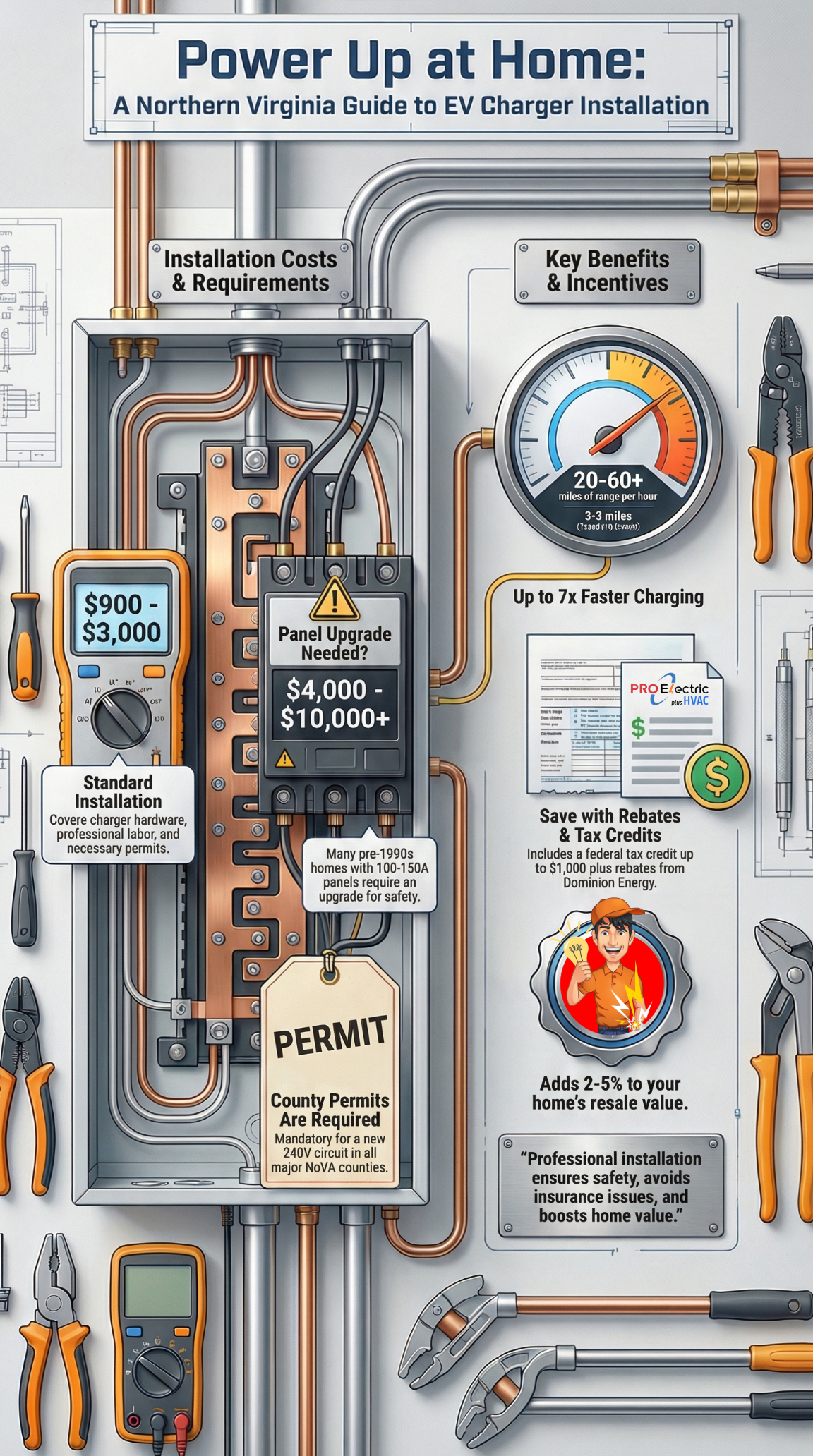
Many older Northern Virginia homes (especially pre-1990s) have 100–150-amp panels that can’t safely support a Level 2 charger’s 40–60-amp continuous load. Signs you need an upgrade include frequent breaker trips, outdated brands (Federal Pacific or Zinsco), or a load calculation showing insufficient capacity. Upgrading to 200A+ costs $4,000–$10,000+ but future-proofs your home. A licensed electrician performs a load calculation during assessment — essential before proceeding.
For a dedicated walkthrough of when an EV charger requires a panel upgrade, including how to read your existing panel and what to expect from Dominion Energy coordination, see: Why You Should Upgrade Your Electrical Panel for an EV Charger.
Step-by-Step Installation Process
- Assessment: Electrician evaluates panel capacity, wiring route, and charger location.
- Charger Selection: Choose UL-listed, smart-enabled for incentives.
- Permitting: Required for new circuits/hardwiring in all Northern Virginia counties.
- Installation: Run a dedicated circuit, install a breaker, and mount the charger. Takes 2–8 hours typically.
- Inspection: County verifies code compliance.
- Activation: Test and connect to app/utility programs.
For charger-specific questions before installation, two FAQ articles cover the most common ground: Level 2 EV Chargers for Homes: Top 10 FAQs Answered and the Tesla focused 10 Common Tesla Home EV Charger FAQs. For broader install questions across all charger brands, see: Simple FAQs: Home EV Chargers in Northern Virginia.
County-Specific Permit Requirements
All four counties (Fairfax, Loudoun, Arlington, Prince William) require permits for new circuits or hardwired Level 2 installations. A licensed electrician handles the application and inspections to ensure NEC compliance — skipping permits risks fines, insurance issues, or failed home inspections.
Cost Breakdown
Typical Level 2 installation without panel upgrade: $900–$3,000 (average $1,500–$2,500). Add $4,000–$10,000+ if panel upgrade needed. Charger hardware runs $400–$1,200; labor and materials $500–$1,500; permits $0–$300.
For the broader question of whether an EV pencils out for your driving patterns and electricity costs, our regional analyses cover payback periods and total cost of ownership: Cost-Benefit Analysis of Major Electric Vehicle Brands and EV vs Gas Vehicles in Northern Virginia.
Incentives and Rebates
- Dominion Energy EV Charger Rewards: $125 rebate for qualified Level 2 smart charger + $40 annually for managed charging enrollment.
- Federal Tax Credit: Up to $1,000 for charger/installation (30% of costs) via Alternative Fuel Refueling Property Credit.
Tesla buyers in Virginia have an additional layer of incentives that overlap with the federal credit. Our dedicated guide covers what currently applies: Understanding Tesla Tax Credits for Virginia Buyers.
Local EV Charger Installation Service Areas
We install Level 2 chargers across every community in the four Northern Virginia counties. The pages below cover the cities where we install most frequently, with local permit nuances, common panel configurations, and recent project notes:
- EV Charger Electrician near Arlington, VA
- EV Charger Electrician near Herndon, VA
- EV Charger Electrician near Leesburg, VA
- EV Charger Electrician near Ashburn, VA
- EV Charger Electrician near McLean, VA
- EV Charger Electrician near Purcellville, VA
- EV Charger Electrician near Manassas, VA
- EV Charger Electrician near Woodbridge, VA
- EV Charger Electrician near Lorton, VA
- EV Charger Electrician near Sterling, VA
- EV Charger Electrician near Gainesville, VA
- EV Charger Electrician near Middleburg, VA
Final Thoughts from Peter: Charge Ahead Safely
With over 20 years of experience electrifying homes in Northern Virginia, I’ve installed hundreds of EV chargers. A proper Level 2 setup not only slashes charging time but also prepares your home for the EV future, adding 2–5% to your home’s resale value. Don’t risk DIY or outdated panels amid growing demands.
Contact us at PRO Electric plus HVAC for a free assessment. Book online today. We handle permits, incentives, and everything code-compliant across Fairfax, Loudoun, Arlington, and Prince William.
🔗 Related reading: An older panel that can’t handle an EV charger is one of many signs your home’s electrical system needs attention. For the complete list of warning signs across Northern Virginia homes, read: signs your panel is too old to handle an EV charger.