
FAQs cover the most common questions. For the long-form walkthrough of the actual installation process, including cost ranges and county permit specifics, see the Detailed Guide to EV Charger Installation in Northern Virginia.
By Peter, Master Electrician | PRO Electric plus HVAC | EV Charger Installation
BOTTOM LINE UP FRONT (BLUF)
Installing a home EV charger in Northern Virginia is one of the smartest moves you can make as an EV owner because it delivers unmatched convenience, predictable overnight charging, and long-term savings compared with relying on public chargers. Homeowners benefit most from dedicated Level 2 chargers, but the proper setup depends on your vehicle, driving habits, and your home’s electrical capacity. Most jurisdictions, including Fairfax, Loudoun, Arlington, and Prince William Counties, require electrical permits when adding new circuits or hardwiring a charger to ensure safety and code compliance. A licensed electrician also handles load calculations, panel readiness, and local code requirements so your installation is safe, legal, and optimized for everyday use. With the proper planning and professional support, a home EV charger makes powering your EV effortless while protecting your electrical system and enhancing your daily routine.
Electric vehicles are no longer a niche purchase in Northern Virginia.
From Fairfax and Loudoun to Arlington and Prince William County, homeowners are asking the same questions before installing an EV charger at home.
How fast will it charge?
Do I need a panel upgrade?
Is it worth the cost? Do I need a permit?
This guide answers every major question homeowners ask about home EV chargers in Northern Virginia.
If you are considering charging at home, this article is written for you.
Table of Contents
- What Is the Best Home EV Charger for My Electric Vehicle?
- How Do Home EV Chargers Work?
- Why Should I Install an EV Charger at My House?
- Are Home EV Chargers Worth the Cost?
- What Is the Difference Between Level 1 and Level 2 Home EV Chargers?
- Can I Use a Regular Outlet to Charge My EV at Home?
- How Much Does It Cost to Install a Home EV Charger in Northern Virginia?
- How Fast Will a Home EV Charger Charge My Car?
- How Long Does It Take to Charge an EV at Home Overnight?
- Which EV Charger Is Compatible With My Specific EV Model?
- What Electrical Upgrades Does My Home Need for an EV Charger?
- Do I Need to Upgrade My Electrical Panel for EV Charging?
- Is It Safe to Install a Home EV Charging Station?
- How Do I Choose the Right Power Level for My Home EV Charger?
- What Do EV Charger Power Levels Mean in Amps and Kilowatts?
- Can Solar Panels Be Integrated to Charge My EV at Home?
- Do Home EV Chargers Have Smart Features or Apps?
- What Safety Features Should I Look For in a Home EV Charger?
- Do I Need a Permit to Install a Home EV Charger in Northern Virginia?
- Can I Install a Home EV Charger Myself or Do I Need an Electrician?
- What Maintenance Does a Home EV Charger Need?
- What Is the Average Lifespan of a Home EV Charger?
- Are Home EV Chargers Compatible With All EV Brands?
- Are There Tax Credits or Incentives for Home EV Chargers?
- What Should I Expect During a Home EV Charger Installation?
- What are the Electrical Requirements for EV Charger Installation?
- What are Fairfax County’s Permit Requirements?
- What are Prince William County’s Permit Requirements?
- What are Loudoun County’s Permit Requirements?
- What are Arlington County’s Permit Requirements?
- Summary of Local Authority Requirements
Most Common FAQs:
What Is the Best Home EV Charger for My Electric Vehicle?
The best home EV charger depends on three things:
Your vehicle
Your daily driving habits
Your home’s electrical capacity
Most modern EVs support Level 2 charging, which delivers faster charging and better long-term convenience. Brands matter less than compatibility, power rating, and safety certification. The charger must match your vehicle’s onboard charger capacity and your electrical panel limits.
In Northern Virginia, most homeowners choose a Level 2 charger rated between 32 and 48 amps for overnight charging convenience.
What Is the Best Home EV Charger for My Electric Vehicle?
The best home EV charger depends on three things:
Your vehicle
Your daily driving habits
Your home’s electrical capacity
Most modern EVs support Level 2 charging, which delivers faster charging and better long-term convenience. Brands matter less than compatibility, power rating, and safety certification. The charger must match your vehicle’s onboard charger capacity and your electrical panel limits.
In Northern Virginia, most homeowners choose a Level 2 charger rated between 32 and 48 amps for overnight charging convenience.
How Do Home EV Chargers Work?
A home EV charger delivers electricity from your home’s electrical panel to your vehicle in a controlled and safe way.
Level 1 chargers plug into a standard 120-volt outlet and charge slowly.
Level 2 chargers connect to a 240-volt circuit and charge much faster.
The charger communicates with your vehicle to regulate power, prevent overheating, and stop charging automatically when the battery is full.
Why Should I Install an EV Charger at My House?
Home EV charging offers three major benefits for Northern Virginia homeowners:
You charge overnight instead of relying on public stations.
Electricity at home is usually cheaper than public fast chargers.
Your vehicle is ready every morning without planning or waiting.
With longer commutes common across Northern Virginia, home charging removes range anxiety and saves time.
Are Home EV Chargers Worth the Cost?
For most homeowners, yes.
When you compare the cost of installing a charger to the long-term savings on fuel and public charging fees, home charging usually pays for itself within a few years. It also adds resale appeal, especially in EV-heavy areas like Fairfax County and Arlington.
What Is the Difference Between Level 1 and Level 2 Home EV Chargers?
Level 1 Chargers
Use a standard household outlet
Add roughly 3 to 5 miles of range per hour
Best for very light daily driving
Level 2 Chargers
Require a 240-volt circuit
Add roughly 20 to 40 miles of range per hour
Ideal for most Northern Virginia households
For most drivers, Level 2 charging is the practical choice.
Can I Use a Regular Outlet to Charge My EV at Home?
Yes, but with limitations.
A regular outlet can work temporarily, but it charges very slowly and may strain older wiring. Many Northern Virginia homes were not designed for sustained high loads on standard outlets.
For safety, reliability, and convenience, a dedicated EV charging circuit is strongly recommended.
How Much Does It Cost to Install a Home EV Charger in Northern Virginia?
Costs vary based on your home’s electrical setup, but typical ranges include:
Charger hardware
Electrical labor
Permits and inspections
Possible panel upgrades
Homes with newer panels and open capacity cost less to upgrade. Older homes or homes needing panel work will cost more. A proper site evaluation is the only way to know exact pricing.
How Fast Will a Home EV Charger Charge My Car?
Charging speed depends on the charger level, amperage, and your vehicle.
A Level 2 charger typically charges most EVs overnight, even after long daily commutes. This makes it ideal for Northern Virginia drivers who rely on their vehicle every day.
How Long Does It Take to Charge an EV at Home Overnight?
Most Level 2 chargers fully recharge an EV in 6 to 10 hours, depending on battery size and state of charge.
That means you plug in at night and wake up with a full battery.
Which EV Charger Is Compatible With My Specific EV Model?
Most EVs sold in the US use a standard Level 2 charging connector. Tesla vehicles may require an adapter depending on the charger.
Compatibility depends on:
Connector type
Maximum amperage supported by your vehicle
Smart charging preferences
An electrician can confirm compatibility before installation.
What Electrical Upgrades Does My Home Need for an EV Charger?
Common upgrades in Northern Virginia include:
New 240-volt circuit
Breaker space or load management
Electrical panel upgrades in older homes
Grounding or bonding improvements
Homes built decades ago often require updates to support EV charging safely.
Do I Need to Upgrade My Electrical Panel for EV Charging?
Maybe. If your panel is full or maxed out on load, an upgrade might be necessary.
A load calculation performed by a master electrician determines if your current service can handle the additional demand of an EV charger.
Is It Safe to Install a Home EV Charging Station?
Yes, when installed correctly.
Safety depends on:
Proper wiring
Correct breaker sizing
Load calculations
Code compliant installation
Improper installation increases fire risk and equipment damage.
How Do I Choose the Right Power Level for My Home EV Charger?
Power level depends on:
Your daily mileage
Your vehicle’s charging capacity
Your electrical panel capacity
Most homes benefit from chargers between 32 and 48 amps. Higher power is not always better if your vehicle or panel cannot support it.
What Do EV Charger Power Levels Mean in Amps and Kilowatts?
Charging power is measured in kilowatts (kW), determined by the amperage.
Common levels:
32 Amps = ~7.7 kW
40 Amps = ~9.6 kW
48 Amps = ~11.5 kW
Higher kilowatts mean faster charging, provided your vehicle and panel can handle it.
Can Solar Panels Be Integrated to Charge My EV at Home?
Yes.
Many Northern Virginia homeowners pair EV chargers with solar systems. Smart chargers can prioritize solar energy when available, reducing grid usage and lowering energy costs.
Do Home EV Chargers Have Smart Features or Apps?
Many modern chargers include:
Scheduling to charge during off-peak hours
Energy usage tracking
Utility integration
Remote monitoring
Smart features help manage energy costs and improve convenience.
What Safety Features Should I Look For in a Home EV Charger?
Important safety features include:
Automatic shutoff
Overcurrent protection
Ground fault protection
Temperature monitoring
UL or equivalent safety certification
Do I Need a Permit to Install a Home EV Charger in Northern Virginia?
Yes.
Northern Virginia jurisdictions typically require permits and inspections for EV charger installations. This ensures safety and compliance with electrical codes.
Can I Install a Home EV Charger Myself or Do I Need an Electrician?
In most cases, no.
EV chargers involve high voltage circuits, load calculations, and code compliance. Improper installation can void warranties and insurance coverage.
A certified electrician ensures the system is installed safely and legally.
What Maintenance Does a Home EV Charger Need?
Very little.
Occasional inspection
Keeping connections clean
Ensuring firmware stays updated for smart chargers
Most chargers are designed for long-term use with minimal upkeep.
What Is the Average Lifespan of a Home EV Charger?
Most quality chargers last 10 to 15 years.
Lifespan depends on:
Build quality
Environmental exposure
Electrical stability
Are Home EV Chargers Compatible With All EV Brands?
Generally, yes. Most Level 2 chargers use the standard J1772 connector, which fits all non-Tesla EVs in North America. Tesla vehicles come with an adapter to use these chargers. Alternatively, Tesla Wall Connectors are designed for Teslas but can charge other EVs with an adapter.
Are There Tax Credits or Incentives for Home EV Chargers?
Federal and state incentives may be available depending on the year and program availability. Many homeowners qualify for credits that reduce installation costs.
What Should I Expect During a Home EV Charger Installation?
A professional installation typically involves:
Site assessment and load calculation
Permitting and scheduling
Installation of conduit and wiring
Mounting the charger
Final testing and inspection
Setup of smart features
What are the Electrical Requirements for EV Charger Installation?
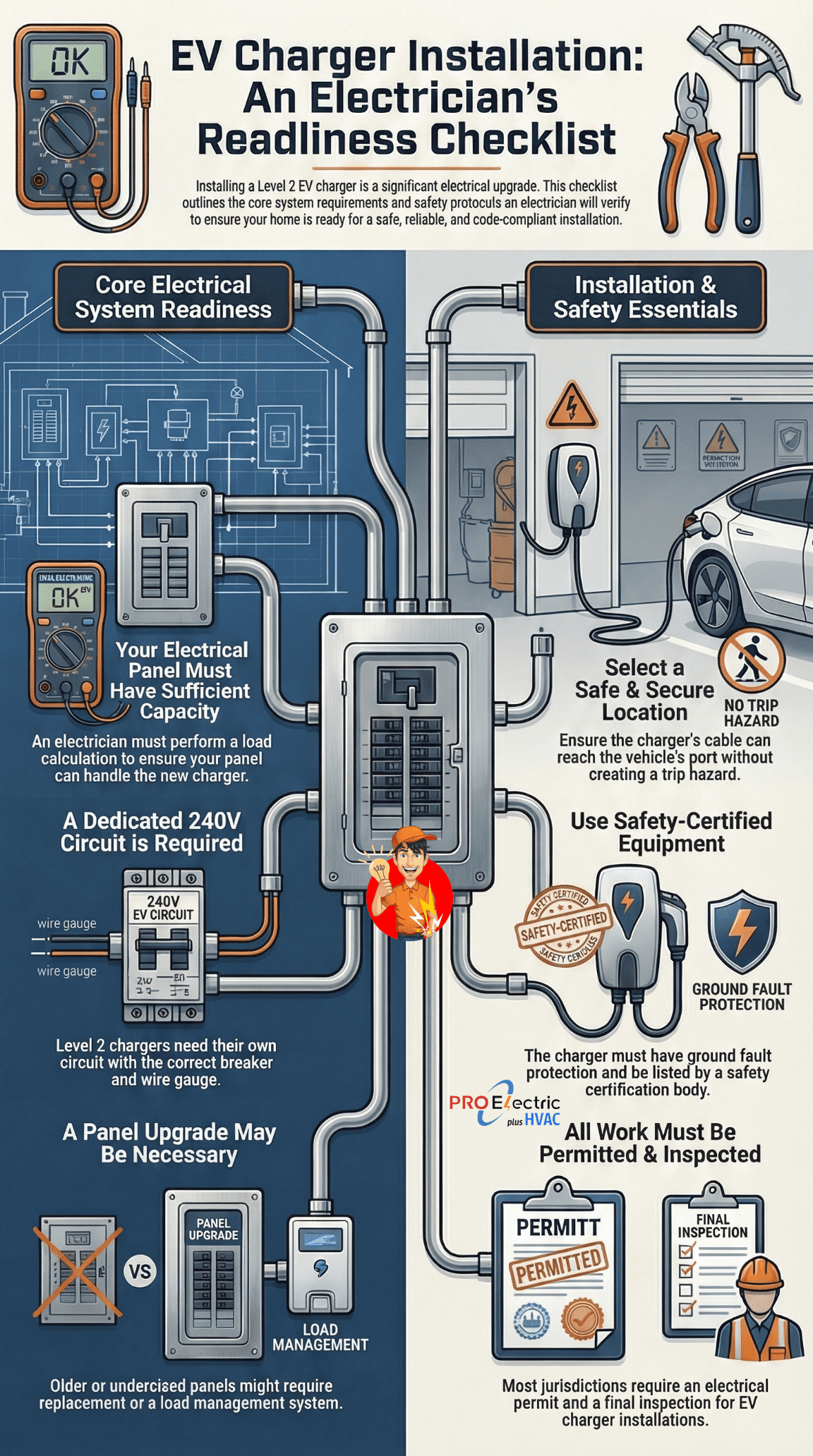
Use this checklist to determine whether your home is ready for an EV charger and what an electrician needs to verify before installation.
Home Electrical Panel Readiness
☑ Electrical panel amperage is identified – Most homes are 100 amp, 150 amp, or 200 amp service
☑ Panel has open breaker space available – EV chargers require a dedicated breaker
☑ Panel is not overloaded – Electric HVAC, heat pumps, electric water heaters, ranges, and dryers all affect available capacity
☑ Panel condition is safe and up to code – No corrosion, overheating marks, recalled breakers, or loose connections
☑ Main service capacity has been evaluated – A load calculation is required before adding EV charging
Dedicated Circuit Requirements
☑ Dedicated 240 volt circuit planned – Level 2 EV chargers require a 240 volt circuit
☑ Correct breaker size selected – Breaker size must match charger continuous load requirements
☑ Proper wire gauge selected – Wire size must match amperage and distance to prevent overheating
☑ Continuous load rules followed – EV chargers run for long periods and must be sized correctly
☑ Voltage drop considered for long runs – Long distances from panel to charger may require larger wire
Charger Type and Power Level
☑ Level 1 or Level 2 charger selected – Level 2 is recommended for most Northern Virginia homeowners
☑ Charger amperage confirmed – Common sizes include 32 amp, 40 amp, or 48 amp chargers
☑ Charger power matches vehicle capability – Vehicle onboard charger limits actual charging speed
☑ Plug in or hardwired charger chosen – Some jurisdictions prefer hardwired for higher amperage
Installation Location
☑ Charger location identified – Garage wall, carport, or exterior wall near driveway
☑ Cable reach verified – Charging cable can reach vehicle charge port safely
☑ No trip hazards created – Cable routing avoids walkways and doors
☑ Outdoor charger rated for weather if applicable – Outdoor units must be weather resistant
☑ Mounting surface suitable and secure – Wall structure can support charger weight
Safety and Code Compliance
☑ Ground fault protection included – Required for EV charging safety
☑ Proper grounding and bonding verified – Critical for electrical safety
☑ Correct disconnect method used – Some installations require an accessible disconnect
☑ Equipment listed and safety certified – Chargers should be safety tested and approved
☑ Installation meets local electrical code – Northern Virginia jurisdictions require code compliance
Permits and Inspections
☑ Electrical permit required and planned – Most EV charger installs require a permit
☑ Inspection scheduled after installation – Ensures safe and compliant work
☑ Utility requirements reviewed – Some utilities offer EV programs or require notification
Load Management and Upgrades
☑ Load calculation performed – Determines if the panel can support EV charging
☑ Load management considered if panel is near capacity – Allows EV charging without full panel upgrade
☑ Panel upgrade evaluated if needed – Older or undersized panels may require replacement
☑ Future expansion considered – Second EV or higher power charger planning
Smart Charging and Energy Management
☑ Smart charger features reviewed – Scheduling, monitoring, and energy tracking
☑ Off peak charging capability enabled – Helps reduce electric bills where applicable
☑ Solar integration considered if available – Some chargers work with home solar systems
Final Pre-Installation Check
☑ Vehicle make and model confirmed – Ensures charger compatibility
☑ Home electrical photos ready – Panel and install location photos speed up estimates
☑ Installation timeline discussed – Includes permit and inspection timing
☑ Warranty and support reviewed – Charger and installation warranty understood
If your home passes most of this checklist, you are likely ready for a home EV charger.
If multiple items are uncertain, a licensed electrician should evaluate your system before installation.
A proper EV charger installation protects your home, charges your vehicle faster, and ensures long-term reliability.
What are Fairfax County’s Permit Requirements?
EV Charging Station Permits and Requirements
Fairfax County’s official government page explains that a residential electrical permit is required when adding new circuits or outlets for EV chargers, though no permit is needed if plugging a stand-alone charger into an existing outlet. The county enforces the Uniform Statewide Building Code and electrical inspections to ensure safe installations.
Residential Electrical Permit Rules
Fairfax County’s Land Development Services clarifies that a residential electrical permit is required for new electrical circuits and equipment, including EV charging station circuits and outlets.
Zoning and EV Charger Standards
Fairfax County zoning documentation shows Level 1 and Level 2 charging stations are permitted in residential areas when properly sited, and all permits and easements must be secured before installation.
What are Prince William County’s Permit Requirements?
Residential EV Charger Permit Requirements
Prince William County’s Building Development Division states that an electrical permit is required when adding or extending a circuit to supply a residential EV charging system or when hardwiring the charger. Existing circuits that meet manufacturer requirements and are used without extending wiring may not need a permit. Load calculations and documentation are required for systems above 20 amperes.
What are Loudoun County’s Permit Requirements?
Permitting Process (General Code Requirement)
Loudoun County’s permitting page confirms that permits must be obtained for residential construction and electrical work, which includes installations like EV charging stations that involve new circuits or wiring. You apply through the county’s permitting system (LandMARC).
Electrical Permit Access Forms
Official Loudoun County building permit documentation shows the electrical permit application form, which homeowners and contractors must complete to obtain authorization for electrical work that would include EV charger installations.
⚠️ Note: Loudoun County does not yet publish a specific EV charger policy on its official site, but its general permitting framework applies to all electrical work including charging station installations.
What are Arlington County’s Permit Requirements?
Electrical Permits Needed for Electrical Work
Arlington County’s building permit information confirms that an electrical permit is required to add, remove, or relocate electrical wiring or equipment. This would apply to dedicated circuits or hardwired EV charging installations at homes.
EV Charging Installation Guidance
Arlington County’s official sustainability and transportation webpage provides guidance on EV charger installation, zoning considerations, and the need to coordinate with multiple county departments depending on site layout, electrical capacity, and zoning rules.
Summary of Local Authority Requirements
Permits and Inspections
- All four counties require electrical permits for new or modified circuits or hardwired EV charger installations.
- Plug-in chargers that use an existing, properly grounded outlet often do not need a permit, but local regulations vary and may still require inspection.
Electrical Code Compliance
- Installations must comply with the Virginia Uniform Statewide Building Code and local electrical safety requirements as administered through county Land Development or Building divisions.
Licensed Professionals
- In general, counties expect EV chargers and associated electrical work to be installed by licensed electricians familiar with local and state codes to ensure safety and code compliance.
Schedule your Northern Virginia EV charger installation consultation today
🔗 Related reading: Adding a Level 2 EV charger often reveals other limits in a home’s electrical system that were not obvious before the load calculation. A panel running near capacity, breakers nearing end of life, or wiring not rated for continuous load all surface during an EV charger install. For a complete picture of every warning sign that a Northern Virginia home’s electrical system is failing, read our cornerstone guide: 10+ Signs Your Northern Virginia Home’s Electrical System Is Failing.