
By Peter, Master Electrician | PRO Electric plus HVAC
BOTTOM LINE UP FRONT (BLUF)
Homebuyers and sellers in Northern Virginia often face critical electrical and HVAC issues that can make or break a real estate deal. As a Master Electrician serving Fairfax, Loudoun, Prince William, and Arlington Counties, I’ve seen firsthand how outdated wiring, aging HVAC systems, code violations, and unpermitted work can derail a home sale if not properly inspected and addressed. In this guide, I’ll walk you through eight common reasons why an electrical or HVAC inspection may be necessary as a contingency in a home purchase or sale.
If you are considering buying or selling a home, this article is written for you.
Table of Contents
- Chapter 1: Outdated Electrical Systems in Older Homes
- Chapter 2: Unpermitted and DIY Electrical Work
- Chapter 3: Aging HVAC Systems Near End-of-Life
- Chapter 4: HVAC Functional Problems and Safety Concerns
- Chapter 5: Code Compliance and Safety Upgrades
- Chapter 6: Home Inspection Contingencies and Deal Breakers
- Chapter 7: Local County Perspectives
- Chapter 8: Case Studies and Best Practices
- Frequently Asked Questions
- References (APA Format)
Chapter 1: Outdated Electrical Systems in Older Homes
The single most common electrical issue that surfaces during Northern Virginia home inspections is also the most predictable: a panel that was installed forty, fifty, or sixty years ago, never replaced, and is now running a 2026 household. Buyers tour the home, fall in love with the kitchen, and never look at the utility room. Then the inspector opens the panel cover and writes three pages of findings that the buyer cannot easily ignore.
In Fairfax County alone, the housing stock spans from pre-war Falls Church and Vienna homes through the explosive 1960s and 1970s buildouts of Annandale, Springfield, Burke, and Centreville, into the 1980s and 1990s subdivisions in Chantilly, Oakton, and Fairfax Station. Every one of those construction eras left a different electrical legacy. The Annandale homes were built when 100-amp service was a luxury. The Burke and Springfield homes were wired with aluminum branch circuits in the 1970s. The Falls Church and Vienna pre-war homes still carry knob-and-tube in some attics. None of these systems were designed for central HVAC, EV chargers, home offices with server-grade equipment, or modern kitchen appliance loads.
Loudoun County tells a similar story with different chapters. Leesburg and Purcellville carry the oldest housing stock, much of it predating modern electrical code. The eastern Loudoun buildout that brought Ashburn, Sterling, Brambleton, and South Riding into existence happened in the late 1990s and early 2000s — those homes are now hitting the 20 to 25 year mark when original panels and breakers start showing fatigue. Hamilton, Round Hill, Lovettsville, Hillsboro, Middleburg, and Aldie hold pockets of much older housing where the panel has not been touched since the original certificate of occupancy.
The Three Panels Inspectors Flag Every Single Time
Three specific panel brands appear in inspection reports across all four Northern Virginia counties with such regularity that experienced inspectors flag them on sight, before they even test anything.
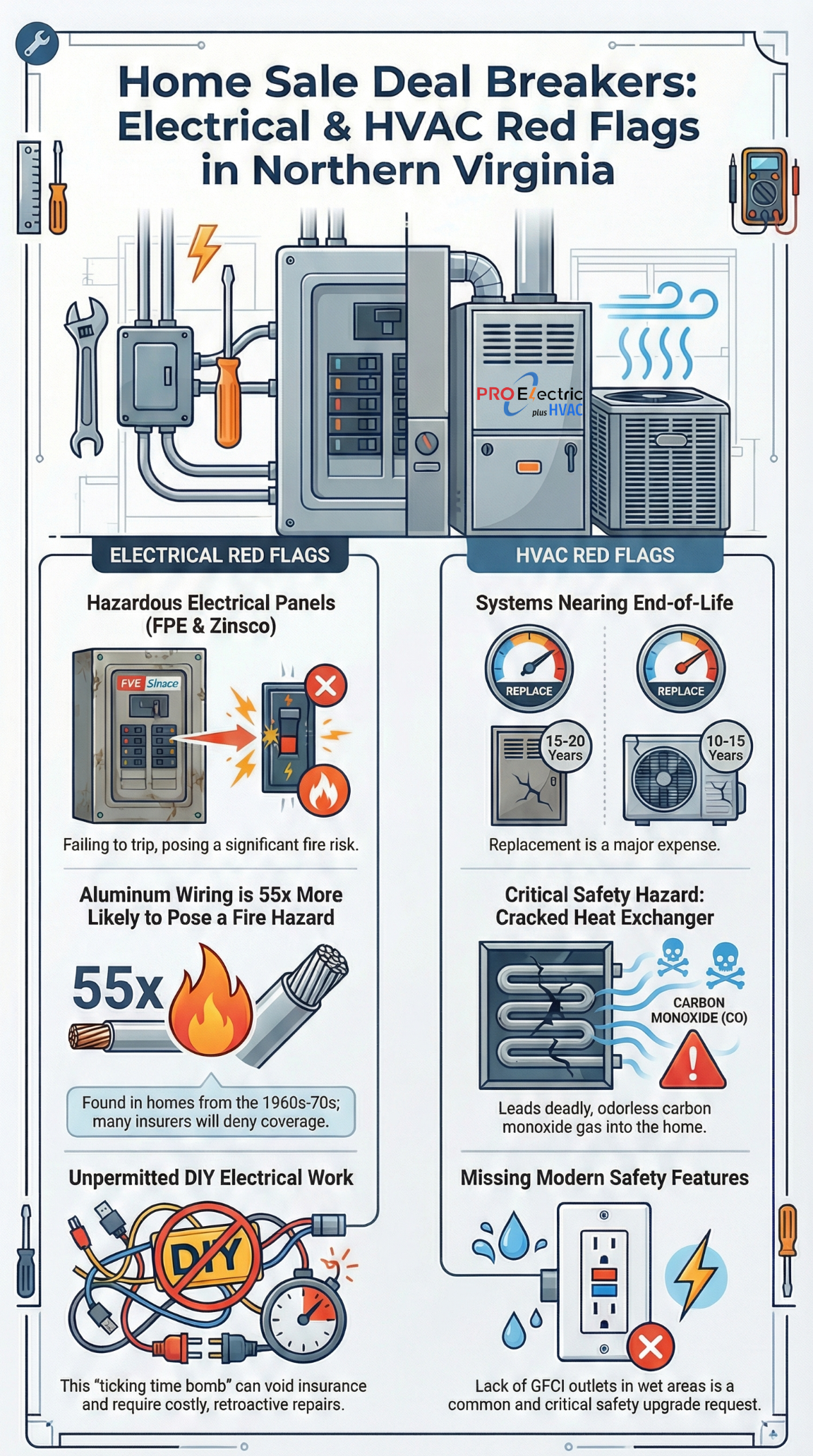
⚠️ Federal Pacific Electric (Stab-Lok): Installed in tens of thousands of Northern Virginia homes built between 1955 and 1983. The Stab-Lok breakers fail to trip under overload at a rate that has been documented in federal investigations. When a Stab-Lok breaker should trip and does not, the wiring downstream overheats. This is a documented fire risk and inspectors universally call for replacement.
⚠️ Zinsco and GTE-Sylvania: Common in 1960s and 1970s homes across Arlington, Prince William, and parts of Loudoun. The breakers can weld themselves to the bus bar over time, losing the ability to trip at all. A welded breaker is a breaker that has been bypassed permanently.
⚠️ Split-bus panels: Popular through the 1960s and 1970s. These panels lack a single main disconnect, which means the home cannot be fully de-energized with one switch. Fire departments across Northern Virginia routinely cite split-bus panels as a serious hazard. See our dedicated breakdown: Split Bus Panel Replacement in Northern Virginia.
Aluminum Branch Wiring
Homes built from roughly 1965 to 1973 across Fairfax, Loudoun, and Prince William Counties often have aluminum branch-circuit wiring. Aluminum expands and contracts more than copper as the wire heats and cools under load. Over decades, this thermal cycling loosens the connections at every outlet, switch, and breaker terminal. Loose connections produce heat. Heat produces arcing. Arcing produces fires.
Inspectors who know what they are looking for spot aluminum branch wiring immediately. The remediation is not a full rewire in most cases. Proper remediation requires either CO/ALR-rated devices at every termination or copper pigtailing performed with the correct purple twist-on connectors. Both approaches are accepted by Northern Virginia code authorities, but neither is something a homeowner should attempt without licensed help.
Service Amperage and Capacity
A 100-amp service panel was standard in nearly every home built before 1980. In 2026, that same panel is being asked to support a 3-ton heat pump, an electric range or induction cooktop, a 50-gallon electric water heater, a dryer, a home office with multiple monitors, possibly an EV charger, and the dozens of small electronics every household now runs continuously. The math does not work, and the inspector knows it.
For a deeper look at panel issues specific to Northern Virginia, including remediation costs and what to expect from a Dominion Energy service upgrade, our companion guide covers the territory: Northern Virginia Electrical Panel Safety Guide. For the cornerstone overview of warning signs that an electrical system is failing across all four counties: 10+ Signs Your Northern Virginia Home’s Electrical System Is Failing.
Chapter 2: Unpermitted and DIY Electrical Work
Northern Virginia is a high-renovation market. Owners finish basements, expand kitchens, add a second floor, convert garages, build outdoor kitchens, and pull EV charger circuits. Most of this work gets done by licensed contractors with proper permits and inspections. A meaningful portion does not. When the homeowner who skipped the permits eventually sells, the inspector finds the evidence and the deal slows down.
The telltale signs of unpermitted electrical work are easy to spot once you know what to look for, and the difference between professional and amateur installations becomes obvious the moment the panel cover comes off.
What Inspectors Find Inside DIY Panels
- Double-tapped breakers: Two separate circuit wires landed on a single breaker terminal. Unless the breaker is specifically rated for two conductors (most are not), this is both a code violation and a fire hazard. The second wire can arc internally at the terminal, and the breaker itself will never trip for it. Our companion article covers the specifics: The Dangers of Mismatched Circuit Breakers in Your Electrical Panel.
- Mismatched breaker brands: A Square D panel filled with Eaton breakers, or a Siemens panel with Murray breakers. They physically fit the bus, but they are not listed for use together and may not trip at the rated current.
- Oversized breakers protecting undersized wire: A 30-amp breaker on a 14-gauge wire is the most dangerous configuration in residential electrical work. The wire will overheat and fail long before the breaker trips. This happens when a homeowner replaces a breaker that keeps tripping by going up a size instead of fixing the underlying overload.
- Backstabbed receptacles in renovation work: Wires pushed into spring-clip holes on the back of receptacles instead of secured under screw terminals. These connections loosen over time. They are responsible for a disproportionate number of residential electrical fires.
- Romex run through conduit improperly: NM cable used in commercial-style conduit applications where it does not belong, or worse, exposed Romex run across the surface of a finished basement wall.
- Missing junction boxes: Wires spliced together with wire nuts in the wall, attic, or ceiling cavity with no junction box. Every splice in residential wiring is required to be inside an accessible box. Open splices behind drywall are illegal and they are fire hazards.
- Improper bonding and grounding: Missing bonding jumpers between the neutral and ground at the main panel, missing equipment grounding conductors on metal devices, or grounds connected to plumbing in homes where the plumbing is partially plastic.
Pulling the Permit History
Every Northern Virginia county and incorporated jurisdiction maintains a public-facing permit history database. Fairfax County, Loudoun County, Arlington County, Prince William County, Manassas City, Manassas Park, and Falls Church all allow address-based searches. Smart buyers and their agents pull this history during the contingency period and compare it to what the inspector sees.
A finished basement that does not appear in the permit record is a red flag. An addition that lacks the corresponding electrical permit means the wiring inside the new walls was never inspected. A second-floor expansion with a missing rough-in inspection means the wiring behind the drywall was never verified by an inspector. For the broader picture on why rough-in inspections matter, see: Rough-In Inspections: A Simple Homeowner’s Guide and The Challenges of Skipping Rough-In Inspections.
🚨 Insurance Implications: Unpermitted electrical work that contributes to a fire can void homeowner insurance coverage. Most policies include language excluding losses caused by code violations or work performed without required permits. The same exclusion language commonly appears in title insurance and lender requirements. This is not a theoretical risk; insurance carriers routinely deny claims on this basis.
Chapter 3: Aging HVAC Systems Near End-of-Life
After the electrical panel, the second most common deal-affecting finding in a Northern Virginia home inspection is an HVAC system at or past its expected service life. Buyers see “central air” and “gas furnace” on the listing and assume those systems have years of useful life ahead. Inspectors read the manufacturer date stamp and tell a different story.
Service Life Benchmarks
In the Northern Virginia climate, with our hot humid summers and cold winters, residential HVAC equipment has fairly predictable service lives:
- Central air conditioner condenser: 12 to 15 years typical; 18 to 20 years possible with consistent maintenance and a covered installation location.
- Gas furnace: 15 to 20 years typical; some 80% AFUE units from the late 1990s are still running, but parts availability is the limiting factor.
- Air-source heat pump: 12 to 15 years typical, similar to AC condensers since the outdoor unit faces the same thermal stress.
- Gas water heater (tank-type): 8 to 12 years typical; the anode rod is the consumable that determines whether the tank reaches 12 years or fails at 8.
- Electric water heater: 10 to 15 years typical.
- Ductwork: 20 to 30 years for sheet metal in conditioned space; flexible duct degrades faster, especially in attics where temperatures cycle aggressively.
Inspectors read the manufacturer label on every piece of equipment. The date is sometimes coded into the serial number rather than printed directly. Experienced inspectors can decode the date stamps for every major brand: Trane, Carrier, Lennox, Goodman, Rheem, York, Bryant, American Standard, Heil, and so on. A 2008 condenser feeding a 2007 air handler is a system that is past replacement age regardless of how recently it was serviced.
The R-22 Refrigerant Transition
Any AC or heat pump installed before 2010 likely uses R-22 refrigerant. R-22 has been phased out under federal regulation and is no longer produced. Existing stockpiles are sold at multiples of their historical price, often $90 to $150 per pound, with a typical residential charge running 6 to 12 pounds. A small leak on an R-22 system can cost $600 to $1,800 to refill, and that does not include diagnostic time or the cost of the leak repair itself.
From a home inspection perspective, R-22 equipment is essentially terminal. The cost to maintain it exceeds the cost to replace it within a few service calls. Inspectors flag R-22 systems specifically because buyers need to know the refrigerant matters as much as the equipment age.
Capacity Versus Modern Envelope
A second HVAC issue inspectors flag is capacity mismatch. A home that has been weatherized, had insulation upgraded, had new windows installed, and had air sealing work done now needs less cooling than it did when the original equipment was sized. The result is an oversized AC that short-cycles, fails to dehumidify properly, and wears out faster than a correctly sized unit would. Northern Virginia’s humid summers make oversized AC particularly noticeable; the air feels cold but clammy because the unit cycles off before pulling moisture out.
For a deeper read on the most common HVAC failures Peter sees in Northern Virginia homes: Common Heat Pump and Furnace Issues in Northern Virginia and Why Your AC Fails in Scorching Summer Heat.
Chapter 4: HVAC Functional Problems and Safety Concerns
Equipment age is one issue. Functional safety problems are a different category, and inspectors prioritize them above almost everything else they find. A buyer can negotiate a credit for an aging condenser. A cracked heat exchanger that vents carbon monoxide into the home is not a negotiation; it is a safety call to action.
Cracked Heat Exchangers
The heat exchanger is the steel chamber inside a gas furnace where combustion happens. The blower fan pushes house air across the outside of the exchanger; the exhaust gases go up the flue. The two air streams never mix when the exchanger is intact. When the exchanger cracks, the two streams can mix, and combustion byproducts including carbon monoxide enter the home’s air distribution.
Inspectors look for the visible signs of a cracked exchanger: rust patterns on the burner side, soot deposits where there should be none, flame distortion when the blower kicks on, and CO readings inside the supply ductwork. When any of these show up, the inspector recommends immediate evaluation by an HVAC technician with a borescope. Furnaces over 15 years old are particularly vulnerable.
🚨 Carbon Monoxide is the Silent Killer: CO has no color, no smell, and no taste. Modern code requires a CO detector outside every sleeping area in homes with combustion appliances. Many Northern Virginia homes from the 1980s and earlier still lack CO detection entirely. This is a low-cost fix that inspectors universally flag and that buyers should never accept as a negotiating concession.
Refrigerant Leaks
Modern AC and heat pump systems are sealed; they should not lose refrigerant during normal operation. When a system is low on charge, there is a leak somewhere in the closed loop. Inspectors flag low charge with temperature splits measured at the supply and return; a properly charged system shows a 15 to 22 degree split across the coil. A split below 12 degrees suggests low charge or airflow problems. Either condition warrants HVAC service before closing.
Improper Venting and Combustion Air
Gas furnaces and water heaters need both proper exhaust venting and an adequate supply of combustion air. Inspectors find several recurring problems in Northern Virginia basements:
- Double-walled flue pipe replaced with single-walled by an unlicensed handyman, often with the wrong clearance to combustible materials.
- Atmospheric-vent water heaters and furnaces sharing a flue with mismatched flue diameters, causing one appliance to backdraft into the other.
- Sealed mechanical rooms with no combustion air opening, so the furnace and water heater starve for air and pull combustion gases back into the room.
- Power-vent appliances vented through a wall but terminated too close to a window, door, or grade level. Northern Virginia code requires minimum clearances that are routinely ignored on DIY installations.
Condensate Handling and Microbial Growth
Every modern AC and high-efficiency furnace produces condensate that has to go somewhere. Inspectors look for blocked condensate lines, missing drain pans, primary drains that dump into secondary drain pans without alarms, and AC coils so coated with biofilm that the entire indoor air supply smells musty. Drain line failures cause water damage to ceilings below the unit in attic installations. Microbial growth in the coil or drain pan is an indoor air quality issue that inspectors sometimes recommend resolving with a duct cleaning, a coil cleaning, or both.
For homes with chronic comfort problems that go beyond simple equipment failures, particularly older homes with no ductwork or with rooms that always run hot or cold, the ductless mini-split is often the right answer: Why Install a Ductless Mini-Split in Northern Virginia.
Chapter 5: Code Compliance and Safety Upgrades
The National Electrical Code updates roughly every three years, and Virginia adopts each new edition with state-specific amendments. What was legal when the home was built is often not legal under current code, but most existing homes are grandfathered as long as no permitted work triggers a code update. Home inspectors flag the gaps anyway, because buyers need to know what would need to change if they renovate, and because some of the gaps are genuine safety concerns regardless of grandfathering.
AFCI and GFCI Protection
Modern code requires Arc Fault Circuit Interrupter (AFCI) protection on all 15 and 20-amp circuits in living spaces, including bedrooms, family rooms, dining rooms, hallways, closets, and laundry areas. Ground Fault Circuit Interrupter (GFCI) protection is required at kitchen counters, bathrooms, garages, outdoor outlets, basements, and within six feet of any sink. Older Northern Virginia homes generally have neither, leaving them without the two most powerful electrical fire and shock prevention tools available.
Adding AFCI and GFCI protection to an existing home is straightforward in most cases. The protection can be added at the breaker (AFCI/GFCI breakers cost $40 to $60 each and replace standard breakers in the panel) or at the outlet (a single GFCI receptacle can protect downstream receptacles on the same circuit). For a closer look at GFCI behavior and the most common troubleshooting scenarios: GFCI Outlet Keeps Tripping? Causes and How to Fix It.
Tamper-Resistant Outlets
Since the 2008 NEC, all 15 and 20-amp receptacles in dwelling units must be tamper-resistant (TR). The inside of a TR receptacle has spring-loaded shutters that block foreign objects from being inserted by children. Homes built before 2008 are not required to retrofit, but inspectors note the absence of TR receptacles in the report. Replacing receptacles with TR versions is inexpensive and worth doing during a renovation regardless of whether code requires it.
Bonding, Grounding, and the Single-Point Bond
The bonding and grounding system in a home is what gives every metal surface a path back to the earth at the same electrical potential. When the bonding is right, a fault current finds the ground path immediately and the breaker trips. When the bonding is wrong, fault current can take an unintended path, which is how people get shocked by appliances and how electrical fires start.
Inspectors check for the main bonding jumper at the service panel, the equipment ground at the service disconnect, ground rods or ground rings outside the home, bonding to the water service entry, bonding to the gas line, and bonding of any pool or hot tub equipment. In older Northern Virginia homes, partial bonding is common: the original bonding may have been correct in 1972, but plumbing repairs introduced plastic pipe that broke the bond chain, or panel upgrades over the years left some connections incomplete.
Smoke and Carbon Monoxide Detection
Northern Virginia code requires hardwired interconnected smoke detectors with battery backup outside every sleeping area, inside every bedroom, on every level including the basement, and within 10 feet of cooking appliances on the main level. CO detection is required outside every sleeping area in any home with combustion appliances or an attached garage. Inspectors test every detector and flag any that fail to operate, any that are past their 10-year service life, and any installations that lack proper interconnection.
Exterior Emergency Disconnect
Recent code editions adopted by Fairfax County and other Northern Virginia jurisdictions require an exterior emergency disconnect for single-family dwellings. This requirement catches many homeowners by surprise during inspections because it is relatively new and not retroactively enforced. Buyers planning major renovations should know that the disconnect requirement may be triggered when the panel is replaced. For the full picture: Exterior Emergency Shut-Off Requirements in Fairfax County.
Chapter 6: Home Inspection Contingencies and Deal Breakers
In a typical Northern Virginia real estate contract, the buyer has a defined contingency period (commonly 7 to 14 days) to conduct inspections and either accept the property, request repairs or credits, or walk away. The inspection is the buyer’s leverage. Knowing which findings translate into successful negotiations and which fall through helps both buyers and sellers manage the process realistically.
Findings That Usually Lead to Successful Negotiations
- Federal Pacific or Zinsco panel: Documented fire risk; most buyers will not close without a credit or seller-completed replacement.
- Cracked heat exchanger: Carbon monoxide risk; safety-tier finding that virtually always results in furnace replacement or a substantial credit.
- Aluminum branch wiring with no remediation: Insurance carriers often refuse coverage or charge significantly higher premiums.
- Active water leak at HVAC drain or supply: Visible damage that the buyer can quantify in writing.
- Lead paint, asbestos, or radon above EPA action level: Health-tier findings that lenders may flag.
- Major unpermitted work: Buyer’s lender or title insurer may refuse to close until the work is permitted retroactively or removed.
Findings That Usually Get Negotiated Down or Absorbed
- HVAC system at end of life but functional: Buyers know they are buying an older system at this price point.
- Missing GFCI or AFCI on circuits not currently required to have them: Inexpensive to add; usually absorbed by the buyer.
- Cosmetic electrical issues: Painted-over outlets, mismatched faceplates, minor wiring untidiness.
- Outdated but functional fixtures: Old ceiling fans, original light fixtures, replaceable items.
Repair Credit Versus Seller-Completed Repairs
Buyers and sellers often have to choose between asking the seller to complete repairs before closing or accepting a credit at closing. Each approach has trade-offs:
💡 Repair credits favor the buyer when: The buyer wants control over the contractor selection, the work involves matters of taste (cabinet choice, fixture selection), or the seller is unmotivated to oversee the work properly. Buyers should obtain their own contractor quotes during the contingency period to size the credit appropriately.
💡 Seller-completed repairs favor the buyer when: The lender requires the repair to be completed prior to closing (lender repair conditions are common with FHA, VA, and conventional loans on older homes), the work is structural or safety-related and the lender needs documentation, or the buyer lacks the time or capacity to oversee post-closing repairs.
Re-Inspection and Verification
When repairs are completed by the seller, the buyer should always require a re-inspection before final walkthrough. The re-inspection verifies that the work was done by a licensed contractor, was performed to code, and was permitted and inspected by the county where required. The cost of a re-inspection ($150 to $300 in most Northern Virginia markets) is trivial compared to the cost of discovering after closing that the work was done by the seller’s brother-in-law over a weekend.
For a deeper read on the specific electrical issues that derail Northern Virginia home sales, our companion guide breaks down 50 of them: 50 Electrical Inspection Issues for Homebuyers in Fairfax County. For the broader question of what hidden costs an older home can bring: Hidden Dangers: The Real Costs of Buying an Old Home Without Proper Inspections.
Chapter 7: Local County Perspectives
Each of the four Northern Virginia counties has its own permit culture, its own typical housing stock by era, and its own predictable inspection findings. Knowing what to expect by county helps buyers and sellers prepare realistically.
Fairfax County
Fairfax County has the most diverse housing stock in Northern Virginia. The pre-war neighborhoods of Vienna, Falls Church, and parts of McLean hold the oldest homes. The post-war boom in Annandale, Springfield, Burke, and the Mason District filled out the 1950s through 1970s. The 1980s buildouts brought Centreville, Chantilly, Oakton, and Fairfax Station. The newer subdivisions of South Riding (technically Loudoun but adjacent), Fairfax Corner, and the Mosaic District represent the latest era. The most common inspection findings track to the era: pre-war homes show knob-and-tube and 60-amp service; 1960s and 1970s homes show Federal Pacific panels and aluminum branch wiring; 1980s and 1990s homes show aging HVAC and code gaps that have been left in place.
Fairfax County’s permit office is well-organized and the online lookup system is reliable. Renovation permits are available for retroactive review if needed, and the county has an established process for legalizing unpermitted work when buyers and sellers want to clean up a permit history before closing. For a deeper look at Fairfax-specific renovation permitting: Home Renovations in Fairfax County: Building Permits Guide.
Loudoun County
Loudoun County splits sharply into two halves. Western Loudoun (Hamilton, Round Hill, Lovettsville, Hillsboro, Middleburg, Bluemont, Aldie, Purcellville, much of Leesburg) is dominated by older homes, including many that predate modern electrical code entirely. Findings in western Loudoun include knob-and-tube wiring, 60 to 100-amp service panels, fuse boxes still in active use, and well-pump electrical setups that have been jerry-rigged across multiple ownership changes.
Eastern Loudoun (Ashburn, Sterling, Brambleton, Broadlands, South Riding, Stone Ridge, Lansdowne) is dominated by 1990s and 2000s subdivisions. The homes are now 20 to 25 years old, which is when original AC condensers fail, original water heaters start to leak, and original panels begin showing the early signs of wear at the bus bars and breaker terminals. Eastern Loudoun inspections are often dominated by aging HVAC findings rather than dangerous electrical findings.
Arlington County
Arlington has the most compressed and diverse housing stock per square mile in the region. The Lyon Village bungalows from the 1940s, the Cherrydale colonials from the 1930s and 1940s, the Aurora Highlands ranchers from the 1950s, and the Buckingham garden apartments from the 1930s sit within a few miles of new Ballston and Pentagon City condominiums. The inspection findings track to the era as elsewhere, but Arlington has a high concentration of homes with combined electrical-plus-condo board issues: shared service feeders, common-area electrical mixed with unit electrical, and HOA rules that constrain what can be replaced and how. For Arlington panel issues specifically: Arlington County’s Two Electrical Panel Problems Depending on When Your Home Was Built.
Prince William County
Prince William County is dominated by 1970s and 1980s subdivisions: Dale City, Woodbridge, Lake Ridge, Montclair, and the early communities of Manassas. These homes carry the predictable problems of their era — Federal Pacific panels are particularly common in Dale City and Lake Ridge, aluminum branch wiring shows up across the 1970s neighborhoods, and original HVAC has long since been replaced (sometimes well, sometimes poorly). The western Prince William growth areas of Gainesville, Haymarket, Bristow, Nokesville, and Catharpin are newer but include pockets of much older rural housing with well pumps, septic systems, and electrical infrastructure that was sized for a different era. Manassas City and Manassas Park, as independent jurisdictions, enforce their own permit processes that operate separately from Prince William County’s.
Chapter 8: Case Studies and Best Practices
Three short examples from recent inspection-driven calls illustrate how the patterns above show up in real transactions, followed by practical advice for buyers and sellers approaching a sale.
Case 1: A 1974 Springfield Colonial
Buyer was a young family moving from a Falls Church townhouse to a 1974 colonial in Springfield. Listing photos showed a fully finished basement, an updated kitchen, and a recent HVAC system. The inspector opened the electrical panel and found a Federal Pacific Stab-Lok with 22 breakers in a 20-slot panel (two illegal tandem breakers), aluminum branch circuit feeding the kitchen, and a sub-panel in the basement that lacked any permit history. Inspector’s report listed seven separate electrical findings. The negotiation centered on a $14,000 credit at closing that covered panel replacement, aluminum branch remediation, and bringing the basement sub-panel into permit compliance. Deal closed on schedule because both sides understood the work was needed and the credit was reasonable.
Case 2: A 1995 Ashburn Subdivision Home
Buyer was purchasing their first home, a 1995 colonial in an Ashburn subdivision. Inspection turned up an original AC condenser dated 1995, a 1995 furnace with a heat exchanger showing the early signs of stress cracks under borescope examination, and a hot water heater dated 2008. None of the electrical was problematic; the panel was a modern 200-amp Square D in good condition. The negotiation centered on a $9,500 credit covering AC and furnace replacement plus a new water heater. The seller initially balked at replacing the furnace based on the borescope finding alone, but the buyer’s HVAC contractor confirmed the cracks and recommended replacement. Deal closed three weeks later than originally planned to accommodate the additional inspections.
Case 3: A Pre-War McLean Home
Buyer was an empty-nest couple downsizing to a 1937 McLean home that had been beautifully renovated cosmetically. The inspection found knob-and-tube wiring still active in the attic space, a 100-amp panel feeding a home that needed 200 amps for the modern HVAC and EV charging the buyer planned, and no exterior emergency disconnect. The total scope of electrical work to bring the home current ran $28,000. The buyer renegotiated the purchase price downward by $20,000 and assumed the rest of the cost themselves. The home closed and the electrical work was completed over six weeks after move-in.
Best Practices for Buyers
- Pull the permit history before making an offer. All four Northern Virginia counties allow this online. Compare the permitted work to what you see in the listing photos.
- Use an inspector who specializes in older Northern Virginia housing stock. The patterns described in this article are predictable, but only to inspectors who have seen them many times.
- Consider a separate electrical-specific inspection. For homes built before 1985, a licensed Master Electrician’s evaluation can catch issues that a general inspector misses: Electrical Inspection Before Purchasing a House in Northern Virginia.
- Get contractor quotes during the contingency period. Quotes are leverage. A $3,000 estimate beats a generic “they say it needs work.”
- If using a VA loan, know what the appraiser will flag. VA inspections are stricter on safety items than conventional inspections: Should You Skip the Electrical Inspection on a Home Purchase with a VA Loan?
Best Practices for Sellers
- Get a pre-listing electrical and HVAC audit. Spending $300 to $500 on a pre-listing audit lets you fix the easy items (GFCI receptacles, smoke detector batteries, panel labeling) before the buyer’s inspector finds them. The negotiation room you preserve is worth multiples of the audit cost.
- Have permit records ready. If you have done any work, gather the permit numbers and inspection sign-offs before listing.
- Replace known time-bombs proactively. A Federal Pacific panel is going to come up. A 22-year-old furnace is going to come up. Replacing them before listing eliminates the negotiating leverage and may improve the listing presentation enough to support a higher price.
- Document recent maintenance. AC service records, furnace tune-ups, water heater anode rod replacements, and any electrical work all reduce buyer anxiety.
💡 PRO Electric plus HVAC provides pre-listing and pre-purchase electrical and HVAC inspections across all four Northern Virginia counties. Master Electrician’s assessment of the panel, service amperage, branch circuits, GFCI/AFCI coverage, smoke detector and CO detector circuits, and HVAC condition. Documented report you can share with your agent, your inspector, or the other side of the transaction. Call (703) 225-8222 to schedule.
Frequently Asked Questions
Short answers to the questions buyers and sellers in Fairfax, Loudoun, Arlington, and Prince William Counties ask most often about home inspections and the electrical or HVAC findings that surface during a sale.
What do home inspections typically uncover in Northern Virginia homes?
Home inspections in Northern Virginia commonly uncover electrical safety hazards, aging HVAC systems, unpermitted renovations, outdated panels, wiring issues, and code-related safety gaps that can impact a real estate transaction.
Why do electrical issues cause home sales to fall through?
Electrical issues raise safety, insurance, and lending concerns. Problems like outdated panels, aluminum wiring, or unpermitted work often trigger repair demands or cause buyers to terminate contracts.
What electrical red flags do inspectors look for during a home sale?
Inspectors commonly flag outdated breaker panels, ungrounded outlets, double-tapped breakers, aluminum wiring, knob-and-tube wiring, and missing GFCI protection.
Are HVAC issues a common deal breaker in Northern Virginia real estate?
Yes. HVAC systems near end of life, safety concerns, or poor performance frequently lead buyers to request repairs, credits, or cancel contracts.
How old is too old for an HVAC system when selling a home?
Most buyers and inspectors consider HVAC systems over 15 to 20 years old to be near or past their expected lifespan, especially in Northern Virginia’s climate.
Can a buyer walk away from a contract after a home inspection in Virginia?
Yes. Under the home inspection contingency, buyers can terminate the contract if significant deficiencies are discovered and no agreement is reached.
What is considered a material deficiency in a home inspection?
A material deficiency is an issue that affects safety, function, or a reasonable person’s decision to purchase the home, such as fire hazards or non-functioning HVAC systems.
Do home inspections check for code compliance?
Home inspections focus on safety and function, not full code compliance. Licensed electricians or HVAC professionals are needed for detailed code evaluations.
What happens if unpermitted electrical work is discovered?
Unpermitted work often must be corrected, permitted, or removed before closing, or the buyer may terminate the contract due to safety and liability concerns.
Are Federal Pacific electrical panels a problem during home sales?
Yes. Federal Pacific panels are widely known fire hazards and are frequently required to be replaced before insurance approval or closing.
Why do insurers care about electrical inspections?
Insurance companies may deny coverage for homes with outdated panels, aluminum wiring, or unsafe electrical conditions, forcing repairs before closing.
What HVAC safety issues are most concerning to buyers?
Carbon monoxide risks, cracked heat exchangers, refrigerant leaks, poor ventilation, and inadequate heating or cooling capacity are major buyer concerns.
Can a seller refuse to make inspection repairs?
Yes, but the buyer can then choose to terminate the contract if the issues meet the definition of deficiencies under the inspection contingency.
Is a home sold as-is exempt from inspection issues?
No. Buyers can still conduct inspections and terminate contracts if serious safety or functional issues are discovered, even in as-is sales.
Do FHA and VA loans require stricter inspection standards?
Yes. FHA and VA loans often require electrical and HVAC systems to meet minimum safety and functionality standards before loan approval.
What electrical upgrades are commonly requested during negotiations?
Common requests include panel upgrades, GFCI installation, grounding corrections, removal of hazardous wiring, and adding dedicated circuits.
Are GFCI outlets required when selling a home in Virginia?
They may not be required for older homes, but buyers frequently request GFCI upgrades as a safety improvement during inspections.
Why do buyers request HVAC servicing before closing?
Servicing helps confirm system functionality, reduces immediate failure risk, and provides peace of mind for buyers concerned about aging equipment.
Can buyers negotiate credits instead of repairs?
Yes. Buyers often negotiate closing credits to handle electrical or HVAC repairs themselves after purchase.
How do inspection issues affect appraisal and financing?
Appraisers and lenders may require safety issues to be corrected before funding, delaying or jeopardizing the transaction.
Are older homes more likely to have inspection problems?
Yes. Homes over 40 years old are more likely to have outdated wiring, undersized services, and aging HVAC systems.
What role do county regulations play in inspection outcomes?
Local county permitting and inspection rules influence what must be corrected when repairs are agreed upon during a sale.
Can missing permits delay a home closing?
Yes. Missing or open permits may need to be resolved before title transfer or lender approval.
What HVAC performance issues are commonly flagged?
Uneven temperatures, insufficient cooling or heating, excessive noise, leaks, and poor airflow are common inspection findings.
Should sellers get a pre-listing electrical inspection?
Yes. Pre-listing inspections help sellers address problems early and reduce the risk of failed contracts.
Do home inspectors test every outlet and circuit?
Inspectors test a representative sample, not every outlet. Electrical contractors can perform more detailed evaluations if needed.
Are aluminum wiring homes harder to insure?
Yes. Aluminum wiring can increase fire risk and often requires remediation before insurance approval.
Can inspection issues be resolved after closing?
They can, but buyers lose leverage after closing and may bear full repair costs if issues were not addressed during contingencies.
Why are electrical inspections especially important in Northern Virginia?
Northern Virginia has a high concentration of older homes, frequent renovations, and strict lending standards that elevate electrical inspection importance.
What happens if an HVAC system fails during escrow?
The failure typically becomes a negotiation point requiring repair, replacement, credit, or contract termination.
Do inspections look at EV chargers or generators?
Yes. Inspectors often flag unpermitted EV chargers, generators, or transfer switches during home sales.
How can buyers protect themselves during inspections?
Buyers should use licensed specialists, document deficiencies, prioritize safety issues, and understand their inspection contingency rights.
How can sellers avoid failed inspection negotiations?
Sellers can avoid failed negotiations by fixing known issues, disclosing conditions honestly, and responding reasonably to safety-related requests.
References (APA Format)
American Society of Home Inspectors. (2023). Standards of practice for home inspections. ASHI.
Consumer Product Safety Commission. (2011). Report on potential hazards associated with Federal Pacific Electric (FPE) Stab-Lok circuit breakers. United States Consumer Product Safety Commission.
Environmental Protection Agency. (2020). Phase out of HCFC-22 (R-22) refrigerant under the Clean Air Act. EPA Office of Air and Radiation.
Fairfax County Department of Land Development Services. (2024). Residential building permit lookup and inspection records. Fairfax County.
International Association of Electrical Inspectors. (2023). Residential electrical inspection guidelines: Existing homes. IAEI.
Loudoun County Department of Building and Development. (2024). Residential permit search and inspection history. Loudoun County.
National Fire Protection Association. (2023). NFPA 70: National electrical code (2023 edition). NFPA.
National Fire Protection Association. (2023). NFPA 720: Standard for the installation of carbon monoxide detection and warning equipment. NFPA.
Northern Virginia Association of Realtors. (2024). Standard residential sales contract addenda and inspection contingencies. NVAR.
U.S. Department of Housing and Urban Development. (2023). Minimum property standards and FHA appraiser inspection requirements. HUD.
U.S. Department of Veterans Affairs. (2023). VA loan minimum property requirements for existing housing. VA Loan Guaranty Service.
Virginia Department of Housing and Community Development. (2023). Virginia residential code: Based on the 2021 international residential code with Virginia amendments. DHCD.

Peter Wang
Master Electrician | PRO Electric plus HVAC
Serving Fairfax, Loudoun, Prince William, and Arlington counties with expert electrical and HVAC solutions.
🔗 Related reading: Electrical and HVAC problems found during home inspections are often part of a bigger pattern of aging infrastructure. For a complete picture of every warning sign that a Northern Virginia home’s electrical system is failing — from aging panels to smoke detectors, blown circuits, and EV charger capacity — read our cornerstone guide: 10+ signs your Northern Virginia home’s electrical system is failing.