

By Peter, Master Electrician | PRO Electric plus HVAC
BOTTOM LINE UP FRONT (BLUF)
Homeowners in Northern Virginia, including Fairfax, Loudoun, Prince William, and Arlington Counties, often turn to ductless mini-split HVAC systems to solve specific comfort challenges in their homes. As a Master Electrician and Certified HVAC Technician, I’ve seen firsthand how mini-splits excel in scenarios ranging from older houses without ductwork to new room additions, addressing uneven temperatures, providing zoned climate control, and boosting energy efficiency. In our humid summers and chilly winters, a mini-split can be a game-changer for year-round comfort. Below, I’ll explore the most common reasons (in Q&A format) for needing a mini-split HVAC system in your home, and how this solution addresses local home and climate needs.
My name is Peter, and I am a Master Electrician and Certified HVAC Technician with PRO Electric plus HVAC. Having served homeowners across Fairfax, Loudoun, Prince William, and Arlington Counties in Virginia for many years, I’ve become very familiar with the unique heating and cooling challenges in our area. Northern Virginia’s housing stock is diverse, from historic Arlington homes built before central air was common to modern sprawling houses in Loudoun County. We also experience a wide range of weather, with hot, humid summers and moderately cold winters. These factors mean that a one-size-fits-all HVAC solution often doesn’t cut it.
One technology I frequently recommend is the ductless mini-split heat pump system. A mini-split consists of an outdoor compressor unit and one or more small indoor air-handler units. They deliver conditioned air directly into different rooms or zones, without using centralized ductwork. Over the years, I’ve installed many mini-splits and witnessed how they solve problems that traditional HVAC setups struggle with.
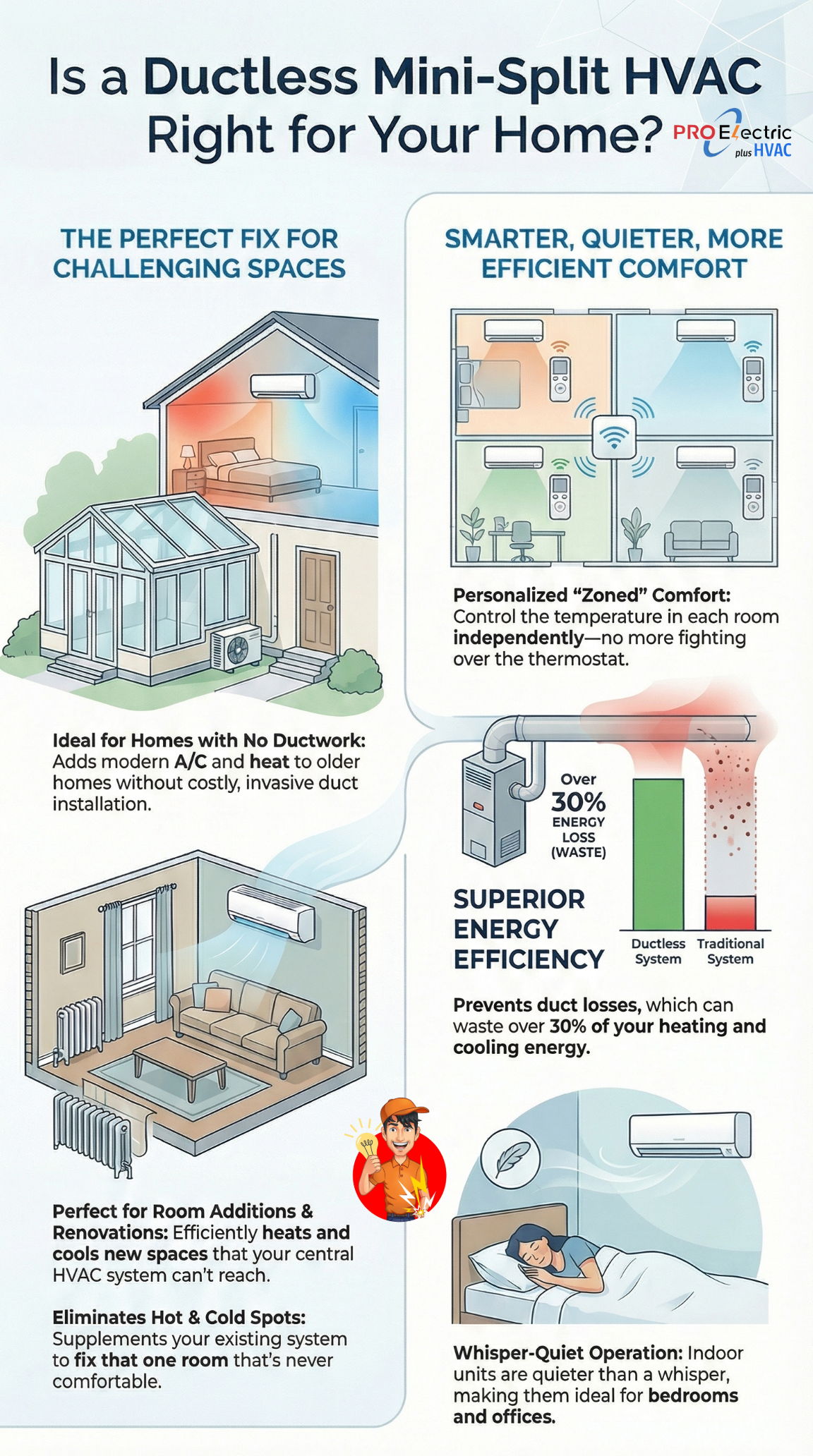
In this guide, I will answer key questions about why homeowners in our Northern Virginia communities might need a mini-split HVAC system (use our HVAC decision matrix tool). Each chapter addresses a common scenario or benefit – from homes without ducts, to new additions, to energy savings, and beyond backed by both my professional experience and authoritative sources. Let’s dive in.
If you are considering a Mini-split at home, this article is written for you.
Table of Contents
- Chapter 1: Why choose a mini-split if my home has no existing ductwork?
- Chapter 2: How do mini-splits benefit room additions or renovations?
- Chapter 3: How can a mini-split fix hot or cold spots without replacing my whole HVAC system?
- Chapter 4: What makes ductless mini-splits ideal for zoned comfort?
- Chapter 5: Do mini-splits really improve energy efficiency in a home?
- Chapter 6: Can a mini-split HVAC improve my indoor air quality?
- Chapter 7: Why is mini-split installation quicker and more flexible than traditional systems?
- Chapter 8: Are ductless mini-splits quieter than other cooling and heating options?
- Chapter 9: Will a mini-split provide both cooling in summer and heating in winter?
- Chapter 10: How are mini-splits environmentally friendly, and are there rebates or incentives?
- FAQs
- References
Chapter 1: Why choose a mini-split if my home has no existing ductwork?
For homes that were built without ductwork – for example, older houses with baseboard or radiator heating installing a conventional central AC or furnace system can be impractical, invasive, and expensive. I encounter this frequently in historic parts of Arlington and Fairfax, where retrofitting ducts would mean major construction. In such cases, a ductless mini-split is often the ideal solution.
Mini-splits require no duct infrastructure. Instead, the indoor and outdoor units connect via a small conduit through the wall (typically a 3-inch hole). This means you don’t have to tear open walls, floors, or ceilings to run large air ducts. According to Carrier’s HVAC experts, in older homes without existing ductwork, a mini-split system has a clear advantage because it delivers heating and cooling without installing ducts at all. Avoiding duct installation not only preserves the character of an older home but also significantly reduces installation time and complexity.
Many classic homes in our area rely on window AC units or portable heaters to add comfort, but these are often inefficient and unsightly. I’ve helped homeowners replace multiple window units with a single mini-split system – instantly improving comfort and appearance. The U.S. Department of Energy (DOE) notes that ductless heat pump systems are excellent for retrofitting houses with non-ducted heating systems (like radiators or electric baseboards). In other words, if your home has no ductwork, a mini-split can provide modern central heating and cooling capabilities without the massive undertaking of adding ducts.
In summary, for a home with no existing ducts, a mini-split offers a modern comfort upgrade with minimal disruption. You get efficient air conditioning and heating throughout the living space, while preserving the home’s structure and avoiding the cost of ductwork construction. This makes mini-splits especially popular in older Virginia homes and historic properties.
Chapter 2: How do mini-splits benefit room additions or renovations?
Room additions, finished basements, attic conversions, sunrooms, and other renovations create new living space, but they often aren’t easily served by your existing central HVAC system. I frequently see this in Northern Virginia: perhaps you’ve added an extension or finished an attic, and suddenly that area is too hot or cold because the central HVAC can’t adequately reach it. Extending the current ductwork into a new room can be difficult or even impossible (for example, running ducts to a sunroom or garage apartment may not meet code or space constraints). This is where a mini-split shines.

Common areas in a home that often need a dedicated mini-split system include:
• Finished basements that stay cold in winter and humid in summer
• Attic conversions or loft spaces with poor airflow from central HVAC
• Bonus rooms over garages that never match the rest of the house temperature
• Detached or attached garages converted into living or hobby spaces
• Home offices added during renovations that need quiet, independent climate control
• In-law suites or guest apartments that require separate temperature settings
• Sunrooms or four-season rooms with large windows and heat gain
• Workshops or maker spaces where tools and equipment generate extra heat
• Barns or outbuildings converted into studios, gyms, or living spaces
• Enclosed porches or mudrooms upgraded for year-round use
These spaces are often the hardest for a central HVAC system to handle. A mini-split lets you condition each area independently, without tearing into walls to run ductwork or overworking the main system.
Mini-splits are an ideal choice for individual additions or renovated spaces. They operate as independent, compact HVAC units for the new area. The DOE highlights explicitly that ductless systems are excellent for room additions where extending or installing ductwork is not feasible. Instead of upsizing your whole-house furnace or air conditioner to handle the extra square footage (which might still leave the addition uncomfortable), you can install a dedicated mini-split for that space. I’ve installed mini-splits in newly finished basements, bonus rooms over garages, and in-law suites across Fairfax and Loudoun, and my clients immediately notice the improvement, as the new space becomes fully usable year-round without straining the central HVAC.
Another benefit is that the mini-split in the addition can be controlled separately from the main house. For example, if you have a guest suite or a home office in an addition, you can keep it at a different temperature as needed without affecting the rest of the house. This targeted conditioning is far more efficient than forcing your central system to heat/cool an isolated area. Carrier’s guidelines state that ductless systems are well-suited for room additions or conversions, such as garages or attics, since they can add comfort without upsizing the existing system or running new ducts.
In short, if you’ve invested in expanding or remodeling part of your home, a mini-split allows you to extend comfort to that new space in an innovative, cost-effective way. It’s essentially tailoring the climate control to match your home’s updated layout.
Chapter 3: How can a mini-split fix hot or cold spots without replacing my whole HVAC system?
It’s common in many two-story and larger homes: certain rooms are always too hot in summer or too cold in winter, even though your central HVAC is running. Perhaps it’s an upstairs bedroom that never gets enough cooling, or a family room over a garage that stays chilly. These persistent hot or cold spots are a top complaint I hear from homeowners. Traditionally, people might crank up the whole-house thermostat to compensate (overheating or overcooling the rest of the home in an attempt to fix one room), which is inefficient and often ineffective.
A ductless mini-split offers a targeted cure for these problem areas. You don’t need to replace your entire HVAC system or add a second central unit; instead, you can supplement the existing system with a mini-split serving just the troublesome zone. The ENERGY STAR program notes that mini-split heat pumps are increasingly used to supplement your existing HVAC system for precisely these kinds of needs. Rather than redesigning your entire HVAC system, you install one or two small ductless units to deliver extra heating or cooling to the specific rooms that need it.
For example, I had a client in Prince William County with a home office that ran hot due to electronics and sun exposure. We put in a mini-split just for that room. Now, they can keep the office a comfortable 70°F in summer without freezing the rest of the house via the central AC. According to ENERGY STAR, ductless systems are ideal for homes with hot or cold spots, such as a single room that never feels as comfortable as the rest of the house. The mini-split evens out those temperature imbalances by giving that area its own source of heating/cooling.
The beauty of this approach is zoned correction: you boost comfort in the problematic zone without wasting energy on the rest of the house. In technical terms, the mini-split adds supplemental heating/cooling capacity exactly where needed. If your central HVAC struggles with one corner of the home, a mini-split can efficiently pick up the slack for that zone. This is often far more cost-effective than, say, installing a second full-size AC unit or running extensive new ductwork to the area (which might still not work well). From my experience, homeowners are relieved to learn they can address that one persistently uncomfortable room with a mini-split, instead of living with the discomfort or undertaking a major HVAC overhaul.
Chapter 4: What makes ductless mini-splits ideal for zoned comfort?
Households rarely agree on the “perfect” temperature everywhere – maybe the kids want their bedrooms cooler, while the elderly parent in an in-law suite needs more warmth. With a standard single-zone HVAC, one thermostat controls the entire home’s climate, so you’re stuck with one setting for everyone and every room. Ductless mini-splits inherently solve this by providing zoned comfort control.

Each indoor unit of a mini-split system has its own thermostat and can maintain a different temperature in its zone. For instance, you could set the living room unit to 72°F, the kitchen unit to 68°F, and a bedroom unit to 65°F at night, all independently. This level of individualized control is a primary reason many families opt for mini-splits. Carrier Corporation explains that because each room or zone with a ductless unit is controlled separately, a ductless mini split system is, by definition, a zoned system. You heat or cool each space based on its usage and occupants’ preferences, rather than a one-size-fits-all approach.
From a technical perspective, this zoning capability not only improves comfort but also saves energy. You no longer need to condition rooms that aren’t being used. For example, you can turn down or turn off the air conditioning in guest bedrooms or the basement when they’re unoccupied, while keeping the main living areas at your desired comfort level. In Northern Virginia, where large homes might have many rooms, zoned mini-split systems prevent energy waste by avoiding over-cooling or overheating unused spaces. Fire & Ice HVAC gives a relatable example: instead of cooling an entire three-bedroom house to 68°F just because one person likes their room colder, you could set that one bedroom’s mini-split to 68°F while keeping the rest of the house at 75°F. This targeted approach means everyone stays comfortable and no one is “fighting over the thermostat.”
Another advantage is how well zoning works for multi-story homes or homes with complex layouts. In many Fairfax County split-levels, for instance, the upstairs can be sweltering while the downstairs is comfortable. Mini-splits let you divide the home into zones (upstairs and downstairs, or even room-by-room) to balance temperature differences properly. Overall, the ability to customize each area’s climate is a game-changer – it delivers personalized comfort and can reduce household arguments about heating and cooling. It’s a level of control that isn’t possible with a single central thermostat.
Chapter 5: Do mini-splits really improve energy efficiency in a home?
Yes, ductless mini-split systems are known for their high energy efficiency, often outperforming traditional HVAC setups. I usually recommend mini-splits to homeowners looking to lower their utility bills or concerned about energy waste. There are a few key reasons why mini-splits can save energy:
- No duct losses: In a central air system, a significant portion of energy can be lost as the air travels through ductwork – especially if those ducts run through unconditioned spaces like attics or crawlspaces. Leaky or poorly insulated ducts allow heated or cooled air to escape before it reaches the rooms, wasting energy. The U.S. Department of Energy estimates that duct losses can account for over 30% of a typical home’s space-conditioning energy consumption. Mini-splits eliminate this issue by delivering air directly to the room, with no ducts for energy to leak out. All the cooled or heated air goes straight into your living space. This immediate delivery system is inherently more efficient.
- High-performance components: Mini-split heat pumps use advanced inverter-driven compressors and fans. Instead of the on/off cycling of older furnaces or ACs, mini-splits modulate their speed to maintain steady temperatures. This avoids the energy-intensive starts and stops. Many ductless units also have very high Seasonal Energy Efficiency Ratio (SEER) ratings. A good central AC might be SEER 14–16, whereas ductless systems often achieve SEER ratings well above 20. (Today, with SEER2 standards, top mini-splits boast even higher efficiency levels.) This means they produce the same cooling output for less electrical input.
- Targeted usage: As mentioned in the zoning chapter, with mini-splits, you only use energy to condition the rooms you need at the moment. You’re not wasting energy cooling empty areas of the house. If you have one small unit on in the evening for the bedroom and the others off, you’re using far less electricity than running a big central blower to cool the entire home. The result is often noticeable savings on monthly bills.
Data backs the efficiency gains. The DOE notes that by avoiding ducts, mini-splits sidestep the typical energy losses of central systems. Additionally, because of their design, many mini-splits can achieve efficiencies (SEER for cooling and HSPF for heating) that surpass those of conventional units. In my experience, homeowners who switch to mini-splits often report a drop in utility costs, especially if they were previously using older, less-efficient HVAC equipment or electric baseboard heaters.
It’s important to size and install them properly to realize these savings. An oversized unit could short-cycle and reduce efficiency. But when done correctly, a mini-split system can heat and cool your home using significantly less energy. In summary, you’ll get the comfort you want while consuming less electricity, which is good news for both your wallet and the environment (as we’ll discuss later).
Chapter 6: Can a mini-split HVAC improve my indoor air quality?
Indoor Air Quality (IAQ) is a big concern for many homeowners today. Dust, allergens, and mold in the HVAC system can circulate throughout the house and affect your family’s health.

Mini-split systems can indeed help improve IAQ in a couple of ways:
1. No ducts means less dust and allergens spread. In a traditional forced-air HVAC with ducts, those ducts can accumulate dust, pet dander, pollen, and even mold over time. Every time the system kicks on, it can blow some of those contaminants into various rooms. If the ductwork hasn’t been cleaned or has leaks, it might be contributing to indoor air pollution. Ductless mini-splits, as the name implies, have no ducts. This alone reduces the chances of exposing your indoor air to airborne contaminants that leaky ductwork could harbor. In fact, one local HVAC provider, CroppMetcalfe, points out that without ducts, mini-splits accumulate far less dust, pollen, and mold, and therefore won’t spread those through your home. Essentially, removing the duct network removes a primary reservoir and distribution path for allergens.
2. Built-in filtration: Each indoor unit of a mini-split typically has an easy-to-clean air filter (often washable) that captures dust and particulates from the air as it circulates. Many mini-split models come with advanced multi-stage filtration or optional air-purification add-ons. Because the air gets filtered right at the unit in the room, it continuously cleans the air for that space. Homeowners with allergies have told me they noticed reduced dust buildup and cleaner-smelling air after switching to ductless units. It’s still important to clean or replace mini-split filters regularly (usually monthly or as recommended) to maintain air quality and efficiency. But doing so is straightforward – you pop open the indoor unit cover and slide out the filter.
3. No combustion byproducts: Unlike gas furnaces, electric mini-split heat pumps do not produce combustion fumes. There’s no risk of introducing combustion gases like carbon monoxide or nitrogen oxides into your indoor air, because nothing is being burned inside. ENERGY STAR notes that using heat pumps (like mini-splits) means no direct emissions in the home, which improves indoor air quality by eliminating combustion pollutants. This is especially beneficial if you’re transitioning from an oil or gas-heating system.
In my professional view, while a mini-split isn’t a cure-all for every air quality issue (you may still need dedicated air purifiers for specific concerns), it definitely helps create a cleaner breathing environment. Many of my clients appreciate that they no longer have dusty duct grilles or musty odors when the heat comes on. And because each zone is separate, there’s no cross-contamination via ducts between, say, a kitchen and a bedroom. Overall, going ductless removes a significant source of dust and allergens in the HVAC system, and that’s a big win for your home’s air quality.
Chapter 7: Why is mini-split installation quicker and more flexible than traditional systems?
When it comes to installing a new HVAC system, homeowners dread a long, messy process – cutting into walls, days or weeks of contractors running ductwork, etc. One of the great advantages of mini-splits is how quick and minimally invasive the installation is, especially compared to a complete ducted system. From my experience, a single-zone mini-split (one outdoor unit and one indoor unit) can often be installed in a single day, and even a multi-zone system takes only a few days, with very little disruption to your home.
Here’s why installation is faster and more flexible:
- No bulky ductwork to run: As mentioned earlier, we only need to drill a small hole (about 3″) through the wall to connect the indoor and outdoor units. Carrier notes that installing a mini-split is typically easier because there is no ductwork to install. Just a small hole is needed to connect the piping between the outdoor and indoor units. By contrast, a central HVAC installation requires running large ducts throughout the house, which may involve opening ceilings, walls, or floors. That process can take a significant amount of time and may require additional repairs (drywall, paint, etc.) afterwards. With a ductless install, we avoid all that. We mount the indoor air handler on a wall (or ceiling), run the slim refrigerant lines through the wall to the outside unit, and that’s essentially it.
- Flexible placement of units: Mini-split indoor units come in various styles – high wall-mounted, ceiling cassettes, floor consoles – giving a lot of flexibility for different room configurations. You can install them where it makes the most sense aesthetically and functionally (above a doorway, near the ceiling, low on a knee-wall, etc.). The outdoor unit can also be situated up to 50 feet away from the indoor unit, allowing us to hide it in a convenient spot outside. This flexibility means we can adapt the installation to almost any room or structure. In tight spaces or custom home layouts in Northern Virginia (like loft conversions or historic home retrofits), there’s almost always a way to incorporate a ductless unit. As one contractor site describes, mini-splits can fit even in tight spaces where traditional HVAC systems cannot.
- Minimal home disruption: Installing a ductless system generally means less noise, dust, and disruption for you during installation. We don’t have to demo large areas of your home. Arlington Heating & AC (a local company) emphasizes that their professionals can install a mini-split with minimal disruption to your home or office. From my own jobs, I know that homeowners are often pleasantly surprised – we arrive in the morning, and by evening they have a working new HVAC zone, with only a small opening in the wall to patch around the line-set (often covered by a neat line-hide channel). There’s no extensive remodeling required.
Overall, the process is faster, cleaner, and more adaptable to your home’s needs. This is a huge plus if you want to add AC to an older home that never had it – you avoid turning your house into a construction zone. It’s also convenient for adding climate control to a specific room without affecting the rest of the house. In Northern Virginia, I’ve installed mini-splits in everything from brick townhouses (running the lines discreetly along mortar lines) to modern condos, and that versatility and speed of install make the decision much easier for homeowners.
Chapter 8: Are ductless mini-splits quieter than other cooling and heating options?
Noise is an often-overlooked factor in HVAC satisfaction. Traditional HVAC systems can be noisy – think of the loud whoosh from air rushing through vents or the rattle of a window AC unit. Mini-split systems are generally very quiet in operation, both inside and outside, which makes them ideal for bedrooms, home offices, and living areas where you want peace.
Indoor noise: The indoor air handlers of mini-splits are designed to operate at low sound levels. They use variable-speed fans that often run at a gentle, slow speed once the set temperature is reached, making very little sound. There are no big blower fans or echoes in the ductwork. Carrier points out that eliminating ductwork also eliminates a source of noise – airflow noise and vibrations in ducts. In addition, modern ductless units, when running in low fan mode, can be as quiet as about 24 decibels (dB). To put that in perspective, 24 dB is quieter than a whisper or the sound of rustling leaves. In practical terms, many of my clients barely notice when their mini-split is on; you might hear a faint hum or the gentle sound of a breeze, but it’s far less intrusive than the constant cycling roar of some central AC fans or the drone of a window unit. This is especially appreciated in bedrooms at night – the mini-split won’t kick on with a start and wake you up.
Outdoor noise: The outdoor component of a mini-split (the condenser) is also usually quieter than a typical central AC compressor. They are often smaller and equipped with sound-dampening technology and variable-speed compressors that don’t always run at full tilt. You and your neighbors will likely find a ductless unit less noticeable when it’s running outside. This matters in dense neighborhoods or townhomes in Arlington, where an old outdoor AC could be heard across the yard – the mini-split is a polite neighbor by comparison.
Compared to alternatives: If you’re currently using window air conditioners or portable ACs in summer, a mini-split will be a night-and-day difference in noise. Window units typically generate a lot of mechanical noise and vibration. By switching to a mini-split, the compressor is moved outside, and the indoor unit is super quiet. Similarly, older furnaces or boilers can make clunking or blower noises; mini-splits have none of that. CroppMetcalfe calls ductless systems “nearly silent” and an excellent choice for non-disruptive air conditioning in homes.
In summary, mini-splits operate with a whisper-like quietness. I often highlight this benefit for clients creating a home office or nursery – you can maintain a comfortable temperature without the noise distractions. It’s one more reason these systems tend to fade into the background of your home life; they do their job without drawing attention, allowing you to sleep, work, and relax in a calm environment.
Chapter 9: Will a mini-split provide both cooling in summer and heating in winter?
Absolutely. Most mini-split systems are heat pumps, meaning they work as air conditioners in the summer and as heaters in the winter. This dual functionality is a key benefit: you get year-round climate control with a single integrated system.

For the climate in Northern Virginia, where we experience both hot summers and cold (but not arctic) winters, a heat pump mini-split can typically provide comfort year-round.
In cooling mode, a mini-split removes heat from inside your home and dumps it outside (just like any air conditioner). In heating mode, it does the opposite: it extracts heat from the outside air (even when it’s cold out) and brings it inside. This reversible refrigeration cycle is what makes heat pumps so versatile. According to the Department of Energy, a mini-split heat pump can efficiently cool your home in the summer and heat it in the winter, all with one system. In other words, you don’t need separate furnace and AC units – the mini-split handles both duties.
In my experience, many homeowners in our area use mini-split heat pumps as a primary source of heating and cooling. Today’s models are designed to work in cold temperatures much better than older heat pumps did. Many can provide heat even when outdoor temps drop into the teens or single digits Fahrenheit (though with somewhat reduced efficiency at the extremes). For the majority of our winter days, which might be in the 30s or 40s °F, a modern mini-split has no problem keeping a room warm and comfortable. Some units are “cold-climate” models with special compressors and refrigerants that allow effective heating well below freezing – if you’re in western Loudoun with colder nights, for example, we would select an appropriate model. The U.S. Energy Star program notes that new cold-climate certified mini-splits excel at providing heat even in the coldest climates, thanks to advanced technology. So, heating-wise, they are up to the task in Virginia’s winter.
The convenience of this year-round capability cannot be overstated. It means one installation and one system to maintain. In fall and spring, the same unit can gently take the chill off a cool morning or cool down an unusually warm afternoon. Many mini-splits also have a dehumidification mode, which is excellent in our humid summers – they’ll remove excess moisture from the air for added comfort. You can retire those space heaters and maybe even that old furnace or boiler. I’ve had customers in Arlington bungalows completely switch to ductless heat pump units and report that they stay cozy through winter (and enjoy the central air in summer which they never had before).
To sum up, a mini-split is a versatile, all-in-one solution for home comfort. It cools you down in July, warms you up in January, and does both efficiently. As long as it’s appropriately sized for your space and the model is suited for the climate range, you can rely on a mini-split system for reliable year-round comfort.
Chapter 10: How are mini-splits environmentally friendly, and are there rebates or incentives?
Homeowners are increasingly conscious of the environmental impact of their heating and cooling choices, and many also wonder about incentives for installing high-efficiency systems. Ductless mini-splits score well on both counts: they are often more environmentally friendly than older HVAC systems, and they can qualify for various energy rebates or tax credits.
Environmental benefits: As discussed, mini-splits use less energy to produce the same cooling/heating output as many traditional systems. Using less electricity means lower demand on power plants and reduced greenhouse gas emissions. ENERGY STAR-certified mini-split heat pumps, for example, use up to 60% less energy than standard electric resistance heating (like baseboard heaters). Over the lifespan of the unit, this can add up to a substantial reduction in carbon footprint. In fact, the ENERGY STAR program estimates that using a mini-split in a typical home can avoid over 4,500 pounds of greenhouse gas emissions compared to a standard system over its lifetime. That’s equivalent to the emissions from a car driving for several months. So, by choosing a high-efficiency ductless system, you’re not only saving on bills but also doing your part to cut emissions.
Moreover, since mini-splits are electric and don’t burn fossil fuel on-site, they help improve local air quality and safety (no combustion = no carbon monoxide risk, as mentioned earlier). As our electricity grid gets cleaner with more renewable energy, electric heat pumps effectively become greener over time, whereas a gas furnace will always emit carbon from burning fuel. Many homeowners in Northern Virginia opt for mini-splits as a step toward a more eco-friendly home, aligning with goals to reduce energy waste.
Rebates and incentives: Governments and utilities have taken notice of heat pumps’ efficiency and often encourage their adoption. There are typically rebates, tax credits, or financing incentives available for installing energy-efficient mini-split systems. For example, the U.S. federal government (under the Inflation Reduction Act) currently offers a tax credit of up to $2,000 for qualifying heat pump installations, which includes many ductless mini-splits that meet high efficiency criteria. Here in Virginia, some electric utilities or state programs also provide rebates for heat pump systems or for switching from fuel heating to electric heat pumps.
When I consult with clients, I always recommend checking for local incentives. Many are surprised to learn they can get, say, a $300 or $500 rebate from a utility for a ductless install, or a low-interest loan for energy-efficient HVAC. The U.S. DOE notes that available rebates and financial incentives can help offset the initial cost of a mini-split system. This is important because while the upfront cost of a mini-split can be higher than that of a basic window AC or a simple furnace replacement, the combination of incentives and long-term energy savings often makes it a financially smart choice over the system’s life.
Mitsubishi Electric, a major mini-split manufacturer, has even pointed out that qualified homeowners could access significant rebates (potentially thousands of dollars) when they upgrade to heat pump systems, especially under new clean energy incentive programs. The exact amounts and eligibility will vary, but the message is: there’s money on the table for going ductless. It’s worth exploring these programs when planning your installation.
In summary, ductless mini-splits align with both green living and cost savings goals. They reduce energy consumption and emissions, helping the environment, and you may get external financial support to install them. I find that doing right by the planet also ends up doing right by the homeowner’s wallet in this case truly a win-win situation.
Closing Summary
Ductless mini-split HVAC systems offer tailored solutions to many of the heating and cooling challenges we face in homes in Fairfax, Loudoun, Prince William, and Arlington County.

In this guide, I answered key questions and outlined 12 common reasons homeowners in our Northern Virginia region might need a mini-split:
- No Existing Ductwork: For older or historic homes without ductwork, mini-splits provide modern comfort with minimal installation, avoiding the high cost and hassle of adding ductwork.
- Room Additions/Renovations: If you’ve expanded your home or have a space not served by your central HVAC, a mini-split can independently heat/cool that area efficiently.
- Hot/Cold Spots & Supplementing: Mini-splits can eliminate persistent comfort problem areas by supplementing your current system, targeting only the zones that need extra help.
- Zoned Comfort: With individual room controls, ductless systems let you personalize temperatures in different rooms, keeping everyone happy and saving energy in the process.
- Energy Efficiency: Mini-splits often operate at higher efficiencies than traditional systems and avoid energy losses from ductwork, leading to lower utility bills and less wasted energy.
- Better Indoor Air Quality: No ducts means less dust and mold circulation, and built-in filtration improves the air you breathe. A ductless system can reduce allergens and provide cleaner indoor air.
- Flexible, Quick Installation: Mini-split installations are relatively fast and non-intrusive – requiring only small wall openings and offering versatile placement options – making them great for retrofits and unique spaces.
- Quiet Operation: These systems run whisper-quiet compared to central HVAC or window units, enhancing comfort in noise-sensitive areas like bedrooms and studies.
- Year-Round Comfort: As heat pumps, mini-splits deliver both cooling and heating through a single system, which is ideal for our climate, which sees both hot summers and chilly winters.
- Environmentally Friendly & Incentives: By using less energy (often up to 30-60% less) and eliminating on-site fuel combustion, mini-splits reduce your home’s carbon footprint. Plus, you can often take advantage of rebates or tax credits that make installing a mini-split more affordable.
In my role at PRO Electric plus HVAC, I’ve witnessed how each of these benefits plays out in real homes – transforming comfort levels, solving long-standing issues, and delivering efficient performance. The decision to go with a ductless mini-split is usually driven by one primary need (like a hot upstairs or an addition that’s too cold), but homeowners quickly appreciate the secondary benefits, like quiet operation and lower energy bills.
If you see your situation reflected in any of the reasons above, a mini-split could very well be the solution that fits your home’s needs. As always, it’s wise to consult a qualified HVAC professional to properly size and install the system for maximum benefit. From my perspective, as someone who lives and works in this community, I can say that mini-splits have been a game-changer for many Northern Virginia homeowners seeking targeted, effective comfort upgrades. They bring modern heating and cooling anywhere it’s needed – efficiently, quietly, and cleanly.
Contact us now for a free estimate or to book your service appointment.
📞 Call 703.225.8222 today to speak with our HVAC experts!
Schedule your Northern Virginia Mini-split installation consultation today.
Mini-Split FAQs
What is a ductless mini-split HVAC system?
A ductless mini-split is a heating and cooling system with an outdoor compressor and one or more indoor units that deliver conditioned air without the need for traditional ductwork.
How does a ductless mini-split system work?
It transfers heat using refrigerant between indoor and outdoor units to cool or heat your home, allowing zone-by-zone temperature control without ducts.
Why are mini-split systems more energy efficient than traditional HVAC?
Because they eliminate duct losses and use inverter technology that adjusts output to actual demand, mini-splits can use significantly less energy.
Can mini-split systems heat and cool my home year-round?
Yes, most ductless mini-splits act as heat pumps, providing efficient cooling in summer and heating in winter.
Are mini-split systems good for homes without existing ductwork?
Absolutely; they are ideal for older homes or spaces where adding ductwork would be costly or impractical.
Do ductless mini-splits provide zoning for different rooms?
Yes, each indoor unit can be controlled independently, letting you set different temperatures in different areas of your home.
Is installing a ductless mini-split system easier than adding ductwork?
Yes, installation typically requires only a small hole for the line set and takes less time and disruption than installing ducts.
Can a ductless mini-split improve indoor air quality?
Ductless systems have individual filters for each indoor unit and don’t circulate air through ducts, which can reduce dust and allergens in your home.
What factors affect the cost of a ductless mini-split system?
Costs vary based on system size, number of indoor units, and installation complexity, with complete systems typically costing several thousand dollars.
Are mini-split HVAC systems quieter than traditional HVAC units?
Yes, ductless mini-splits are designed for quiet operation, making them suitable for bedrooms, offices, and living areas.
References
- Carrier (n.d.). Advantages and Disadvantages of Mini Split Systems. Carrier Corporation.
- U.S. Department of Energy. (n.d.). Ductless Minisplit Heat Pumps. Energy Saver – Department of Energy.
- U.S. Department of Energy. (n.d.). Ductless Mini-Split Air Conditioners. Energy Saver – Department of Energy.
- ENERGY STAR. (n.d.). Ductless Heating & Cooling. U.S. Environmental Protection Agency.
- CroppMetcalfe. (n.d.). Duct Free Splits. CroppMetcalfe HVAC.
- HomElectrical Electrical Supply, Inc. – All About Ductless Mini-Split Systems FAQs
- Progressive Air Systems – FAQs on Mini-Split Systems
- Fire & Ice – Mini-Split vs. Central Air Pros & Cons
- NE Mini Split Installers – FAQs
- A-1 Mechanical – Common Questions About Ductless Mini-Split Systems
- Endless Energy – Understanding the Benefits of Ductless Mini-Split Systems
- Arlington Heating & Air Conditioning – How Much Does It Cost to Install a Ductless Mini-Split?