
BOTTOM LINE UP FRONT (BLUF)
Northern Virginia homes aren’t just at risk from simple power outages. Severe thunderstorms with lightning, heavy winter snow and ice, and the sudden voltage surges that happen before, during, and after these events pose serious threats to your electrical system, appliances, and sensitive electronics. These surges can instantly damage equipment or silently shorten its lifespan over time, costing you money and stress. Understanding these electrical risks and how to protect your home is critical if you live in Fairfax, Loudoun, Arlington, or Prince William Counties.
If you are searching for answers to questions like these, this article is written for you.
How do lightning storms and heavy snow threaten my home’s electrical system?
Can power surges from storms damage my HVAC and electronics?
What’s the difference between a blackout and a harmful voltage surge?
Do I need whole-home surge protection to prevent storm damage?
How can I protect sensitive appliances from repeated electrical surges?
By Peter, Master Electrician | PRO Electric plus HVAC | Surge Protection
Why Northern Virginia Homes Face Rising Power Threats
Northern Virginia’s residential power infrastructure faces challenges from a variety of natural and electrical disturbances. In particular, Fairfax County, Loudoun County, Prince William County, and Arlington County in Virginia experience frequent thunderstorms (often with lightning), occasional intense winter storms, and other power disturbances (surges and sudden outages) that negatively affect home electricity reliability. This report examines short-term impacts (immediate outages and damage) and long-term patterns (trends over years and infrastructure resilience) in these counties, and provides data on the frequency and severity of outages by event type.
It also explores how local utilities (Dominion Energy and NOVEC) have been impacted by and responded to severe weather, including typical recovery times and mitigation efforts. In the second part, we discuss the benefits of installing whole-house surge protectors on residential electrical panels – how these devices mitigate lightning and surge damage, their effectiveness in reducing appliance damage and costs, expert recommendations, and a cost-benefit analysis of installing such protection.
Key Findings on Storm Impacts, Power Surges, and Home Electrical Protection in Northern Virginia
- Northern Virginia experiences frequent severe thunderstorms with lightning, causing widespread outages and dangerous voltage spikes affecting Fairfax, Loudoun, Prince William, and Arlington homes.
- Winter storms with heavy wet snow and ice snap tree limbs and power lines, leading to long outages and damaging surges when power is restored.
- Restoration surges during grid re-energizing can severely damage HVAC systems, refrigerators, computers, and sensitive electronics even if the outage was brief.
- Rural and wooded areas in Loudoun and Prince William are more vulnerable because long overhead lines and dense tree cover increase storm-related failures.
- Dominion Energy and NOVEC have improved reliability with grid upgrades, tree trimming, and targeted undergrounding, but surges still reach homes during storms.
- Most surge damage comes from nearby lightning strikes and utility switching operations, not direct strikes on the home.
- Repeated small surges during the year silently weaken appliances and shorten the lifespan of electronics across all four counties.
- Whole house surge protectors at the electrical panel provide the strongest defense by diverting dangerous spikes before they enter home circuits.
- Case studies show surge protectors costing a few hundred dollars can prevent thousands of dollars in damage to appliances and electrical systems.
- Layered protection combining whole house surge protection with point-of-use devices offers optimal safety for computers, smart home equipment, and home office electronics.
Weather-Related Power Outages in Fairfax, Loudoun, Prince William, and Arlington
Severe weather is the primary cause of large-scale power outages in Northern Virginia. Thunderstorms (often accompanied by lightning and high winds) and winter storms (snow/ice and wind) have historically caused the most significant disruptions to residential electricity in Fairfax, Loudoun, Prince William, and Arlington counties. In addition, sudden outages can occur from equipment failures or accidents, often inducing power surges when electricity is restored. Below we detail the impacts of each type of event on these counties, with recent examples and historical context.
Dominion Energy’s Power Outage Map
Thunderstorms and Lightning Strikes
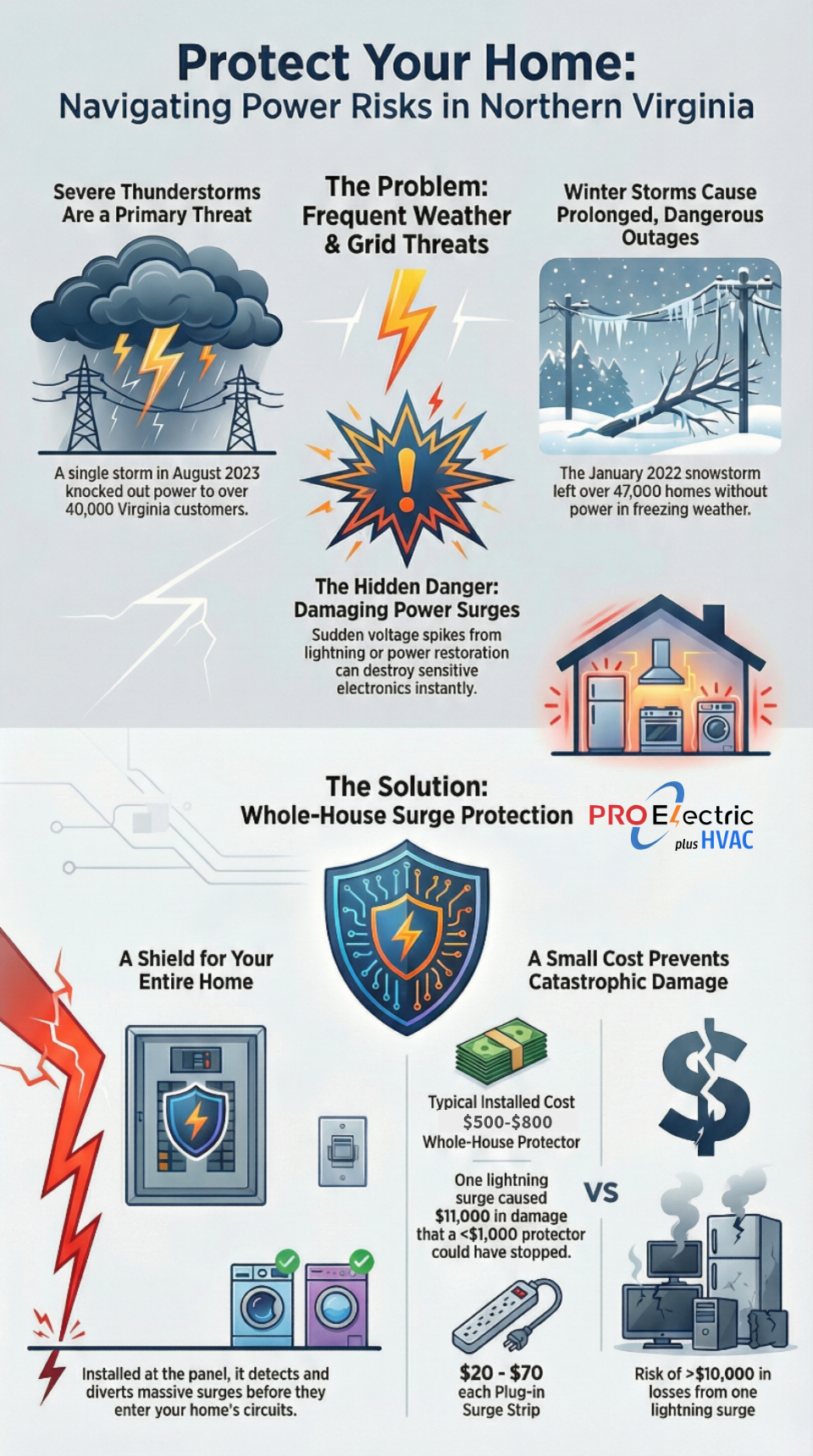
Thunderstorms – especially those bringing strong winds, lightning, and heavy rain – are a frequent threat in summer months. Short-term impacts include downed trees and power lines, lightning damage to equipment, and widespread outages. For example, a severe storm on August 7, 2023 brought winds up to ~80 mph and triggered tornado warnings, knocking out power to more than 40,000 customers across Virginia. Fairfax County saw the most outages (about 13,829 customers without power), with Loudoun County around 2,744 out and Prince William County about 3,485 out during that event. Arlington County was also affected, though on a smaller scale (estimated in the low thousands). Such summer squall-line storms can cause dozens of outage incidents as trees fall onto overhead lines and lightning strikes equipment.
Lightning strikes themselves can directly damage the electrical grid and homes. A direct lightning strike to a power line or transformer can send a massive voltage spike through the system, instantly knocking out service and potentially frying household electronics. Lightning-caused surges are less common than wind damage but still feared for their intensity. In June 2022, a line of severe thunderstorms with intense lightning caused outages affecting over 25,000 customers in Northern Virginia. Loudoun County saw about 1,600 outages in that storm, and in one dramatic example a lightning bolt struck a house in Aldie (Loudoun), igniting an attic fire and causing $336,000 in damage. This illustrates the destructive potential of lightning – not only can it cut power, but it can irreparably damage a home’s electrical system and appliances in an instant.
Lightning-induced power surges are a significant concern for homeowners during these storms. A lightning strike on or near a line can send tens of thousands of volts through the grid. While direct strikes on the home are rare, nearby strikes cause sudden voltage spikes that travel into houses. Sensitive electronics can be destroyed in microseconds if not protected. One electrical consultant notes that even minor fluctuations can cumulatively harm devices – “You might not even notice it… Then a year later your microwave stops working.” Thus, the negative effects of thunderstorms and lightning are twofold: immediate outages due to physical damage and power-quality disturbances (surges) that shorten the lifespan of electrical appliances.
Frequency and severity: On average, the Northern Virginia region experiences numerous thunderstorm events each year, but only a handful become severe enough to cause major outages. Summer thunderstorms routinely cause scattered outages of a few hundred customers in these counties, which utilities restore within hours. More severe storm fronts (often associated with squall lines or remnants of tropical systems) can occur a few times per year and tend to cause larger outages (thousands to tens of thousands of customers). For instance, another potent storm on August 14, 2023 (just a week after the above event) caused flash flooding and additional outages – at one point 8,900+ customers lost power in Fairfax County during that storm. These counties also occasionally experience small tornadoes or microbursts embedded in thunderstorms, which can take down localized sections of the grid. In general, Fairfax County (as the largest and most populated) often sees the highest number of outages in regional storms, while Loudoun and Prince William, with more suburban/rural mix and some newer infrastructure, tend to have fewer outages unless the storm’s worst hits those areas. Arlington County, being geographically smaller and with significant portions of its grid underground in urban areas, usually sees fewer outages (on the order of hundreds) in routine storms, but it is not immune to larger events. Notably, a strong storm on June 19, 2025 managed to knock out power to 10,859 customers in Arlington (and ~946 in nearby Falls Church) at its peak – an unusually high impact for that county, demonstrating that even urban systems can suffer large outages if a storm hits directly.
Table 1 below highlights a few major thunderstorm-related outage events in the past five years and the number of customers affected in each of the four counties:
Table 1: Selected Major Weather-Related Outages (Thunderstorms/Wind) in Northern Virginia (2018–2025)
| Date and Event | Fairfax County Outages | Loudoun County Outages | Prince William County Outages | Arlington County Outages |
| March 2, 2018 – “Windmageddon” high wind storm (historic) | ~110,000 (Dominion) | ~? (some areas less impacted) | ~? (significant, but less than Fairfax) | ~? (data not shown) |
| January 3, 2022 – Snowstorm with high winds | 26,313 | 1 (minimal) | 20,805 | 1,269 |
| June 22, 2022 – Severe thunderstorms & lightning | 168 | ~1,600 | <100 (minor) | ~300 (est.) |
| Aug 7, 2023 – Severe thunderstorms (60–80 mph winds) | ~13,829 | ~2,744 | ~3,485 | “2,000–200” (est. ~1,000) |
| June 19, 2025 – Derecho-like storm (high winds) | ~5,000 (Dominion)** | ~? (localized) | ~? | 10,859 |
* 2018 data shown for historical context; 2018 is outside the 5-year focus but represents an extreme wind event. 2025 data is included as a recent event.
** Dominion reported roughly 5,000 out in Fairfax during part of the June 19, 2025 event; the storm’s worst impacts were concentrated in Arlington/Falls Church.
As Table 1 indicates, thunderstorms and windstorms can cause anywhere from a few hundred to tens of thousands of outages, depending on storm severity and track. Fairfax often bears the brunt due to its size, though specific storms (like June 2025) can hit smaller jurisdictions hard. Recovery times for thunderstorm outages are typically on the order of hours to a day or two for most customers. Utilities prioritize restoring critical loads and large feeder lines first, then local tap lines. In the June 2022 storms, Dominion Energy crews had 90% of customers back within about 24–36 hours, but fully resolving all outages (especially in hardest-hit pockets like parts of Fauquier adjacent to these counties) took “several days” due to “catastrophic” damage in some areas (multiple broken poles and crossarms). Likewise, in the August 2023 event, most outages were cleared by the next day, reflecting improved storm response.
In the long term, climate data suggests the Mid-Atlantic is experiencing more frequent heavy rain events and the occasional high-wind derecho or tornado outbreak, though it’s difficult to say if severe thunderstorm frequency is significantly rising. Historical trends do show that the region has always been prone to summer storms – for instance, the June 2012 derecho was a landmark event that knocked out power to about 1 million Virginians, including 63% of Dominion’s Northern Virginia customers, with some outages lasting nearly a week. That disaster prompted major upgrades (discussed under Infrastructure & Resilience below). Overall, thunderstorms remain a consistent annual threat. Homeowners have adapted by using standby generators or battery backups more frequently, and utilities have stepped up preventive tree trimming around lines to mitigate storm fallout.
Winter Storms and Power Outages
Winter storms – including heavy snowfall, ice storms, and blizzards – pose a periodic but serious threat to the electric grid in Northern Virginia. Wet snow or ice accumulation can weigh down tree limbs and power lines, and combined with strong winds, can lead to extensive line breaks and prolonged outages in frigid conditions. While less frequent than summer thunderstorms, winter storms often cause more widespread and longer-lasting outages when they strike, due to the difficulty of repairs (crews contend with snow-blocked roads and dangerous conditions) and the broader impact on infrastructure.
A prime example is the January 3, 2022 snowstorm, which brought 6–12 inches of heavy, wet snow and gusty winds to the region. This storm caused hundreds of thousands of outages across Virginia. By 2 PM on Jan 3, nearly 450,000 Virginia customers were without power statewide. Northern Virginia was hit hard: at 8:45 PM that day, Fairfax County had over 26,300 customers still without power and Prince William County had about 20,800 out. Arlington had ~1,269 out and Fairfax City ~2,142 out at that time. (Loudoun County was largely spared in this particular storm’s track, with virtually no outages by evening.) The heavy snow brought down numerous trees and “knocked down utility poles and power lines across the region”. Some of the worst damage occurred just south of these counties (Stafford County had over 43,000 out, reflecting the storm’s swath). For many residents, power remained out for 1–3 days as Dominion Energy and co-op crews worked through thousands of repair jobs. Dominion reported working on 2,159 separate repair projects in Northern Virginia on the evening of Jan 3 to restore over 182,000 customers still in the dark.
The short-term impact of such winter storms is severe: households are left without heating (a dangerous situation in freezing weather), and the residential electric infrastructure suffers physical damage (e.g. broken distribution poles, downed live wires entangled in fallen trees). Recovery times can be longer than summer outages – utilities strive to restore critical facilities within hours, but full restoration after a major snow/ice storm can take several days or more. In rural or semi-rural neighborhoods of Loudoun and Prince William, where distribution lines may run through forests, repairs are slowed by debris and inaccessible roads. For example, after a December 2020 ice storm, some outlying communities in Loudoun experienced multi-day outages as crews had to replace snapped poles in remote areas (though more central areas were restored faster).
Historically, one of the worst winter events was the January 1998 ice storm (outside our 5-year focus), which caused massive outages in the Mid-Atlantic. More recently, March 2018 brought a hybrid wind/snow event (the “windmageddon” event) which, though mostly a wind storm, also featured cold weather and left 110,000 Fairfax County customers without power at its peak. That event took a few days to fully resolve, with schools closed and warming centers opened. Trends: Significant snowstorms do not hit every year, but the region sees a notable winter storm roughly every 2–3 years on average that can cause thousands of outages. Climate change has introduced some volatility – for instance, warmer winters can lead to heavier wet snows (which are actually more damaging to power lines than light, powdery snow). However, warmer conditions can also mean fewer total snow events. It’s worth noting that in the past 5 years, 2020 and 2021 had relatively mild winters with fewer power disruptions, whereas early 2022 saw an extreme event. Residents and emergency managers remain vigilant each winter, as even one major storm can have long-term impacts (some Jan 2022 outages lasted 3-5 days, leading to extensive food spoilage and property damage from frozen pipes in unheated homes).
In terms of vulnerabilities, all four counties have a mix of underground and overhead distribution, but overhead lines are still prevalent in many neighborhoods, making them susceptible to snow/ice. One long-term pattern is that utilities are identifying the worst-performing circuits in winter and targeting them for improvements. For instance, Dominion has been burying some of its most outage-prone overhead tap lines (often the ones that fail in storms) as part of its strategic resiliency programs (more on this below). This should gradually reduce the scope of future winter storm outages in these counties by removing the lines most likely to come down in heavy snow.
Sudden Power Outages and Surges (Non-Weather Causes)
Not all outages are caused by major storms. Sudden power outages can occur on clear days due to equipment failures, accidents, or other grid disturbances – and these often come with little warning. In Northern Virginia, examples include: a vehicle crash knocking out a power pole (cutting power to a neighborhood), a tree limb falling on a line on a windy (but non-stormy) day, animals (squirrels, birds) shorting out transformers, or grid equipment malfunctions (such as a transformer or circuit breaker failure at a substation). While these incidents are usually localized (affecting tens to hundreds of customers), they can still negatively affect residential life, especially if they trigger power surges or extended outages.
“Power surges” refer to sudden spikes in voltage on the electrical lines. Surges often accompany outages in two scenarios: just before an outage, when a fault causes a voltage spike, or during restoration, when the grid is re-energized and inrush current temporarily overshoots. Home appliances and electronics are vulnerable to these surges. As Fairfax County’s emergency guide notes, when power is returning after an outage, “spikes and surges could occur as power is restored, damaging equipment,” which is why they advise residents to unplug electrical devices during an outage and wait until power stabilizes. In addition, brownouts (partial voltage drops) can occur during heat waves when demand is high, causing lights to dim and stressing motors. These too can shorten appliance lifespan.
Though data on “sudden” outages is harder to compile (since they’re often isolated incidents), the frequency is not negligible. NOVEC, the electric cooperative serving parts of these counties, boasts a 99.99% reliability rate (meaning the average customer sees <1 hour of total outage time per year excluding major storms). This high reliability is achieved by aggressive maintenance – including lightning arrestors, animal guards on transformers, and routine equipment inspections – to minimize unexpected failures. Dominion Energy’s reliability in the region is also strong, but being a larger system, it occasionally experiences bigger glitches. For instance, in April 2021 a software issue in a distribution management system (unrelated to weather) caused a brief outage for a few thousand customers until operators corrected it (illustrating that even cyber/technical issues can cause outages).
From a long-term perspective, Northern Virginia’s growing power demand (e.g. due to an influx of data centers in Loudoun and Prince William) means the grid is operating closer to capacity at times. A U.S. Department of Energy report even projected that by 2030, Northern Virginia could face 400+ hours of outages annually if infrastructure isn’t upgraded, partly due to the strain from rapid growth in electricity use. Local utilities are responding by upgrading transformers and adding redundancy to handle sudden load changes, so that a single equipment failure is less likely to cascade into a wider blackout.
In summary, while weather is the dominant factor in large outages, residents also experience sporadic “blue-sky” outages from accidents and internal grid issues. These typically are resolved faster (often within a few hours) but can still cause damage via surges. All four counties have emergency plans acknowledging that outages “may occur on their own” and can be triggered by factors like extreme heat causing system overload or even cyber-attacks on grid control systems. The negative effects include inconvenience, potential appliance damage, and costs for repairs or spoiled food – even when the lights only flicker or go out briefly.
Infrastructure Resilience and Long-Term Trends
Over the long term, Northern Virginia’s power providers have taken significant steps to reduce the impact of these hazards on customers. One key vulnerability for the region has been its overhead distribution network amid dense tree cover. Downed trees were a major cause of the prolonged outages in the 2012 derecho and other storms. In response, Dominion Energy launched a Strategic Underground Program (SUP) in 2014 – one of the nation’s largest utility undergrounding initiatives. Dominion studied its outage data and found that about 20% of its worst-performing tap lines caused two-thirds of all outages. These tap lines are the smaller neighborhood lines often running through backyards and wooded areas. Dominion set out to systematically bury those most outage-prone lines. As of recently, Dominion has already undergrounded nearly 2,000 miles of vulnerable overhead lines in Virginia, with a goal of reaching 4,000 miles in the coming years. This includes many projects in Fairfax and Prince William counties (as these areas have numerous older neighborhoods with overhead wires). By focusing on these segments, the utility expects that future storms will knock out far fewer customers, and areas not yet undergrounded will be restored faster because crews won’t be repeatedly fixing the same troublesome lines.
NOVEC, for its part, has an advantage in that many of its service areas (especially newer suburban developments in Loudoun and Prince William that it serves) were built with underground utilities from the start. This is one reason NOVEC reports the highest reliability in the region at 99.99% (excluding major storm events). Less overhead exposure means fewer outages from wind or ice. However, NOVEC still suffers damage in extreme events (they maintain extensive tree trimming and have automated switching to isolate faults). After the January 2022 storm, NOVEC’s worst outages were in western Prince William County where heavy snow brought trees onto some of its lines, but they restored power relatively quickly compared to some neighboring Dominion areas. Both Dominion and NOVEC also utilize smart grid technology, such as automatic reclosers and sensors, to reroute power around damaged sections and reduce the number of customers impacted by any single line break.
Another trend is improved emergency response coordination. The counties now have better communication with utilities during storms, and Dominion has enhanced its outage mapping and customer alert systems. When a big event is forecast (e.g. a tropical storm or major windstorm), utilities pre-stage extra crews and coordinate with local governments. For example, before the high-wind event in August 2023, Arlington County preemptively closed some facilities early and Dominion had crews on standby. This meant faster restoration once the storm passed. Consequently, while weather events will continue to cause outages, the duration and scope of outages have been trending downward for comparable events, thanks to these resilience measures.
Nonetheless, the negative long-term impacts of repeated weather events cannot be ignored. Frequent outages (even if shorter) can lead to wear-and-tear on appliances (from frequent power cycling and minor surges) and resident frustration or economic losses. There is also the human impact – for instance, vulnerable populations in these counties (the elderly, those with medical devices) are at risk during extended outages in heat or cold. Thus, the push for resilience is not just about hardening wires but also about community preparedness (e.g., more residents installing home generators, counties opening shelter centers during major outages, etc.).
In conclusion for this section, Northern Virginia’s four key counties face a mix of short-term challenges from lightning, power surges, thunderstorms, sudden outages, and winter storms, and they have experienced significant events in the past five years that tested the grid. Table 1 and the examples cited illustrate that thunderstorms can cause tens of thousands of outages in summer, and heavy snow can do the same in winter. Recovery times vary from hours to days, depending on the damage. Utilities like Dominion Energy and NOVEC continuously work to improve infrastructure (through undergrounding, smart grid tech, and robust maintenance), which is gradually reducing vulnerability. However, severe weather will continue to negatively affect residential electricity reliability in these counties, making home-level protections and preparedness important – one such protection being the use of whole-house surge protectors, discussed next.
Benefits of Whole-House Surge Protectors on Residential Electrical Panels
Given the threats outlined – especially lightning-induced surges and restoration spikes – homeowners in Fairfax, Loudoun, Prince William, and Arlington are increasingly interested in whole-house surge protectors. A whole-house surge protective device (SPD) is installed at a home’s main electrical panel (or meter) to defend the entire home’s wiring and appliances from voltage spikes. In this section, we examine how these devices work to mitigate damage during lightning storms and power surges, their effectiveness and impact on reducing appliance damage/costs, expert recommendations and case studies demonstrating their value, and a brief cost-benefit analysis of installing such protection.
Mitigating Damage from Lightning Strikes and Power Surges
Whole-house surge protectors act as a first line of defense against surges entering the home electrical system. Unlike small plug-in surge strips that protect only a single outlet or device, a panel-mounted surge protector shields every circuit in the house at once. When a sudden spike in voltage occurs on the incoming power lines, the surge protector detects the over-voltage and instantly diverts the excess electricity to ground before it can travel through branch circuits into your appliances. The response is extremely fast (measured in nanoseconds or microseconds), so the harmful surge is clamped down to a safe voltage level in a blink – ideally, your devices “never even see the surge” at all.
During lightning storms, for example, a nearby lightning strike might induce a surge of tens of thousands of volts on the power lines. A quality whole-house protector is designed to handle very large surges (many are rated to stop surges of 50,000 to 100,000 amps in current) – far beyond what a plug strip could withstand. Lightning-induced surges are actually less frequent than smaller everyday surges, but they are potentially devastating when they do occur. A whole-home surge protector will shunt most of that lightning surge energy away from the home’s circuits, preventing a “tidal wave” of voltage from frying everything inside. Electrical experts note that these protectors can handle “99% of power surges, including most lightning-induced events”, with the caveat that a direct lightning hit to your home is one of the few scenarios that can still overwhelm any protective device. In essence, a whole-house SPD greatly reduces the risk of catastrophic damage – it won’t make your home invincible (nothing can, in the face of a direct strike), but it will stop the vast majority of surges that homeowners typically encounter.
Whole-house surge protectors are also crucial during power restoration and grid switching. When a utility fixes a line and re-energizes a circuit, there can be a transient surge. Similarly, when large equipment like a neighborhood transformer or industrial facility switches on or off, it can send a spike down the line. These everyday occurrences can gradually deteriorate sensitive electronics. The surge protector at the panel continuously monitors the voltage and absorbs or diverts these small spikes as well. This means it not only protects against rare lightning hits, but also cleans up the power supply from routine fluctuations, helping electronics last longer. For instance, compressors in HVAC units and refrigerators often fail due to cumulative electrical stress – a surge protector smooths out a lot of that stress, which can extend the lifespan of such appliances.
Another benefit is the reduction of fire risk. A sudden surge can cause wiring to overheat or arc, potentially sparking a fire in the walls. By clamping down surges, a whole-house protector “minimizes this risk by blocking excess voltage at the panel, keeping your home and family safer”. In effect, it helps to avoid scenarios where an unmanaged surge might melt insulation or cause ignition. Electricians consider surge protectors a safety device for this reason, much like circuit breakers protect against overloads.
It’s important to note that optimal surge protection is layered: experts still recommend using plug-in surge protectors for particularly sensitive or expensive electronics (computers, home theater systems, etc.), even if you have a whole-house unit. The whole-house SPD will handle large surges and most routine spikes, while point-of-use strips can filter out minor residual fluctuations and protect against internal surges (for example, one appliance in the home inadvertently causing a surge on the internal circuit). This layered approach provides maximum peace of mind. Nonetheless, if one had to pick a single, broad solution, the whole-house protector offers comprehensive coverage that significantly reduces risk across all appliances at once.
To summarize, installing a whole-house surge protector is one of the most effective measures to mitigate damage from electrical surges, especially those associated with lightning strikes and grid disturbances. It works automatically and silently – homeowners often won’t even be aware it’s “sacrificing” itself to stop a surge. Many units use components like MOVs (metal-oxide varistors) that absorb excess voltage; these components might degrade over years of use, but they save the home’s devices in doing so. As one review by This Old House put it: “Whole-house surge protectors are highly effective at safeguarding your home’s electrical systems and devices from sudden voltage spikes…from lightning strikes to the wear-and-tear of large appliances cycling on and off,” by diverting excess voltage away from your wiring and electronics. In the next section, we’ll see how this translates into tangible dollar savings and protection.
Effectiveness, Cost Savings, and Case Studies
Investing in surge protection has an upfront cost, but it can yield significant long-term savings by preventing costly damage to home electronics and electrical systems. The effectiveness of whole-house surge protectors can be illustrated through real-world case studies and expert testimony, which also inform a cost-benefit analysis for homeowners.
One striking case comes from a home in Acton, Massachusetts (reported by a licensed electrician, Allen Gallant). The homeowners had opted not to install a surge protector during a renovation to save money. Shortly after the house was finished, lightning struck a utility pole near their home, sending a massive surge through the electrical lines. The result was disastrous: “It burned out the motherboard in the Sub-Zero refrigerator, fried the temperature controls in the double-wall oven, killed six dimmer switches, two computers, and every GFCI outlet in the house,” recounts Gallant – an estimated $11,000 in damages to appliances and systems. All of those ruined devices had to be replaced or repaired out-of-pocket (minus whatever insurance covered after the deductible). By comparison, Gallant noted that installing a comprehensive surge protection system would have cost under $1,000, a modest expense that would likely have prevented all of that $11k damage. This case study dramatically highlights the financial stakes: a single lightning surge caused more than ten times the monetary loss than the cost of a protective device that could have stopped it.
Expert recommendations strongly favor whole-house surge protectors as a wise investment against costly damage. As This Old House experts put it, “the initial cost is far outweighed by the potential savings from preventing damage to expensive electronics and appliances.” Many home insurers and risk assessors echo this point. In fact, some home insurance companies offer premium discounts (typically 2–5%) for homes with verified whole-house surge protection, recognizing that it lowers the risk of large insurance claims for electrical damage. While not every insurer does this, it’s worth homeowners in these Virginia counties checking with their provider – installing a surge protector could not only save your appliances but also reduce your insurance cost slightly.
From a cost-benefit perspective, let’s break down typical costs and potential benefits:
- Upfront Cost: A whole-house surge protector unit typically costs around $500 to $800 in many cases, it’s generally under $1000 for most homes.
- Protected Value: Consider all the electronic and electrical items in a modern home. A Northern Virginia household is likely to have $10,000 to $20,000 worth of electronics and appliances connected to power (think HVAC systems, kitchen appliances, TVs, computers, gaming consoles, smart home devices, well pumps, or security systems, etc.). All of these are at risk in a major surge. The math, as one electrician put it, is straightforward: “Spend $600 once to protect $15,000 worth of stuff, or roll the dice and hope nothing happens.” In other words, the one-time investment is a few percent of the total shielding value of the equipment.
- Reduction in Minor Damage: Beyond preventing catastrophic losses, surge protectors yield savings by reducing incremental wear. It’s harder to quantify, but homeowners often find their devices last longer and encounter fewer mysterious failures. For example, someone might avoid having to replace a furnace control board ($500+ value) or a computer ($1000) that cumulative minor surges might have weakened.
- Avoided Costs and “Hassle Factor”: There are also intangible or secondary benefits. Avoiding the hassle of insurance claims, repairs, and downtime is significant. Losing important data on a computer or having your refrigerator die (spoiling food) can be very disruptive. A surge protector effectively buys peace of mind. One customer quote highlighted in an electrical blog: “The money was painful, but losing two years of family photos because our computer got fried? That was devastating.” This underscores that the value is not just in dollars, but in protecting irreplaceable items (data, memories) and avoiding the inconvenience of rebuilding one’s digital life after electronics are destroyed.
Overall, the return on investment for a whole-house surge protector can be extremely high if a surge event occurs. It’s a bit like other insurance or safety measures – if you never have a serious surge, you might feel like you spent a few hundred for nothing; but if you do have one (and in storm-prone Virginia, chances are you eventually will), it can save you thousands in one shot. The good news is that even in the absence of a major event, the device continues to smooth power, likely saving you money in the long run through extended appliance life and fewer small-scale equipment failures.
To further illustrate cost considerations, Table 2 summarizes typical costs of surge protection options versus potential losses:
Table 2: Typical Surge Protection Options and Costs vs. Potential Damage
| Protection Measure | Typical Cost (Installed) | Scope of Protection | Potential Savings/Benefit |
| Whole-House Surge Protector | $500–$800 | Shields entire home circuits at panel. Handles large external surges (lightning, grid spikes). | Prevents multi-thousand-dollar damage to HVAC, appliances, electronics from a single major surge. Reduces cumulative wear on all devices (longer lifespan). May yield insurance discount (2–5%). |
| Quality Plug-in Surge Strip | $20–$70 each | Protects one outlet (multiple devices) at point of use. Limits smaller surges to that device cluster. | Protects sensitive electronics (computers, TVs) from minor surges. Inexpensive, but only covers the specific devices plugged in. Best used as supplement to whole-house. |
| No Surge Protection (Status Quo) | $0 (but risk of high losses) | – | Risk of $$$ in damage: e.g., Lightning strike can cause >$10,000 in home electronics losses in one incident. Even smaller surges can cause hundreds in cumulative damage or repair bills. |
As shown in Table 2, the cost of a whole-home protector is relatively low compared to the potential damage from an unmitigated surge. Even using a few high-quality power strips throughout the house (which might total $100+) does not equal the comprehensive protection of a panel-mounted unit, though those strips are still recommended for a layered defense.
Importantly, experts widely recommend whole-house surge protectors. The National Fire Protection Association (NFPA) and Electrical Safety Foundation International (ESFI) both endorse surge protective devices as part of any modern home’s electrical safety plan. Many local electricians in Northern Virginia (and the broader region) explicitly advertise and advocate for these installations, noting that “in areas like [Virginia] where storms are common and the grid is aging, having a surge protection system in place isn’t just wise; it’s essential.” The consensus is that the effectiveness and peace of mind justify the cost.
To address effectiveness in realistic terms: no surge protector is 100% foolproof. However, a good whole-house unit combined with plug-in protectors where needed creates a robust shield that will eliminate the vast majority of surge problems. One electrician candidly notes, “Think of surge protection as excellent insurance against everything except the absolute worst-case scenarios… Direct [lightning] strikes are rare. Most lightning damage comes from strikes within a few miles that send surges through the grid. That’s exactly what whole-house protection handles beautifully.” In other words, it covers nearly all events that homeowners are likely to experience.
Installation and Additional Considerations
Installing a whole-house surge protector is a straightforward job for a licensed electrician, but it’s not a DIY project for most homeowners. It involves wiring the device into the main service panel (usually on a 240V breaker) and ensuring proper grounding. In Northern Virginia, one should expect to hire a professional who will secure the necessary permit and perform the installation to code. The device itself typically has indicator lights to show that it is functioning; over the years, if those indicators indicate the unit has expired (due to surges), it should be replaced. Manufacturers generally recommend replacing the surge protector every 5–10 years or after any particularly huge surge event, to maintain optimal protection. This maintenance cost is relatively low (essentially the cost of a new unit and service call at those intervals).
Another consideration is protecting other lines – power isn’t the only path for surges. Cable TV, telephone, and internet lines can carry surge voltage (for instance, lightning striking cable infrastructure). Homeowners may opt for surge protection on those lines as well (there are devices for coaxial cables, phone lines, etc., or combined “surge panels” that include them). Whole-house electric surge protectors sometimes come with modules or options for these. Given the proliferation of interconnected devices (security systems, smart TVs, modems), it’s wise to ensure those paths are also protected, either with a combined protector or with separate point protectors.
In terms of cost-benefit over the long run, as noted, typically <$1000 up front safeguards potentially tens of thousands of dollars of equipment and prevents a lot of headaches. If we annualize it, one might say spending $800 that lasts, say, 8 years is $100/year for robust protection. That is a great value compared to other home expenses. In the context of these Virginia counties, where summer storms and occasional lightning are a reality each year, that $100/year can be seen as buying insurance against the frequent power blinks and occasional surges that otherwise threaten your appliances regularly each storm season.
Finally, residents often ask: Is whole-house surge protection really worth it if I’ve never had a big surge problem? The experts’ answer is a resounding yes. As one electrical contractor noted, almost every family that had it installed was “glad they did, especially the ones who’ve experienced surges since then.” And those who didn’t have it and suffered a surge event often immediately invested in it afterwards, to avoid a repeat of the costly lesson.
Conclusion
In the past five years, Fairfax, Loudoun, Prince William, and Arlington counties have experienced numerous incidents where lightning strikes, power surges, thunderstorms, and winter storms adversely affected residential electricity. Short-term impacts have ranged from thousands of homes plunged into darkness for hours or days, to costly damage of home electronics from sudden voltage spikes. Long-term patterns show that while such weather events are not new, their impacts can be mitigated through improved infrastructure and preparedness. Local utilities like Dominion Energy and NOVEC have made strides in strengthening the grid – from the strategic undergrounding of lines to achieving 99.99% reliability in some areas – yet vulnerabilities remain, especially with overhead lines and as extreme weather becomes increasingly intense. Residents in these Northern Virginia communities have witnessed both historic catastrophes (e.g. the 2012 derecho’s week-long outages) and more recent challenges (2022’s snowstorm, 2023’s severe thunderstorms), underscoring the need for resilience at both the utility and household level.
One clear takeaway is the value of whole-house surge protectors for homeowners. These devices provide a relatively inexpensive safeguard against one of the most destructive aspects of these events: power surges. By blunting lightning surges and smoothing out power restorations, a whole-house protector greatly reduces the risk of ruined appliances and costly repairs. Case studies and expert analyses confirm that this protection can pay for itself many times over – as seen when a sub-$1,000 device could have prevented $11,000 in lightning damage. In Northern Virginia, where summer storms are a yearly reality and the power grid is strained by growth, such surge protectors offer peace of mind that the next thunderstorm won’t silently wreak havoc on a family’s electronics.
In conclusion, severe weather and power disturbances will continue to test the resilience of residential electricity in Fairfax, Loudoun, Prince William, and Arlington. However, through data-driven infrastructure upgrades (such as targeted undergrounding and smart grid technology) and proactive measures at home (such as surge protectors and backup power solutions), the adverse effects of these events can be significantly reduced. Homeowners and communities that invest in these protections are far less likely to face the worst outcomes – whether that’s week-long outages in a winter freeze or thousands of dollars of damage from a summer lightning strike. By learning from recent events and leveraging protective technology, Northern Virginia’s residents can keep the lights on more reliably and protect their homes against the unpredictable forces of nature and electricity.
📞 Call 703-225-822 now or book online for installation guidance.
References
- Dominion Energy. (2019). Strategic Underground Program overview. Dominion Energy Virginia.
- Dominion Energy. (2022). Storm restoration updates for Virginia customers following June 22 severe thunderstorms. Dominion Energy Virginia.
- Fairfax County Government. (2017). Power outage hazard specific annex. Office of Emergency Management, Fairfax County.
- NOVEC. (2021). Reliability and system performance report. Northern Virginia Electric Cooperative.
- NOVEC. (2023). System reliability and outage statistics for Northern Virginia. Northern Virginia Electric Cooperative.
- Patch. (2022, January 3). Northern Virginia power outages top one hundred eighty thousand after heavy snow. Patch Media.
- Patch. (2023, August 7). Severe storms knock out power for thousands in Fairfax Loudoun Prince William and Arlington counties. Patch Media.
- Patch. (2025, June 19). Strong winds leave more than ten thousand customers without power in Arlington and Falls Church. Patch Media.
- This Old House Editors. (2020). A guide to whole house surge protectors. This Old House.
- Vance Electric. (2023). Surge protection for Springfield Virginia homes benefits of panel mounted protection. Vance Electric.
- WTOP News. (2022, June 22). Severe thunderstorms cause widespread power outages across the DC region. WTOP.
- WTOP News. (2022, January 3). Heavy snow and high winds leave hundreds of thousands without power in Virginia. WTOP.
- R and A Langevin Electric. (2021). Why every home should have whole house surge protection. R and A Langevin Electric.
- United States Department of Energy. (2023). Electric grid reliability and data center growth in Northern Virginia. Office of Electricity, United States Department of Energy.
🔗 Related reading: Surge damage from storms is rarely the only warning sign that a home’s electrical system needs attention. Homes that suffer repeat surge events frequently turn out to have older panels, weak grounding, or wiring connections that were already on borrowed time before the lightning hit. For a complete picture of every warning sign that a Northern Virginia home’s electrical system is failing, read our cornerstone guide: 10+ Signs Your Northern Virginia Home’s Electrical System Is Failing.