BLUF
Bottom Line Up Front from Peter
If you live in Northern Virginia, your heat pump cannot be average. Our weather changes too fast, our humidity lingers too long, and our neighborhoods are too close together for a one size fits all system to work. The right heat pump for Fairfax, Loudoun, Arlington, and Prince William homes must deliver steady comfort during wild temperature swings, pull moisture out of sticky summer air, run quietly in tight neighborhoods, and stay reliable through long heating and cooling seasons. When a system is properly selected and installed for how Northern Virginia actually behaves, comfort becomes effortless, energy bills make sense, and you stop thinking about your HVAC altogether. That is not luck. That is the result of choosing the right heat pump for the right climate, installed the right way.
If you find yourself typing any of the questions below into Google or ChatGPT….
Will a heat pump actually lower my home energy bills compared to my old furnace or AC?
Can a heat pump keep my whole house comfortable all year long in Northern Virginia’s changing weather?
How does a heat pump work differently than a traditional HVAC system or separate furnace and air conditioner?
What does it cost to install a heat pump and are there rebates or tax credits available?
Do heat pumps still work when it gets cold in winter or will I need backup heat?
…then this article is written for you.

Table of Contents
The Ultimate Guide to Heat Pumps in Northern Virginia
- 1. Understanding Northern Virginia Weather and Why It Matters
- 1.1 Climate Realities Across Fairfax County
- 1.2 Weather Patterns in Loudoun County
- 1.3 Urban Density and Microclimates in Arlington County
- 1.4 Seasonal Extremes in Prince William County
- 2. Heat Pump Stages and Speeds Explained
- 2.1 Single Stage Limitations in Fairfax Area Homes
- 2.2 Two Stage Performance in Loudoun Communities
- 2.3 Variable Speed Comfort for Arlington Living
- 2.4 Matching Modulation to Prince William Homes
- 3. Comfort During Rapid Temperature Swings
- 4. Humidity Control for Virginia Summers
- 5. Sound Performance in Northern Virginia Neighborhoods
- 6. Energy Savings That Actually Show Up on Electric Bills
- 7. Reliability That Holds Up in Northern Virginia
- 8. Installation Details That Make or Break Performance
- 9. Long Term Ownership and What to Expect Over Time
- 10. How to Choose the Right Heat Pump
- 20 Frequently Asked Questions
Section 1
Understanding Northern Virginia Weather and Why It Matters
I have installed and serviced heat pumps all over Northern Virginia, and here is the truth most homeowners do not hear upfront. You cannot choose a heat pump for this area the same way someone would in a mild climate. What works fine in other parts of the country often struggles here.
In places like Fairfax County, Loudoun County, Arlington County, and Prince William County, we live in the in between. Summers are hot and sticky, winters are usually mild but unpredictable, and spring and fall are full of fast temperature swings that can make a house feel uncomfortable even when the system is technically running.
I see this every day in towns like Reston, Ashburn, Vienna, Falls Church, Leesburg, and Manassas. One week the system is cooling hard because the humidity will not let go. The next week the heat is running in the morning and the AC is kicking on by late afternoon. That constant back-and-forth is where the wrong heat pump starts to show its weaknesses.
Northern Virginia does not give your system long stretches of stable weather. Instead, we get:
- Sticky summer air that makes homes feel clammy
- Surprise cold snaps that show up overnight
- Long shoulder seasons where the system runs almost constantly at partial load
- Big day to night temperature changes, especially in spring and fall
This matters because a heat pump spends most of its life running during those mild but unstable conditions. That is where comfort is either won or lost. A system that can only turn on or off will struggle to keep your home even. Rooms feel warm, then cool, then warm again. Humidity lingers. The system sounds louder than it should because it is constantly starting and stopping.
In tighter neighborhoods like Arlington or inside the Beltway areas of Fairfax, these issues become even more noticeable. Homes are closer together. Outdoor units are near patios, bedrooms, and property lines. Noise complaints, uneven comfort, and high electric bills are common when the system is not matched to how Northern Virginia actually behaves.
This is why I always tell homeowners that shopping by brand or price alone is a mistake here. The climate drives everything. The right heat pump for Northern Virginia must be adaptable. It needs to handle long mild runs efficiently, pull moisture out of the air during humid stretches, and respond smoothly when temperatures swing without blasting on at full power every time.
When a heat pump is selected with our local weather in mind, the house feels different. Temperatures stay even. Humidity is controlled. The system runs quieter. Electric bills make more sense. And most importantly, the home feels comfortable even when the weather outside cannot make up its mind.
That foundation matters. Because once you understand how Northern Virginia weather actually works, everything else about choosing the right heat pump starts to fall into place.
If you are ready, the next section breaks down heat pump stages and speeds, and why that single decision has a greater impact on comfort in Northern Virginia than almost any other feature.
↑ Go Back to Table of Contents
Section 2
Heat Pump Stages and Speeds Explained for Northern Virginia Homes
One of the biggest mistakes I see homeowners make in Northern Virginia is underestimating the importance of heat pump staging. On paper, a heat pump is a heat pump. In real homes across Fairfax County, Loudoun County, Arlington County, and Prince William County, the number of stages and how smoothly a system can adjust makes a noticeable difference every single day.
I explain it to homeowners like this. Northern Virginia weather rarely asks your system to work at full power for long stretches. Most of the time, it needs gentle, steady output. That is where staging and speed control come in.
Single Stage Heat Pumps
A single stage heat pump has one setting. On or off. Full power or nothing.
In theory, that sounds simple. In practice, it is a poor match for our area. I see this a lot in older homes in places like Springfield, Burke, or parts of Manassas where a basic system was installed to meet minimum requirements.
What happens is predictable:
- The system blasts on at full power
- The temperature overshoots the target
- The system shuts off
- The house warms or cools back out of range
- The cycle repeats
This constant starting and stopping causes temperature swings, uneven room comfort, higher humidity, and more wear on the equipment. It also tends to be louder, which matters when your outdoor unit sits near a bedroom window or backyard.
Single stage systems can work, but in Northern Virginia they rarely feel comfortable for long.
Two-Stage Heat Pumps
Two stage heat pumps are a significant step up for this region.
Most of the time, they run in a lower stage. When the weather turns extreme, they shift into the higher stage to keep up. That makes a big difference in towns like Ashburn, Chantilly, or Vienna, where day-to-day temperatures change constantly.
With two stage operation, homeowners usually notice:
- More even indoor temperatures
- Fewer hot and cold swings
- Longer, quieter run cycles
- Better humidity control
Instead of blasting on, the system spends more time gently maintaining comfort. That fits Northern Virginia shoulder seasons much better, especially those weeks in spring and fall when the heat runs in the morning and cooling is needed by late afternoon.
Variable Speed Heat Pumps
Variable speed systems take everything a step further.
Rather than jumping between fixed stages, these systems can adjust output in very small increments. That allows the heat pump to match what the home actually needs at that moment.
I see the biggest difference with variable-speed systems in homes around Reston, Falls Church, and older Arlington neighborhoods, where construction styles and insulation levels vary from room to room. These systems excel at keeping temperatures steady even when outdoor conditions change quickly.
Variable speed heat pumps:
- Maintain consistent comfort
- Reduce temperature swings almost entirely
- Run quieter most of the time
- Improve humidity control naturally
- Reduce system stress over time
For many Northern Virginia homes, this type of system simply feels better. The house stays comfortable without you thinking about it. That is usually the goal.
Why This Matters So Much Here
In Northern Virginia, your heat pump spends most of its life operating below full capacity. It is not battling extreme cold every day. It is managing mild but unstable conditions.
That is why staging and speed matter more here than raw heating power. A system that can modulate smoothly will outperform a larger, more aggressive system that can only turn on or off.
When I help homeowners choose a heat pump, this is often the turning point. Once they understand how stages and speeds affect comfort in real Northern Virginia conditions, the decision becomes much clearer.
In the next section, I will explain how these same staging differences directly impact comfort during rapid temperature swings, which is one of the most common frustrations I hear from homeowners across the region.
↑ Go Back to Table of Contents
Section 3
Comfort During Rapid Temperature Swings

If you have lived in Northern Virginia for more than one year, you know this problem well. It can be 38 degrees when you wake up, 62 by lunchtime, and pushing 70 inside the house by late afternoon just from sun exposure. That swing happens constantly across Fairfax County, Loudoun County, Arlington County, and Prince William County.
This is where many heat pumps fall apart from a Heat Pump System comfort standpoint.
I hear the same complaints from homeowners in places like McLean, Herndon, Leesburg, and Woodbridge.
- The house feels fine in the morning.
- By mid-afternoon, it feels warm upstairs.
- By evening, one room is chilly and another still feels stuffy.
The thermostat says everything is normal, but the house does not feel right.
Why Temperature Swings Are So Hard on Systems
Most homes in Northern Virginia gain heat quickly during the day. Sunlight pours through the windows. Upper floors warm faster. South-facing rooms heat up even when the outdoor temperature is still mild.
At night, that heat disappears fast. Temperatures drop. Walls and attic spaces cool. The system suddenly needs to reverse direction and provide heat again.
A heat pump that only runs at full power struggles with this pattern. It overcorrects. It shuts off too quickly. It restarts too aggressively. The result is uneven comfort and constant cycling.
How Better Modulation Fixes the Problem
Two-stage and variable-speed heat pumps handle this far more gracefully.
Instead of reacting aggressively, they adjust gently. When the sun heats the house faster than expected, the system reduces output rather than shutting off completely. When the temperature drops in the evening, it ramps back up smoothly.
In real Northern Virginia homes, this means:
- Fewer noticeable temperature changes
- More consistent comfort from room to room
- Less reliance on thermostat adjustments
- Reduced need for supplemental heat or cooling
This is especially important in multi-level homes and townhouses, common throughout Fairfax and Loudoun. Upstairs rooms stay more stable. Basements do not swing as wildly. The whole house feels more balanced.
Spring and Fall Are the Real Test
Most homeowners think summer and winter are the hardest seasons. In my experience, spring and fall are the true test of a heat pump.
Those are the months when the system runs the most hours at partial load. It is constantly adjusting. That is where comfort is either smooth or frustrating.
A well-matched heat pump in Northern Virginia should make those seasons almost boring. You should not be thinking about whether the system is heating or cooling. You should just feel comfortable.
When homeowners tell me they no longer notice temperature swings after upgrading to an appropriately selected system, that is usually the reason. The system finally matches how Northern Virginia weather actually behaves.
Next, I am going to break down humidity control during Virginia summers, because temperature alone is only half of what determines comfort in this region.
↑ Go Back to Table of Contents
Section 4
Humidity Control for Virginia Summers
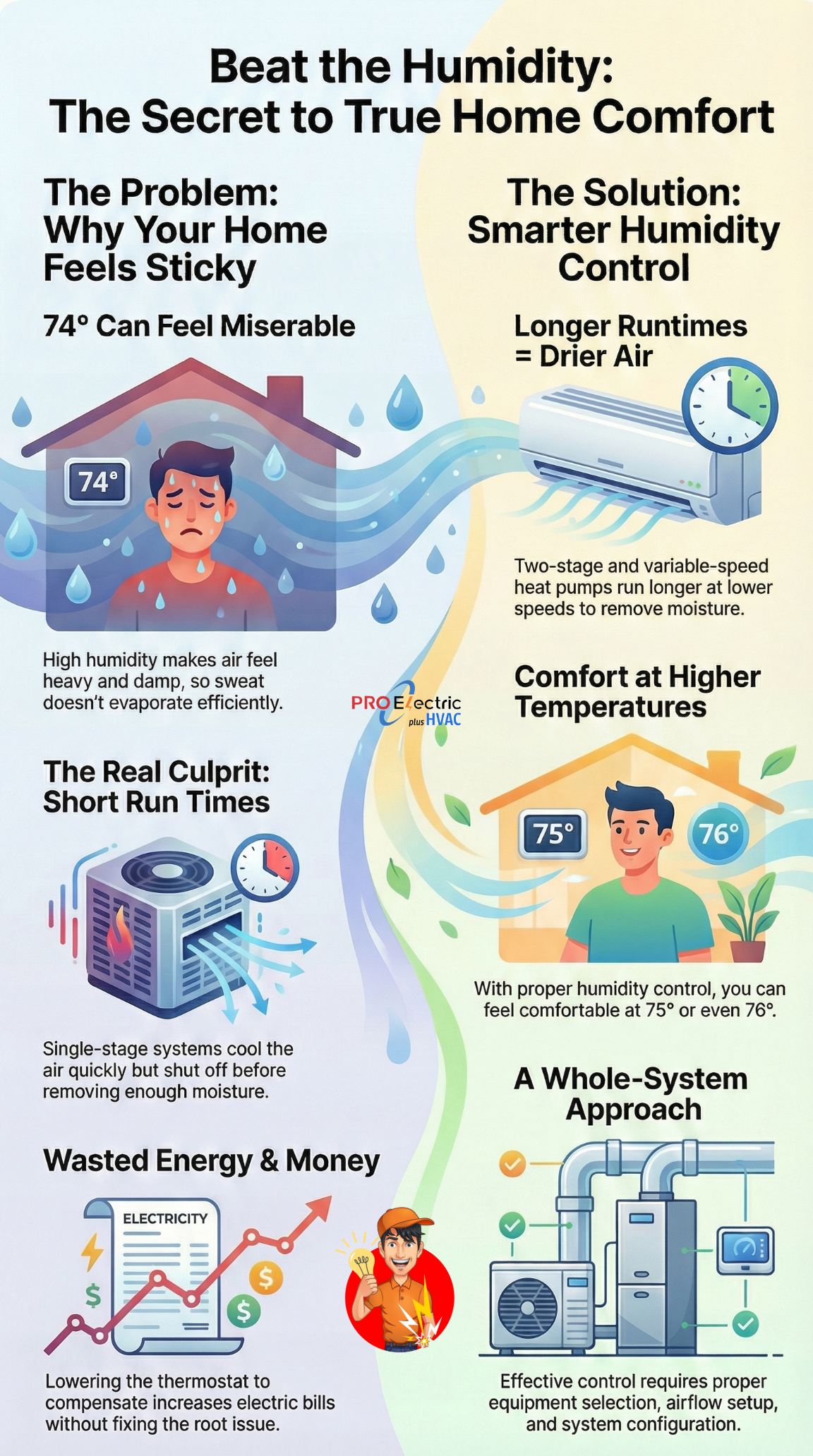
Humidity is the silent comfort killer in Northern Virginia. I can walk into a home in Fairfax County, Loudoun County, Arlington County, or Prince William County and tell within seconds whether the system is controlling moisture properly. The thermostat might say 74, but the air tells a different story.
This is one of the most misunderstood problems I see in homes across Reston, Ashburn, Vienna, Falls Church, and Gainesville. Homeowners assume they need colder air. In reality, what they need is drier air.
Why Temperature Alone Does Not Equal Comfort
If you have ever been comfortable at 74 in one house and miserable at 74 in another, humidity is almost always the reason.
High humidity makes the air feel heavy and sticky. Sweat does not evaporate efficiently. Furniture feels damp. The house smells musty after storms. People lower the thermostat trying to compensate, which increases electric bills without fixing the real issue.
This is common in Northern Virginia because summer temperatures are often moderate, but humidity stays high for long stretches. The system runs, but not long enough or consistently enough to pull moisture out of the air.
How Heat Pump Design Affects Humidity
Humidity control depends heavily on how long the system runs and how gently it operates.
Single stage heat pumps tend to cool quickly and shut off. That short run time removes less moisture. The air temperature drops, but the humidity remains.
Two stage and variable speed heat pumps behave differently. They can run longer at lower output. That extended runtime allows the indoor coil to remain cold long enough to condense moisture from the air.
In real Northern Virginia homes, that leads to:
- Drier indoor air
- Fewer clammy rooms
- Less need to overcool the house
- Improved comfort at higher thermostat settings
Many homeowners are surprised to learn they can feel comfortable at 75 or even 76 once humidity is under control. That is where real energy savings begin.
After Storm Comfort Matters
Another place humidity problems show up is after summer storms. The rain stops. The sun comes out. The house suddenly feels sticky inside even though the temperature is not extreme.
A properly selected heat pump continues to run gently under these conditions, drying the air rather than cycling off too quickly. That keeps the home comfortable without dramatic temperature changes.
This is especially noticeable in homes with basements, townhouses, and multi-level layouts standard throughout Northern Virginia. When humidity is controlled, the entire house feels cleaner and more stable.
Humidity Control Is a System Decision
Good humidity control is not a single feature. It is the result of:
- Proper equipment selection
- Correct airflow setup
- Accurate refrigerant charge
- Controls configured for longer runtimes
When all of that is done correctly, homeowners stop chasing the thermostat. The house feels right, even on those sticky July and August days that define Virginia summers.
Next, I am going to talk about sound performance in Northern Virginia neighborhoods, because comfort is not just about how a home feels, but also how quiet it stays when the system is running.
↑ Go Back to Table of Contents
Section 5
Sound Performance in Northern Virginia Neighborhoods
Noise is one of the most overlooked parts of heat pump comfort in Northern Virginia. I cannot tell you how many homeowners in Arlington County, Fairfax County, Loudoun County, and Prince William County have told me they never thought about sound until after the system was installed.
In theory, the outdoor unit is just a box outside. In real neighborhoods across Arlington, Falls Church, Vienna, and older Fairfax communities, that box often sits close to bedrooms, patios, fences, and neighboring homes. When it is loud, everyone notices.
Why Noise Matters More Here
Northern Virginia homes are close together. Yards are smaller. Townhouses share walls. Outdoor living spaces are used heavily in the evenings and on weekends.
When a heat pump kicks on hard at full power, the sound carries. It interrupts backyard conversations. It wakes light sleepers. Once you notice it, it becomes something you cannot ignore.
I have been called out to homes where the system worked mechanically but failed in one important way. It was simply too loud for the setting.
How System Design Affects Sound
Sound is directly tied to how a heat pump operates.
Single stage systems tend to be the loudest. They start abruptly and run at full capacity. That sudden ramp up is what most people hear and dislike.
Two-stage and variable-speed heat pumps are usually much quieter. They spend most of their time running at lower output. Instead of a sudden roar, you get a steady, subdued hum that blends into the background.
In real Northern Virginia neighborhoods, that difference is enormous.
Equipment Features That Reduce Noise
Quieter systems often include:
- Compressor sound blankets
- Vibration isolation mounts
- Advanced fan blade designs
- Insulated cabinet panels
These features matter more when homes are close together. They also matter when outdoor units must be placed near bedrooms or property lines due to lot size restrictions.
In Arlington and inside the Beltway areas of Fairfax, thoughtful equipment selection and placement can be the difference between a system you forget about and one you notice every time it runs.
Placement and Installation Matter
Even the quietest heat pump can sound loud if it is installed poorly.
Proper placement, stable mounting, and correct airflow clearance all reduce noise. This is where experience with Northern Virginia properties matters. Every lot is different. Every neighborhood has its own constraints.
When sound is addressed upfront, homeowners enjoy their patios, open windows at night, and quiet evenings without being reminded that the system just kicked on.
Next, I am going to break down energy savings that actually show up on electric bills, because efficiency numbers only matter if they translate into real world results for Northern Virginia homeowners.
↑ Go Back to Table of Contents
Section 6
Energy Savings That Actually Show Up on Electric Bills

Efficiency numbers look great on a brochure, but Northern Virginia homeowners care about one thing. Does it lower the electric bill without sacrificing comfort. That question comes up in almost every home I visit across Fairfax County, Loudoun County, Arlington County, and Prince William County.
The answer depends on understanding how heat pumps actually save energy in this region.
What the Efficiency Ratings Really Mean
Heat pump efficiency is measured using several ratings. For heating, HSPF2 matters most here. For cooling, SEER2 and EER2 are relevant.
I explain these like miles per gallon on a vehicle. Higher numbers usually indicate better efficiency, but only if the system is driven as it was designed. A high-efficiency heat pump that is oversized or poorly installed will not deliver real savings.
Why Mild Winters Are Where Savings Happen
Northern Virginia does not experience constant deep cold. Most winters are long and mild, with short cold snaps mixed in.
This is where a properly selected heat pump shines. During those mild winter days, a heat pump can provide heat using significantly less energy than older electric strip systems or furnaces that cycle constantly.
The biggest savings usually come from:
- Efficient operation during long mild stretches
- Reduced reliance on electric resistance heat
- Longer, steadier runtimes instead of short aggressive cycles
Homeowners often notice their bills flatten out rather than spike unpredictably.
Cooling Efficiency During Humid Summers
On the cooling side, efficiency is not just about lowering temperature. It is about removing moisture efficiently without running nonstop at full power.
Two stage and variable speed systems use less energy because they do not overshoot the target temperature and shut off repeatedly. They run more steadily, which reduces power draw and improves comfort at the same time.
Installation Determines Real Savings
I cannot stress this enough. Installation quality matters as much as the equipment itself.
Real energy savings depend on:
- Proper system sizing
- Accurate refrigerant charge
- Correct airflow and duct balance
- Controls configured for Northern Virginia conditions
When these details are handled correctly, homeowners see consistent savings month after month. When they are not, even the most efficient heat pump on paper can disappoint.
A Word on Geothermal
Geothermal heat pumps can offer excellent efficiency by using stable ground temperatures. In Northern Virginia, they can make sense for certain properties, especially where land, budget, and site conditions allow.
However, geothermal is not a universal solution. It depends heavily on lot size, soil conditions, and installation complexity. It is an option worth evaluating carefully, not a default upgrade.
Energy savings should feel predictable and logical. When a heat pump is matched correctly to a Northern Virginia home, the bills reflect it.
Next, I am going to talk about reliability and durability, because a system that saves money but breaks down frequently is not a good investment.
↑ Go Back to Table of Contents
Section 7
Reliability That Holds Up in Northern Virginia
When I recommend a heat pump in Northern Virginia, reliability comes first. Comfort and efficiency mean nothing if the system cannot withstand the strain it has to endure here. That is why I only recommend Carrier heat pumps for homes in Fairfax, Loudoun, Arlington, and Prince William Counties.
Northern Virginia systems do not get a break. They run through long, humid summers, extended heating seasons, and constant shoulder-season cycling. That kind of workload quickly exposes weak designs. Over the years, Carrier has proven to be the most consistent in terms of durability, performance stability, and long-term dependability in our climate.
Why Reliability Matters More Here
In this region, a heat pump is not a backup system. It is the primary source of heating and cooling for much of the year.
A reliable system means:
- Fewer emergency service calls during heat waves and cold snaps
- Stable performance during long run times
- Less wear from constant cycling
- Predictable comfort year after year
I have seen too many homeowners deal with repeated breakdowns simply because the system was not built for how Northern Virginia actually operates.
Carrier Comfort Series 27SCA5
For homeowners looking for a dependable entry level system, the Carrier Comfort Series 27SCA5 is a solid choice.
This heat pump delivers:
- Up to 15.2 SEER2 efficiency
- Proven single stage reliability
- Sound levels around 69 dBA
- Consistent heating and cooling performance
In many Northern Virginia homes, especially smaller single family homes and townhouses, this system provides steady comfort without unnecessary complexity. It is versatile, dependable, and built to handle year round operation when installed correctly.
Carrier Performance Series 27TPA8
For homeowners who want better comfort control and improved efficiency, the Carrier Performance Series 27TPA8 is where I often guide the conversation.
This model offers:
- Up to 17 SEER2 efficiency
- Two stage operation for smoother comfort
- Quieter operation around 68 dBA
- Excellent pairing with gas furnaces for Hybrid Heat setups
Two stage operation makes a noticeable difference in Northern Virginia. The system runs gently most of the time and ramps up only when needed. That reduces stress on components and improves long term reliability.
This model is especially popular in homes across Ashburn, Vienna, Leesburg, and McLean where homeowners want better comfort without jumping straight to fully variable systems.
Reliability Is More Than the Equipment
Even the best heat pump can fail early if it is not installed correctly.
Carrier systems perform best when:
- The system is properly sized for the home
- Refrigerant charge is set precisely
- Airflow is balanced and matched to the equipment
- Controls are configured for local climate behavior
When those details are right, these systems run smoother, last longer, and deliver the kind of reliability Northern Virginia homeowners expect.
My goal is simple. I want you to stop thinking about your heat pump once it is installed. No constant adjustments. No unexpected failures. Just quiet, steady comfort that works the way it should.
Next, I am going to walk through installation details that make or break performance, because reliability starts on day one and is locked in by how the system is installed.
↑ Go Back to Table of Contents
Section 8
Installation Details That Make or Break Heat Pump Performance
I can install the best heat pump on the market, but if the installation is rushed or done by the numbers instead of by the house, the results will disappoint. In Northern Virginia, installation quality is often the difference between a system that feels amazing and one that constantly feels a little off.
This is especially true in Fairfax County, Loudoun County, Arlington County, and Prince William County, where housing styles, lot sizes, and construction quality vary widely from one neighborhood to the next.
Proper Sizing for Northern Virginia Homes
Oversizing is one of the most common mistakes I see. Bigger is not better here.
An oversized heat pump:
- Cycles on and off too frequently
- Struggles with humidity control
- Creates temperature swings
- Experiences more wear over time
Correct sizing means matching the system to the home’s actual heat loss and gain, not guessing based on square footage alone. Townhouses in Reston behave differently than single family homes in Leesburg. Older Arlington homes behave differently than newer construction in Ashburn.
Airflow and Duct Compatibility
Heat pumps are airflow sensitive. If the duct system cannot move air correctly, even a high quality system will struggle.
I always evaluate:
- Duct size and layout
- Supply and return balance
- Restrictions and bottlenecks
- Leakage and insulation issues
In many Northern Virginia homes, especially those built decades ago, duct improvements are necessary to get the full benefit of a modern heat pump.
Refrigerant Charge Accuracy
Refrigerant charge is not a guessing game. It must be set precisely for the system to operate efficiently and reliably.
Too much or too little refrigerant can cause:
- Reduced efficiency
- Poor heating or cooling performance
- Excessive wear on the compressor
- Premature system failure
This is one of the most overlooked details, and it has a huge impact on long term performance.
Matching Indoor and Outdoor Equipment
Heat pumps are designed to operate as matched systems. Mixing incompatible components leads to performance issues that are hard to diagnose later.
Proper matching ensures:
- Correct capacity
- Stable operation across seasons
- Accurate efficiency performance
- Manufacturer supported reliability
This matters even more in Northern Virginia where the system runs year round.
Control Setup for Local Climate Behavior
Controls are often set to factory defaults. That is a mistake.
In this region, settings should account for:
- Long mild winter operation
- Reduced reliance on electric backup heat
- Smooth transitions between heating and cooling
- Longer runtimes for humidity control
When controls are configured correctly, the system behaves naturally. It adapts to Northern Virginia weather instead of fighting it.
Installation locks in performance on day one. When the details are handled correctly, homeowners enjoy quiet operation, steady comfort, and lower long term costs.
Next, I am going to explain what long term ownership really looks like, including maintenance expectations and how a properly installed heat pump ages in a Northern Virginia home.
↑ Go Back to Table of Contents
Section 9
Long-Term Ownership and What to Expect Over Time
When a heat pump is selected and installed correctly, owning it in Northern Virginia should feel uneventful. That may sound boring, but boring is exactly what you want from a system that runs most days of the year.
I have worked in homes across Fairfax County, Loudoun County, Arlington County, and Prince William County, and the pattern is always the same. Systems that are chosen for the climate and installed with care age far better than those selected on price alone.
What a Healthy System Feels Like
Homeowners often ask me how they will know if their heat pump is working properly years down the line.
A healthy system:
- Maintains steady temperatures without constant thermostat changes
- Runs quietly most of the time
- Handles seasonal transitions smoothly
- Keeps humidity under control
- Does not surprise you with frequent repairs
If you stop thinking about your system, that is usually a good sign.
Reduced Wear Through Proper Operation
Two stage and variable speed heat pumps experience less stress over time. They avoid the constant hard starts that wear out components.
In Northern Virginia, where systems run during long shoulder seasons, that gentle operation makes a real difference. Fewer bad cycles mean longer component life and more stable performance year after year.
Maintenance Expectations
Heat pumps are not maintenance free, but they should not be high maintenance either.
Routine maintenance includes:
- Filter changes
- Coil cleaning
- Electrical connection checks
- Refrigerant performance verification
- Airflow evaluation
These simple steps prevent small issues from becoming expensive problems, especially in a climate that demands year round operation.
Fewer Surprises Means Lower Lifetime Cost
One of the biggest advantages of a properly selected heat pump is predictability. Repair costs are lower. Energy bills make sense. Comfort remains consistent.
I often see homeowners in older Arlington or Fairfax neighborhoods who struggled for years with uneven comfort finally relax once the right system is in place. The house feels stable. The system behaves consistently. Ownership becomes straightforward instead of stressful.
When Upgrades Make Sense
Over time, technology improves. Controls get smarter. Efficiency increases.
A well installed system allows for future upgrades without major rework. That flexibility matters as Northern Virginia continues to evolve toward more electric homes and changing energy standards.
Long term ownership should feel simple. When the system is matched to the home and the climate, that is exactly how it feels.
Next, I am going to pull everything together and show you how to choose the right heat pump for your Northern Virginia home, step by step.
↑ Go Back to Table of Contents
Section 10
How to Choose the Right Heat Pump for Your Northern Virginia Home
After working in hundreds of homes across Fairfax County, Loudoun County, Arlington County, and Prince William County, I can tell you this. Choosing the right heat pump is not about chasing the highest numbers or the flashiest features. It is about matching the system to how your home actually lives and how Northern Virginia actually behaves.
This is where everything we have covered comes together.
Start With Comfort, Not Brand Names
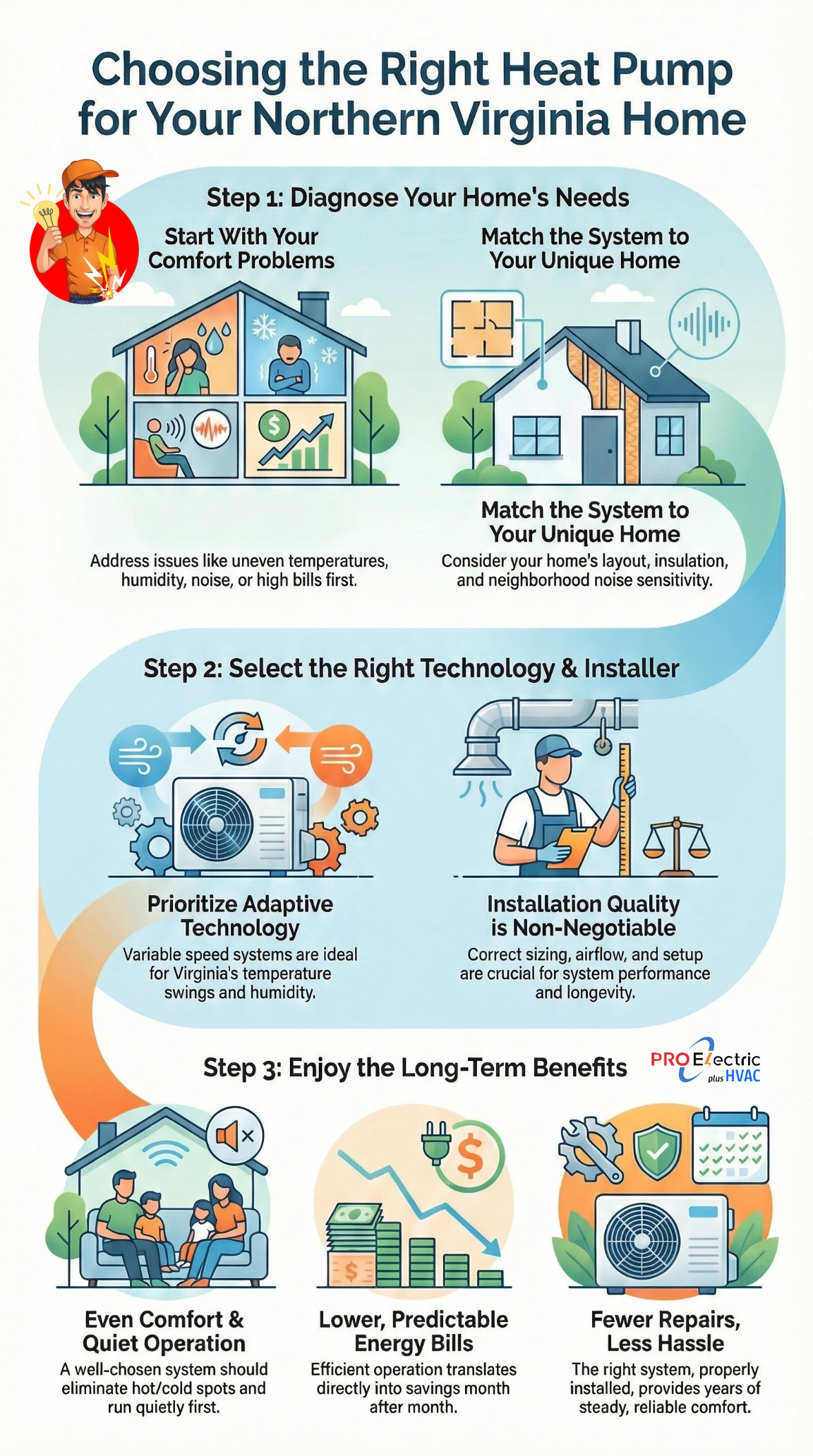
The right heat pump should solve problems you already feel:
- Uneven temperatures
- Sticky indoor air
- Loud outdoor noise
- High electric bills
- Constant thermostat adjustments
If a system does not address those issues, it is not the right system for your home, no matter how good it looks on paper.
Match the System to Your Home and Neighborhood
A townhouse in Reston has different needs than a single family home in Leesburg. An older Arlington home behaves very differently than new construction in Ashburn or Gainesville.
That is why I never recommend one size fits all solutions. Proper selection considers:
- Home layout and insulation
- Lot size and outdoor unit placement
- Neighborhood density and noise sensitivity
- How the house gains and loses heat throughout the day
When those details are respected, comfort improves immediately.
Prioritize Modulation Over Raw Power
In Northern Virginia, the best performing systems are the ones that can adapt.
Two stage and variable speed heat pumps handle our temperature swings, humidity, and long shoulder seasons far better than aggressive single stage systems. They run smoother. They last longer. They feel better day to day.
Installation Is Non Negotiable
The system you choose is only half the equation.
Sizing, airflow, refrigerant charge, equipment matching, and control setup lock in performance for the life of the system. Shortcuts here create years of frustration. Attention to detail creates years of quiet, steady comfort.
Think Long Term
A heat pump is not a short term purchase. It is something you live with every day.
When chosen correctly, you should notice:
- Even comfort throughout the house
- Lower and more predictable energy bills
- Quiet operation inside and out
- Fewer repairs over time
- Less thinking about the system overall
That is the goal.
My Approach
I recommend Carrier heat pumps because they have proven themselves in Northern Virginia homes year after year. I focus on systems that balance reliability, comfort, sound performance, and real world efficiency. And I install them with the expectation that you should not have to think about your HVAC system once it is done.
Northern Virginia weather is demanding. Your heat pump should be prepared for it.
If you take away one thing from this guide, let it be this. The right heat pump does not just heat and cool your home. It adapts to it. It works quietly in the background. And it makes your house feel comfortable no matter what the weather outside decides to do next.
That is how you know you chose the right system.
Talk to Peter About Real Energy Savings
If you are tired of guessing whether a heat pump will actually lower your electric bill, it is time to talk to someone who designs systems for Northern Virginia homes every day.
Peter does not sell equipment based on brochures or hype. He evaluates how your home uses energy, how it gains and loses heat, and how Fairfax, Loudoun, Arlington, or Prince William County weather really affects your comfort and costs.
Reach out to Peter to get clear answers on:
- Why your electric bills spike or stay unpredictable
- Whether your current system is oversized or underperforming
- What efficiency ratings actually matter for your home
- How proper sizing and installation translate into real monthly savings
If you want a heat pump solution that delivers lower bills, steady comfort, and long term reliability, contact Peter and get it done right the first time.

Peter
Master Electrician & HVAC Heat Pump Technician
↑ Go Back to Table of Contents
20 Frequently Asked Questions
1. Are heat pumps strong enough for Northern Virginia winters?
Yes. Northern Virginia winters are mostly mild with short cold snaps. A properly sized and installed heat pump handles the majority of heating needs very efficiently, especially in Fairfax, Loudoun, Arlington, and Prince William homes.
2. Why does my house feel uneven even though the heat pump is running?
This is usually caused by single stage operation, improper sizing, or airflow issues. Northern Virginia temperature swings expose these problems quickly, especially in multi level homes and townhouses.
3. Is a heat pump better than a gas furnace in Northern Virginia?
In many cases, yes. Heat pumps are extremely efficient during our long mild seasons. Hybrid systems that combine a heat pump with a gas furnace can also be an excellent option depending on the home.
4. Why does humidity feel worse in some homes even at the same temperature?
Humidity control depends on runtime and system design. Two stage and variable speed heat pumps remove moisture more effectively, which is critical in Virginia summers.
5. Do heat pumps work well in older Arlington and Fairfax homes?
They can, but older homes often need duct improvements or airflow adjustments. When those are addressed, heat pumps perform very well even in older construction.
6. Are variable speed heat pumps worth the cost in Northern Virginia?
For many homeowners, yes. They provide steadier comfort, better humidity control, quieter operation, and reduced wear, which matters in our climate.
7. Why does my outdoor unit seem loud compared to my neighbor’s?
Noise usually comes from single stage systems, poor placement, or vibration issues. Two stage and variable speed Carrier systems are typically much quieter when installed correctly.
8. How long should a heat pump last in Northern Virginia?
With proper installation and maintenance, a quality heat pump should last 12 to 15 years or more, even with year round operation.
9. Does a bigger heat pump heat and cool better?
No. Oversized systems cycle too often, struggle with humidity, and wear out faster. Correct sizing is critical in Northern Virginia.
10. What efficiency rating should I look for?
HSPF2 matters most for heating here, while SEER2 and EER2 matter for cooling. Real world savings depend heavily on installation quality.
11. Why do my electric bills spike during mild weather?
This often means the system is cycling inefficiently or relying too much on electric resistance heat. Proper control setup fixes this.
12. Can a heat pump handle spring and fall temperature swings?
Yes, if it has two stage or variable speed operation. These systems are designed for exactly that type of weather.
13. Is geothermal better than an air source heat pump?
Sometimes. Geothermal can be very efficient, but it depends on property size, soil conditions, and budget. It is not a universal solution.
14. Do heat pumps work well in townhouses?
Yes. Townhouses in Reston, Ashburn, and Arlington often benefit greatly from variable speed systems that handle shared walls and uneven heat gain.
15. How important is ductwork with a heat pump?
Very important. Heat pumps are airflow sensitive. Poor duct design can ruin comfort and efficiency even with good equipment.
16. Should I worry about noise complaints from neighbors?
In dense areas like Arlington and parts of Fairfax, yes. Choosing quieter equipment and proper placement prevents problems.
17. How often does a heat pump need maintenance?
Annual maintenance is recommended. This keeps efficiency high and catches small issues early.
18. Why does my system switch to backup heat so often?
This usually indicates incorrect settings, improper sizing, or poor installation. Backup heat should be used sparingly in Northern Virginia.
19. Can a heat pump cool my home as well as an AC system?
Yes. Modern heat pumps provide excellent cooling and often better humidity control than older AC systems.
20. What is the biggest mistake homeowners make when choosing a heat pump?
Shopping by price or brand alone instead of matching the system to Northern Virginia weather, the home layout, and proper installation.