
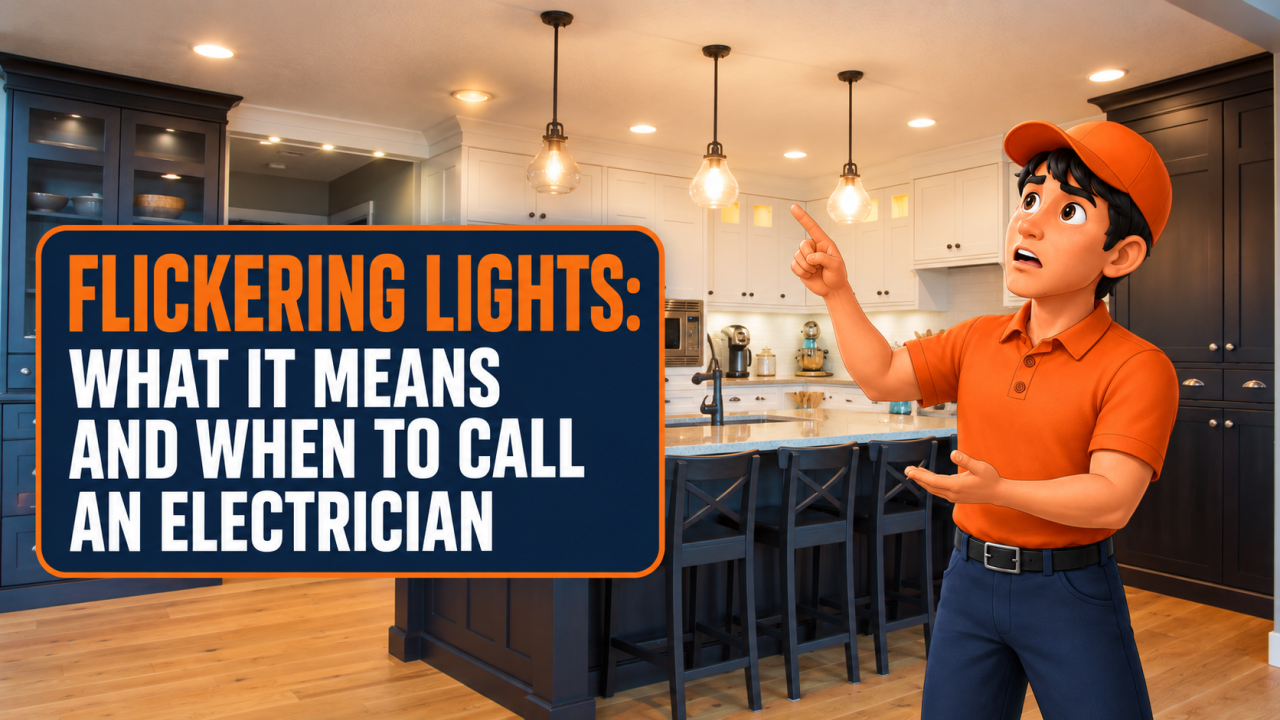
Peter, Master Electrician at PRO Electric plus HVAC
Sometimes it's a bulb. Sometimes it's a loose connection cooking inside a wall. The difference is in the pattern, and you can read the pattern from your couch before you ever call me. This is the guide I wish every Northern Virginia homeowner had read first.
Call 703.225.8222 Book a diagnosis- Licensed Master Electrician
- Electricians and HVAC technicians
- Fairfax, Loudoun, Arlington, Prince William
Quick answer
Are flickering lights a bigger problem? Sometimes.
One bulb or one fixture flickering is almost always the bulb, the socket, a dimmer, or a worn switch. Lights flickering across the whole house, flickering every time a big appliance starts, or lights that brighten in one room while they dim in another point to a loose connection at the panel, the meter, or the utility service, and loose connections are what start electrical fires. Read the pattern first. The rest of this page tells you what each pattern means and when it's time to call a licensed electrician.
Stop and call now if the flicker comes with any of these
These combinations mean a connection is already hot. Turn off the affected breaker, or the main if it is the whole house, and call me at 703.225.8222. This is what our 24/7 emergency electrical service is for.
The 3 flicker patterns, and what each one is telling you
Hi, I'm Peter, the Master Electrician at PRO Electric plus HVAC. When someone calls about flickering lights, I ask 3 questions before I ask for an address: Is it one light, one room, or the whole house? Does it happen when something big turns on? Do any lights get brighter while others get dimmer? The answers put the problem in one of 3 buckets, and each bucket has its own list of causes, its own repair, and its own urgency.
| Pattern | Where the fault usually is | Typical causes | Urgency |
|---|---|---|---|
| 1. One light or one fixture | The bulb, the socket, the dimmer, the switch, or the wiring in that one box | LED on the wrong dimmer, loose bulb, weak LED driver, worn switch, loose wire at the fixture | Low. Fix at your convenience, unless it buzzes or smells |
| 2. One room or one circuit | Somewhere on that circuit between the breaker and the last device | Backstab outlet connection, loose wire nut, failing breaker, too much load on the circuit | Medium. Schedule an electrician this week; turn the breaker off if it buzzes or smells |
| 3. Whole house, or whenever a big appliance starts | The main breaker, main lugs, meter, service drop, neutral, or the utility | Loose service connection, failing main, open neutral, undersized service, utility voltage problem | High. Call the same day; call now if lights brighten and dim |
Pattern 3 is the one that keeps me up at night, and it's also the one people wait longest on, because a whole-house flicker looks like a utility problem and the utility keeps saying their side is fine. It usually is. The connection that's failing is on the house side of the meter, and every time the AC starts, it arcs a little more.
A flicker is a connection asking for help. The whole-house flicker is the connection that carries everything.
Peter, Master Electrician, PRO Electric plus HVACWhat causes lights to flicker in a house, from harmless to dangerous
Here are the causes I find, in roughly the order of how worried you should be. The first 2 you can handle yourself. The rest are ours.
- The bulb. An LED bulb on a dimmer built for incandescent bulbs flickers, buzzes, or drops out at the low end. A bulb that is not seated in the socket flickers. A cheap LED with a weak driver flickers on its own and gets worse as it ages. Swap the bulb for a quality dimmable LED before you call anyone.
- The dimmer or switch. Dimmers have a minimum load, and 1 or 2 LED bulbs may sit below it. Old rotary and slide dimmers were never designed for LEDs. A worn toggle switch with pitted contacts flickers when you touch it or when the house vibrates. An LED-rated dimmer or a new switch fixes this, and we do it as part of light fixture and switch work.
- A loose connection in a box. The most common real fault. A push-in backstab connection on the back of an outlet loses tension and heats up, a wire nut was never twisted tight, or a fixture was hung on a screw terminal that has backed off. Every light and outlet downstream of that point flickers. This is where flicker turns into scorched devices, and it is inside the home wiring, so it is our job.
- An overloaded circuit. A space heater, a hair dryer, or a window AC sharing a 15-amp circuit with the lights pulls the voltage down every time it runs. The lights dim or flicker and the breaker may trip. The fix is moving the load or adding a dedicated circuit.
- A big motor starting. The AC compressor, a well pump, a sump pump, or the dryer motor pulls several times its running current for a fraction of a second at start. A quick, slight dip is normal. A deep dip, a dip that lasts, or a dip that is getting worse is a loose connection or an undersized service, and the section below on AC flicker covers how I tell them apart.
- A failing breaker. Yes, a bad breaker causes flicker. Worn contacts inside the breaker, a breaker that no longer sits tight on the panel bus, or a wire loose under the terminal screw all do it. A failing main breaker does it to the whole house. Circuit breaker replacement is a small job when it is caught early and a panel replacement when the bus behind it has been damaged.
- A loose service connection. The main lugs in the panel, the meter jaws, or the splices where the service drop meets your house. Heat cycling over 20 or 30 years loosens all of them. This is the classic whole-house flicker, the one that flares when the AC starts, and the one that eventually burns a meter base. It is the same failure that ends with half the house losing power.
- A loose or open neutral. The dangerous one. When the neutral connection fails at the panel, the meter, or the drop, the 2 sides of your service stop sharing a reference. One side climbs above 120 volts while the other sags, and it shifts as loads change. Lights brighten and dim at the same time in different rooms, and electronics start dying. Shut off the main and call.
- The utility. A weak transformer shared with several houses, a neighbor's large load, tree contact on the line, or a recloser operating after a fault. If the whole street sees it, or it happens at the same time every evening, it is on the utility side. Report it to Dominion Energy or NOVEC.
Older Northern Virginia homes: 2 things I look for first
Homes wired between roughly 1965 and 1973 may have aluminum branch circuit wiring, which expands, contracts, and loosens at every device connection, and flicker is often the first symptom. Homes with a Federal Pacific Stab-Lok or Zinsco panel can flicker because breakers lose their grip on the bus. Both are documented problems, both are things I check on the first visit, and both are covered on our page about recognizing a failing electrical panel. When the panel is the cause, panel repair or replacement ends the flicker for good.
Can a bad breaker cause lights to flicker?
Yes, and I get asked this enough that it deserves its own answer. A breaker is a mechanical switch with a spring-loaded contact inside. After thousands of cycles and years of heat, the contact surface pits and the spring weakens, so the connection inside the breaker chatters under load. Every light on that circuit flickers. The same thing happens when the breaker's clip has loosened on the panel bus, or when the wire under its terminal screw has crept loose, which is common with aluminum feeders and with breakers that were never torqued to spec.
How I confirm it: I read voltage on the load side of the breaker while the circuit is working, watch for the drop, and check the breaker's temperature against its neighbors with a thermal camera. A breaker running warm with a normal load is a breaker on its way out. If the bus stab behind it is discolored, the panel needs more than a breaker, and that is when we talk about electrical panel repair or replacement instead of a single part.
Why do the lights flicker when the AC, dryer, or another big appliance turns on?
A compressor motor pulls several times its running current for a fraction of a second when it starts. That momentary draw pulls the voltage down for everything on your service, and an incandescent bulb shows it as a dip. LEDs show it too, sometimes more sharply. This is why almost every house blinks a little when the AC kicks on in July.
The question is how much and for how long. Here is my rule of thumb from the truck:
- Normal: a quick, slight dip that lasts less than a second, only at start, and has not changed in years.
- Worth a look: a dip you can clearly see across the house, a dip that lasts a second or more, or a dip that has been getting deeper over the last few months. That is usually a connection loosening under the extra current, or a service that is undersized for the loads that have been added since the house was built.
- Call today: a dip with a buzz or click at the panel, a dip followed by lights that stay dim, or a dip in one half of the house with the other half getting brighter.
Because we are HVAC technicians as well as electricians, we look at both ends of this. A compressor that is starting hard because its capacitor is weak or its start components are failing will pull more inrush than it should, and that alone can turn a normal blink into a noticeable one. Sometimes the fix is on the electrical side, sometimes it is on the AC side, and sometimes it is both. One truck, one visit, no finger pointing between 2 contractors.
Power flickering in the whole house: what to do right now
Whole-house flicker, or what a lot of people describe as the electricity flickering or the power flickering on and off, means the problem is upstream of your branch circuits. Here is the order of operations:
- Ask a neighbor. If their lights flicker at the same time, it's the utility. Report it to Dominion Energy at 866-366-4357 or NOVEC at 703-335-0500 if you are in the parts of Loudoun, Prince William, or Fairfax that NOVEC serves.
- Watch for brightening. If any lights get brighter while others dim, shut off the main breaker and call our emergency line. That is an open neutral, and it destroys electronics while you wait.
- Unplug what you care about. TVs, computers, the fridge if you can spare it for an hour. Unstable voltage is hard on control boards.
- Look, but do not touch. Scorching or a crack at the meter base, a sagging or frayed service drop, a panel door that is warm. Any of those move this from a scheduled visit to a same-day one.
- Call a licensed electrician. If only your house flickers and the neighbors are fine, the failing connection is on the house side and needs a torque check at the lugs, a look at the meter jaws, and a load test of the main. Our power restoration service handles exactly this, day or night.
One more clue: whole-house flicker that happens at the same time every evening, or only during a heat wave, usually comes from a utility transformer that is overloaded when the whole street's air conditioning runs. The utility can measure that and, in my experience, will replace the transformer once it's documented. Keep a note of the dates and times when you call.
Are flickering lights dangerous?
A flickering bulb is annoying. A flickering connection is a fire risk, and the difference matters. When a connection is loose, current jumps the gap thousands of times a second. That arcing makes heat, the heat chars the insulation and the plastic around it, and the charred material conducts a little, which makes more heat. This is how a loose backstab turns into a black outlet and how a loose lug turns into a melted meter base. NFPA, the National Fire Protection Association, counts an estimated annual average of 46,652 home structure fires from 2020 to 2024 that involved an electrical failure or malfunction, with an estimated 527 civilian deaths a year, and lists flickering or dimming lights among the reasons to call a qualified electrician (NFPA, n.d.). The Electrical Safety Foundation International says the same thing in plainer words: lights that flicker or dim, a burning smell, discolored switches, or warm outlets can be signs of a serious wiring problem (ESFI, 2025). The U.S. Consumer Product Safety Commission puts dimming or flickering lights first on its list of electrical system hazard warning signs (CPSC, n.d.).
So is it safe to leave flickering lights on? If it's one bulb on a dimmer, yes. If it's a circuit or the whole house, or it comes with a smell, a buzz, or a warm plate, turn that breaker off and call. A loose connection doesn't improve while it stays energized.
Does flickering raise your electric bill?
I'll answer this one straight, because I see the opposite claim on a lot of websites. No, flickering lights do not waste electricity in any amount you would notice on a bill. A loose connection turns a small amount of energy into heat at the bad joint, which is the problem, but it is a trivial amount of energy. A light that dims is drawing less power in that moment, not more. The cost of a flicker problem shows up as a scorched device, a dead TV, a fried furnace control board, or a fire, not as a higher Dominion bill. If a company tells you to fix flickering lights to lower your bill, ask them to explain the physics.
LED bulbs and dimmers: the flicker that isn't a wiring problem
A good share of the flicker calls we get are LED problems, and I would rather tell you that on the phone than charge you for a visit. LEDs run on a small driver circuit inside the bulb, and that driver has to make peace with whatever is upstream of it.
- LEDs on an incandescent dimmer. The dimmer chops the waveform in a way the driver was not built for. You get flicker, buzz, a narrow dimming range, or bulbs that drop out at the bottom. Replace the dimmer with one rated for LED and CFL loads, and use bulbs marked dimmable.
- Too little load. Many dimmers need a minimum wattage to work. Two 9-watt LEDs may be under it. The fix is a dimmer with a lower minimum or a different bulb.
- Cheap drivers. Bargain LEDs flicker as their capacitors age. If the same fixture flickers with a quality dimmable bulb, the problem is not the bulb.
- Ghost flicker with the switch off. An LED that glows faintly or blinks every few seconds when the switch is off is usually picking up leakage current through an illuminated switch, a smart switch without a neutral, or a long cable run. A different switch, or a small bypass device at the fixture, cures it.
- Mixed bulb types on one dimmer. Incandescent, CFL, and LED on the same dimmer confuse it. Match the bulbs.
If you replace the bulb and the dimmer and a fixture still flickers, the fault is in the box behind it, and that is where the wiring conversation starts.
Flickering after a power outage or a surge
Two things happen after an outage. First, the utility voltage can wobble for a while as the grid comes back and loads across the neighborhood settle, and that shows up as a few hours of flicker that fades on its own. Second, the surge that rides in with restored power can damage the drivers inside LED bulbs and fixtures, which then flicker permanently until they are replaced. If flickering started after an outage and it's still going a day later, or if it is on more than one circuit, a connection at the meter or the panel may have been stressed when power slammed back on, and that is worth a look. A whole-home surge protector at the panel limits the damage next time, and Northern Virginia gets enough summer storms that I consider it standard equipment.
What I check when you call about flickering lights
Diagnosis first, parts second. Here is the visit, in order:
- The interview: which lights, which rooms, when it started, what was running, and whether anything brightens. Most of the diagnosis happens here.
- Voltage at the main with the house under load, then again with the AC or dryer starting. Both legs to neutral, and leg to leg. The numbers tell me whether the service, the neutral, or a branch circuit is the problem.
- A thermal scan of the panel, the main lugs, the breakers, and the meter base. Loose connections run hot, and the camera finds them before I open anything.
- Torque check on the main lugs and the neutral bar, and a look at the meter jaws with the utility's coordination if needed.
- The suspect circuit: the first flickering device in the run, the connections behind it, and the breaker feeding it, tested under load.
- Aluminum branch wiring and panel brand, because in the right vintage of Northern Virginia home those 2 things explain the flicker by themselves.
Most flicker calls end in one of 4 repairs: a device replaced and its connections pigtailed, a breaker replaced, the service connections re-torqued or a burned meter base replaced, or a panel replaced when the bus is damaged. If you want the whole system looked at while we're there, our electrical inspection and electrical safety assessment cover every circuit, not just the one that flickered. Veteran and military discounts apply, and financing is available on request.
Call 703.225.8222 Request a call backWhen to call an electrician for flickering lights, and what kind to call
Handle it yourself
- One bulb flickers: reseat it, then replace it with a quality dimmable LED.
- Lights on a dimmer flicker or buzz: confirm the dimmer is rated for LEDs; if not, that is a simple swap we do in minutes.
- A brief blink when the AC starts that has been the same for years.
Schedule a licensed electrician this week
- A whole room or circuit flickers, or the flicker moves when you plug things in. That is a home wiring fault, and it is where most scorched outlets come from.
- Flicker in a home with aluminum branch wiring or a Federal Pacific or Zinsco panel.
- The dip when the AC starts has been getting worse.
- You replaced the bulb and the dimmer and a fixture still flickers.
Call today, or right now
- The whole house flickers and the neighbors do not.
- Lights brighten in one place while they dim in another.
- Any flicker with a smell, a buzz, a warm plate, sparks, or a tripping breaker.
What kind of electrician: a licensed one who diagnoses before replacing parts, pulls a permit when the job needs one, and will give you the readings, not just a quote. Ask for the Virginia contractor license number. Ours is 2705181607. And if you are tempted to open a device yourself, read our note on what DIY electrical work costs homeowners first; a flicker is a live connection with a problem, and it is the wrong place to learn.
Want the step-by-step version, breaker by breaker? Our companion guide on troubleshooting flickering lights walks through it.
Questions I get about flickering lights
What does it mean when the lights flicker in your house?
It depends on the pattern. One bulb or one fixture flickering usually means the bulb, the socket, a dimmer, or a worn switch. Lights on one circuit flickering point to a loose connection or an overloaded circuit. Lights flickering across the whole house, or whenever a big appliance starts, point to a loose connection at the panel, the meter, or the utility service, and those are the ones a licensed electrician should look at soon.
Why is the power flickering in my whole house?
Whole-house flickering means the problem is upstream of your branch circuits: the main breaker, the main lugs, the meter jaws, the service drop, the neutral, or the utility transformer. Ask a neighbor if they see it too. If they do, call your utility. If only your house flickers, especially when the AC or dryer starts, a loose service connection is the usual cause and it gets worse with every load cycle.
Can a bad breaker cause lights to flicker?
Yes. A breaker with worn or pitted internal contacts, a breaker that has loosened on the panel bus, or a wire that has crept loose under the breaker's terminal screw all cause flicker on every light and outlet that breaker feeds. A bad main breaker does the same thing to the whole house. We test breakers under load and check the connection at both ends before replacing anything.
Why do my lights flicker when the AC turns on?
A compressor pulls several times its running current for a fraction of a second when it starts, and that momentary draw dips the voltage for everything on the service. A quick, slight dip that only happens at start is normal. A deep dip, a dip that lasts more than a moment, a dip that has grown worse over months, or a dip you can hear as a buzz at the panel means a loose connection, an undersized service, or a compressor that is starting hard.
Are flickering lights dangerous?
A single flickering bulb is not. Flickering that comes from a loose connection is, because a loose connection arcs, and arcing makes heat inside a wall, a box, or a panel. NFPA counts an estimated annual average of 46,652 home fires involving electrical failure or malfunction from 2020 to 2024. The patterns to treat as urgent are whole-house flicker, lights that brighten and dim at the same time, and any flicker paired with a burning smell, buzzing, or a warm outlet or switch plate.
Is it safe to leave flickering lights on?
If the flicker is one bulb on a dimmer, yes, and the fix is a new bulb or the right dimmer. If the flicker is on a whole circuit or the whole house, or comes with a smell, buzz, or warmth, turn that breaker off and call an electrician. A loose connection does not get better while it stays energized.
Can flickering lights increase my electric bill?
Not in any way you would notice. A loose connection wastes a tiny amount of energy as heat, and a dimming light is drawing less power, not more. The real cost of a flicker problem is the risk of fire and the damage that unstable voltage does to electronics, appliance boards, and HVAC controls. Fix it for those reasons, not for the bill.
Why do my LED lights flicker?
Most LED flicker has nothing to do with your wiring. LED bulbs on a dimmer that was made for incandescent bulbs flicker, buzz, or drop out at the low end. Cheap LED bulbs with weak internal drivers flicker on their own. An LED that glows or blinks faintly with the switch off is usually picking up a trickle of current from an illuminated or smart switch. The fix is a dimmable LED paired with an LED-rated dimmer, a better bulb, or a switch swap.
Why do the lights flicker in only one room?
One room or one circuit flickering points to a fault on that circuit: a loose wire at an outlet, switch, or fixture, a push-in backstab connection that has heated up, a loose wire nut in a box, a failing breaker, or too much load on the circuit. The first dead or flickering device in the run is usually where the problem lives. Opening devices on a live circuit is not a homeowner job.
Can a power surge or a power outage make lights flicker?
Yes. A surge can damage the small drivers inside LED bulbs and fixtures, which then flicker until they are replaced. After an outage, the utility voltage can wobble for a short time while the grid settles. If flickering starts after an outage and keeps going, a connection at the meter or panel may have been damaged when power came back, and that should be checked. Whole-home surge protection limits the damage the next time.
Should I call an electrician or the utility for flickering lights?
If the neighbors flicker too, call the utility: Dominion Energy at 866-366-4357 or NOVEC at 703-335-0500. If only your house flickers, or the flicker follows a pattern inside the house, call a licensed electrician. PRO Electric plus HVAC answers at 703.225.8222, and if lights are brightening and dimming or you smell burning, that call goes to our 24/7 emergency line.
What kind of electrician should I hire for flickering lights?
A licensed electrician who will diagnose before replacing parts: voltage readings under load, a thermal scan of the panel and meter, torque checks on the lugs, and a look at the actual circuit. In Virginia, ask for the contractor license number and confirm it. PRO Electric plus HVAC works under Virginia license 2705181607 with a Master Electrician on every diagnosis, and because we are also HVAC technicians, we can tell whether the AC is causing the flicker or suffering from it.
Fairfax, Arlington, Loudoun, and Prince William Counties
Get the flicker diagnosed
Tell us which lights, which rooms, and when it happens, and we will get a Master Electrician on it. Or call 703.225.8222.
Lights brightening and dimming? That is an emergency.
An open neutral or a burning connection does not wait for business hours, and neither do we.
24/7 emergency electrical serviceMore troubleshooting guides
Plain English help for the electrical problems I get called about most.
Sources
Field explanations come from service calls across Northern Virginia. Safety authorities and utility contacts were verified in September 2026.
- National Fire Protection Association. (n.d.). Electrical safety in the home. https://www.nfpa.org/education-and-research/home-fire-safety/electrical-safety-in-the-home
- Electrical Safety Foundation International. (2025). Home safety. https://www.esfi.org/home-safety/
- U.S. Consumer Product Safety Commission. (n.d.). National Electrical Safety Month: Electrical system hazard warning signs. https://www.cpsc.gov/s3fs-public/elecsafety.pdf
- U.S. Consumer Product Safety Commission. (2008). Home electrical safety checklist (Pub. 513). https://www.cpsc.gov/s3fs-public/513.pdf
- Dominion Energy. (n.d.). Report outage or emergency. https://www.dominionenergy.com/virginia/report-outage-or-emergency
- Northern Virginia Electric Cooperative. (n.d.). Contact us. https://www.novec.com/Contact_Us/
Read the pattern. Then let us find the connection.
Licensed Master Electricians and HVAC technicians serving Fairfax, Loudoun, Arlington, and Prince William Counties. Honest diagnosis, code first repairs, 24 hours a day. Veteran and military discounts available.
Call 703.225.8222 Book a diagnosisPRO Electric plus HVAC. Virginia Electrical and HVAC Contractor License 2705181607. 800 West Broad Street, Falls Church, VA 22040.