
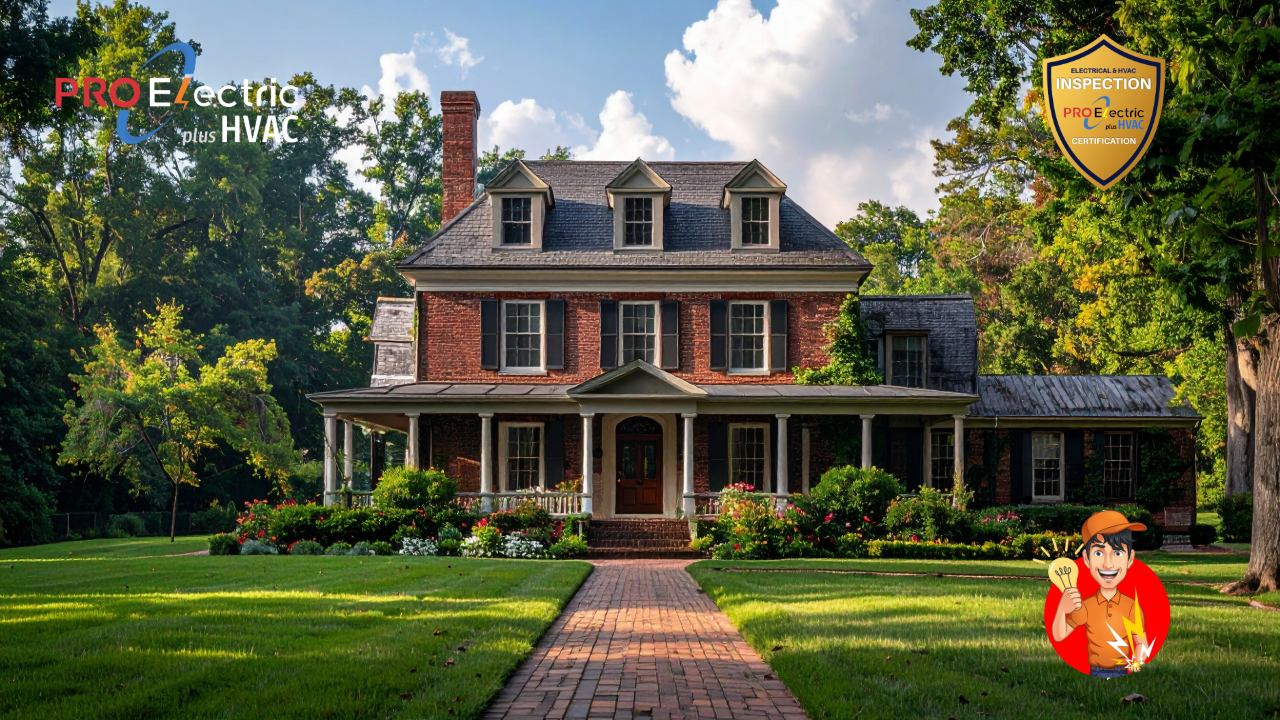
Ashburn is one of the fastest-growing communities in Virginia, and the homes here are largely new. Subdivisions like Brambleton, Broadlands, Belmont Country Club, and One Loudoun are full of houses built in the 2000s, 2010s, and later. Homeowners in these neighborhoods often assume their newer construction means their electrical system is modern, capable, and ready for anything. That assumption is the one that causes the most surprise when an electrician comes out to install an EV charger and recommends a panel upgrade before a single wire is run.
New construction does not mean unlimited electrical capacity. A home built in 2008 with a 200-amp panel was sized for the electrical profile of a 2008 household. That profile did not include two electric vehicles, a whole-home battery backup, an induction range, a heat pump water heater, and a home office drawing power around the clock. Ashburn families in 2026 are living very differently from the families those panels were sized for, and the gap between panel capacity and household demand is showing up in every EV charger consultation we run in Loudoun County.
Why a 200-Amp Panel Is Not Always Enough
A 200-amp service panel is the current standard for residential new construction in Virginia, and it is the right baseline for most homes. But 200 amps is a ceiling, not a guarantee of available capacity. A home with a 200-amp panel that is already running central HVAC, a heat pump water heater, an induction range, a dryer, a refrigerator, and a full suite of electronics may have as little as 20 to 40 amps of available capacity left before the panel approaches its continuous load limit under the National Electrical Code’s 80 percent rule.
A Level 2 EV charger running at 40 to 48 amps is a continuous load. It runs for six to ten hours at a time. Adding that load to a panel already near its safe working limit is not a wiring question. It is a math question, and the math often does not work without either a panel upgrade, smart load management, or a careful circuit audit to identify where capacity can be recovered.
The EV Charger Conversation Ashburn Homeowners Are Not Prepared For
The most common scenario in Ashburn EV charger projects goes like this. The homeowner purchases an EV, researches Level 2 chargers, and calls an electrician to install one in the garage. The electrician performs a load calculation and finds that the panel has less available capacity than the charger requires. The homeowner is surprised because the home is relatively new. The electrician explains that new construction means the panel met code when the home was built, not that it was sized for future EV charging loads.
The fix depends on the actual load calculation result. Some Ashburn homes have enough available capacity once the circuit plan is optimized. Others need a panel upgrade or a smart EV charger with dynamic load management that reduces charging speed when other large loads are running. A small number need a second service panel or a subpanel in the garage. No two homes are identical, which is why the load calculation has to come before the charger.
Smart Load Management as a Middle-Ground Solution
For Ashburn homes where the available capacity is genuinely close but not quite sufficient, smart EV chargers with load management capabilities offer a practical alternative to a full panel upgrade. These devices monitor total panel load in real time and throttle EV charging speed when other large loads like the HVAC system or dryer push the panel near its limit. When those loads drop off, charging speed increases automatically.
Load management does not eliminate the need for a load calculation. It requires knowing exactly how much capacity the panel has, how much the household loads draw, and whether the charger’s minimum output under throttled conditions still meets the homeowner’s daily charging needs. An electrician performs that analysis before recommending load management as the path forward.
Planning for a Second EV in an Ashburn Home
Ashburn households buying a second EV or planning to do so within the next few years should have that conversation with the electrician before the first charger is installed. A panel upgrade done once with two 240-volt charger circuits run at the same time costs significantly less than doing the work in two separate visits. Planning for the second vehicle now avoids the scenario where a panel that just barely supported one charger needs to be upgraded again when the second one arrives.
Frequently Asked Questions
Does a newer home in Ashburn automatically have room for an EV charger?
Not necessarily. A newer home has a panel that met code at the time of construction. Whether that panel has adequate available capacity for an EV charger today depends on a load calculation that accounts for everything currently drawing power from the panel. A new home with many high-draw appliances may have less margin than an older home with fewer electrical loads.
What is the 80 percent rule for electrical panels?
The National Electrical Code requires that continuous loads, meaning loads that run for three hours or more, not exceed 80 percent of a circuit or panel’s rated capacity. For a 200-amp service, this means continuous loads should stay at or below 160 amps. EV charging qualifies as a continuous load, so it counts against this limit directly.
How long does EV charger installation take in Ashburn?
A straightforward EV charger installation on a panel with available capacity typically takes two to four hours. If a panel upgrade is required first, the combined project takes one full working day. PRO Electric plus HVAC handles the load calculation, permit, panel work if needed, charger circuit, and inspection in a single coordinated visit whenever possible.
What EV charger brands does PRO Electric plus HVAC install in Ashburn?
We install a range of Level 2 chargers compatible with all major EV brands, including units from ChargePoint, Enel X JuiceBox, and others. The charger selection should be matched to the circuit capacity and the specific vehicle’s onboard charger rating for best results. We guide homeowners through that selection as part of the project planning.
Is a permit required for EV charger installation in Loudoun County?
Yes. A permit is required for any new 240-volt circuit in Loudoun County, including EV charger circuits. Your electrician should pull the permit before work begins and coordinate the inspection before the circuit is energized.
Related Reading
For a look at the same EV charger panel problem in Prince William County, read our article on why Gainesville panels often cannot support an EV charger without a prior upgrade. If you want to understand the broader panel safety picture across Northern Virginia, our Northern Virginia electrical panel safety guide covers the full range of issues homeowners face.
Get Your Ashburn Home Ready for EV Charging Today
PRO Electric plus HVAC serves homeowners throughout Ashburn and Loudoun County with EV charger installations, load calculations, panel evaluations, and 200-amp service upgrades. We start with the math so the installation goes in safely the first time.
Call 703.225.8222 or visit our contact page to schedule your panel evaluation. Your EV is ready. Let us make sure your Ashburn home is too.