Peter, Master Electrician at PRO Electric plus HVAC
If your electrician or your county inspector has started talking about an outdoor disconnect, here is what it is, whether your house actually needs one, and what makes it suddenly required on a job you thought was simple. Written for Fairfax, Loudoun, Prince William, and Arlington homeowners, against the code Virginia is enforcing right now.
Call 703.225.8222 Get a quote- Licensed Master Electrician
- Permits pulled, utility coordinated
- Fairfax, Loudoun, Arlington, Prince William
Quick answer
What an outdoor service disconnect is, and who needs one
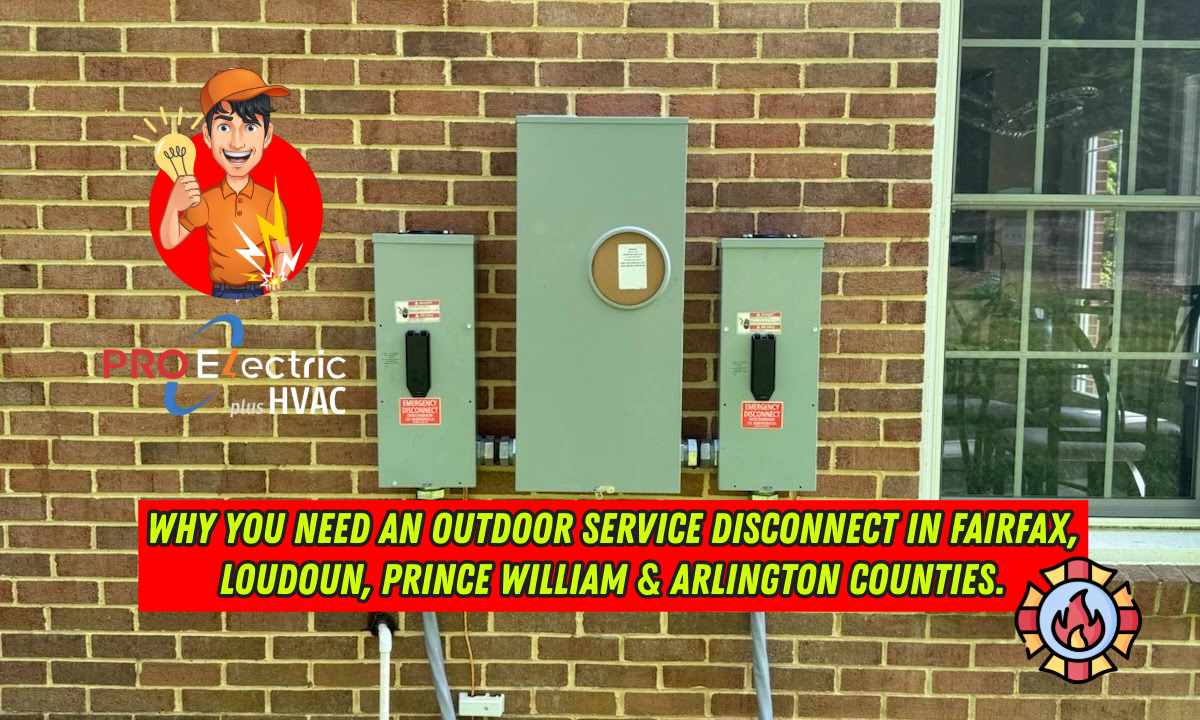
An outdoor service disconnect is a switch or breaker in a weatherproof box on the outside of your house that kills power to the whole home in one motion, so a firefighter can shut the place down without going inside. Virginia requires one on new one- and two-family homes, and on service work where the service equipment is replaced, under Virginia Residential Code Section E3601.8, which carries Section 230.85 of the 2020 National Electrical Code. An existing service that has no disconnect can stay as it is until you touch it. The moment you do a heavy-up, expect the disconnect to come with it.
Before anything else: what you can and cannot touch
The handle on the outside of the enclosure is yours to use. Everything behind the cover is not. The terminals on the line side stay energized by the utility even with the handle in the off position, and no breaker in your house protects them. If you see any of the following, leave it alone and call 703.225.8222 for 24/7 emergency electrical service.
What the box actually is, and where it sits
Hi, I'm Peter, the Master Electrician at PRO Electric plus HVAC. I install these across Northern Virginia most weeks, and almost every call starts the same way: somebody saw a gray box appear on a neighbor's wall, or an inspector wrote it on a punch list, and now they want to know what it is and whether they're about to be told to buy one.
Here's the whole thing in one line of plumbing. Power comes from the utility to your meter. From the meter it goes to a disconnect. From the disconnect it goes to your panel, and from the panel it fans out to the circuits in your house. In an older Northern Virginia home there is no disconnect in that chain, and the first switch capable of killing the whole house is the main breaker inside the panel, usually in a basement or a utility closet.
That's the problem the code set out to fix. A firefighter standing in your yard at 2 in the morning has no safe way to de-energize the house. Going inside a burning building to find a panel isn't an option, and pulling the meter is dangerous work on unprotected conductors. So the code moved a disconnecting means outside, where anyone can reach it.
| What people call it | What it is | What it cuts |
|---|---|---|
| Outdoor service disconnect | A switch or breaker outside, between meter and panel | The entire house |
| Emergency disconnect | The code name for the same device, from NEC 230.85 | The entire house |
| Main breaker | The large breaker at the top of your indoor panel | The entire house, but only from inside |
| AC or HVAC disconnect | Small box on the wall near the outdoor condenser | That one piece of equipment |
| Meter | The utility's measuring device, not a switch | Nothing. It is not a disconnect |
If you want to see one and where it lands on a wall, the short video below walks past a finished installation.
The Virginia code, stated precisely
This is the part most articles get wrong, so I want to be exact about which code Virginia is actually enforcing today.
Virginia adopts model codes through the Uniform Statewide Building Code. The 2021 edition of the USBC took effect on January 18, 2024, and it brought in the 2021 International Codes along with the 2020 National Electrical Code. There was a one year transition where a permit applicant could choose the 2018 or the 2021 code, and that window closed on January 18, 2025. Since then every permit in Virginia is under the 2021 USBC (Virginia DHCD, n.d.; Fairfax County Land Development Services, 2023).
The requirement itself lives in the Virginia Residential Code at Section E3601.8, which carries the text of NEC Section 230.85. Fairfax County lists it in its own summary of 2021 USBC changes as an emergency service disconnect required in a readily accessible outdoor location (Fairfax County Land Development Services, 2024). Chesterfield County's code change summary describes the same section and explains the reasoning: before this edition the service disconnect was allowed to be inside the dwelling, usually in the panel, with no outdoor disconnect required at all (Chesterfield County, n.d.).
The 2020 NEC text is short. For one- and two-family dwellings, all service conductors have to terminate in a disconnecting means with a short-circuit current rating equal to or greater than the available fault current, installed in a readily accessible outdoor location. Where more than one disconnect is provided, they have to be grouped.
Two things you may read elsewhere that do not apply in Virginia yet
The 2023 NEC rewrote 230.85 and added wording about the disconnect being on or within sight of the dwelling, a replacement clause at 230.85(C), and a plaque requirement for other energy sources. Those are real, and they're not in the edition Virginia enforces. The 2026 NEC goes further and deletes 230.85 entirely, folding the requirement into 230.70. Virginia is on the 2020 edition, so 230.85 as written in 2020 is what your inspector is holding. If you are reading an article written for another state, check which edition it is quoting before you plan a job around it.
When is a disconnect required, and when is it not
The short version: new work triggers it, existing work doesn't.
A disconnect is required
- New construction, one- and two-family dwellings.
- A new electrical service to a house that never had one.
- A service change where the service equipment is replaced, including most panel replacements and heavy-ups.
- Any job where the service conductors are re-terminated into new equipment.
A disconnect is not required
- An existing service you're leaving alone. Nothing in the code makes you retrofit one.
- Adding circuits, replacing breakers in an existing panel, or ordinary repairs that leave the service equipment alone.
- Selling the house. There's no Virginia requirement to add one at a sale, though a home inspector may note that the house doesn't have one.
The gray area is the middle case, and it's worth understanding rather than taking on faith. The 2020 NEC does not contain the explicit replacement sentence that the 2023 edition added. What it does say is that all service conductors have to terminate in a disconnecting means in a readily accessible outdoor location. When you replace service equipment, you are re-terminating those conductors into new equipment, and that new termination has to satisfy the rule. That is how Northern Virginia inspectors apply it, and it is why panel repair and upgrade quotes in this area include a disconnect. Ask your county for their interpretation in writing if the cost matters to your decision, since this is an interpretation and not a stand-alone sentence in the adopted edition.
Service upgrades: going from 60 or 100 amps to 200
A lot of the houses we work on in Loudoun and Fairfax were built with 60 or 100 amp service, which was plenty for a 1960s kitchen and no air conditioning. Add a heat pump, an induction range, a hot tub, and a car charger, and that service runs out of room. The upgrade to 200 amps is one of the most common jobs on our board.
Here's what the job actually includes, because homeowners are often quoted for the panel alone and then surprised by the rest:
- New service entrance conductors and meter base. The old wire and meter socket were sized for the old service and can't carry the new one.
- The outdoor disconnect. New service equipment means the service conductors terminate in new equipment, and that termination has to meet E3601.8.
- A new panel and breakers. Sized for the new service, with space for the loads you are adding. See circuit breaker replacement if the panel itself is sound.
- Grounding and bonding brought to current code. Ground rods, water pipe bonding, and the grounding electrode conductor all get checked and usually upgraded.
- Surge protection at the service. The 2021 Virginia Residential Code also added Section E3606.5, which requires a surge protective device at the service panel on this work. Our whole home surge protection page covers what that device does.
- Permit, inspection, and a utility disconnect and reconnect. Dominion Energy or NOVEC pulls the meter so the work can be done safely and sets it again afterward.
Every one of those is required work, not an upsell. If a quote you're comparing leaves out the disconnect or the surge device, it's a job that fails inspection. I'd rather explain that up front than have you find out from an inspector.
Sizing and rating: what actually goes on the wall
For most Northern Virginia houses getting new service equipment, the answer is a 200 amp, 120/240 volt single phase disconnect in a NEMA 3R enclosure rated for outdoor use. A 100 amp service takes a 100 amp disconnect. The enclosure rating matters as much as the amperage, because this thing lives in weather for the next 30 years.
The rating people skip is the short-circuit current rating. The code requires the disconnect to have a rating equal to or greater than the available fault current at that point in the system, which depends on the utility transformer and the length and size of the service conductors. It's a calculation. If someone quotes you a disconnect without knowing your service, they're guessing.
The 2020 NEC gives three ways to satisfy the requirement, and the labeling is different for each. This is what your inspector reads first:
EMERGENCY DISCONNECT, SERVICE DISCONNECT
Used when the outdoor device is the service disconnect itself. The most common arrangement on new work.
EMERGENCY DISCONNECT, METER DISCONNECT, NOT SERVICE EQUIPMENT
Used when a meter disconnect sits ahead of the service disconnect, and the service disconnect stays elsewhere.
EMERGENCY DISCONNECT, NOT SERVICE EQUIPMENT
Used for a separate listed disconnect on the supply side of the service disconnect, where the indoor panel remains the service equipment.
The marking has to be permanent and durable for the environment it's in. A label printed on office paper and taped to the cover doesn't pass, and I have seen jobs held up over exactly that. Getting the wording wrong is the single most common reason these fail a first inspection, which is why I keep the three versions taped inside my van door.
What readily accessible means in the field
Readily accessible is a defined term, and inspectors apply it literally. A person has to be able to get to the disconnect and operate it quickly, without a ladder, without moving obstacles, and without going through a locked space they have no key to.
Things I have had to move or re-plan around: a condenser installed directly in front of the disconnect, a deck built over the meter wall, a gate padlocked by the homeowner, a row of shrubs grown up to the enclosure, and a garden shed built against the house. The disconnect itself can be locked. The path to it cannot be blocked. If you're landscaping or adding a deck near your meter, keep the wall clear, because moving a service after the fact is expensive work.
The other disconnects on your house, and why they get confused
Search for outdoor disconnect and you get results about three different devices. Worth separating them, because we install all three and they do different jobs.
- The service disconnect. Cuts the whole house. Near the meter. The subject of this page.
- The HVAC disconnect. The small box on the wall beside your outdoor condenser. It cuts power to that unit only, and the code requires it to be within sight of the equipment so a technician can't have power restored behind their back. If yours is missing, corroded, or has been replaced with a pulled fuse holder that nobody can find, that is worth fixing at your next air conditioning service visit.
- Appliance disconnects. Water heaters, well pumps, pool equipment, and similar loads can each need a local disconnecting means, depending on the equipment and where its overcurrent device sits. These are small, cheap, and routinely missing on older installations.
If your power is out in only part of the house, none of these are the likely cause. That's a different problem, and I wrote it up separately in half of the house lost power.
Solar, batteries, and EV chargers
Adding solar or a car charger does not by itself trigger the service disconnect rule. What triggers it is replacing the service equipment. The connection is indirect and very common: a 48 or 60 amp charger, or a solar interconnection that won't fit the existing busbar, forces a service upgrade, and the upgrade brings the disconnect with it. So the honest answer to whether an EV charger installation needs an outdoor disconnect is: only if your service has to be replaced to support it, and on a 100 amp service with a heat pump it often does.
Solar carries its own separate requirements on top of anything discussed here, including a PV system disconnecting means and a rapid shutdown initiation device outside the building. Those come from different code articles and a solar contractor handles them. What I'd ask for, before signing anything, is a written scope that says plainly whether your service is being replaced, because that single answer decides whether an outdoor disconnect is part of your project.
How the job runs when we do it
A service disconnect isn't a big construction project, but it's a day where your power goes off and a utility crew has to show up. Here's the sequence:
- A site visit to read your existing service: amperage, meter base condition, conductor routing, wall space, and whether the panel is staying or going.
- Permit filed with the right office. Fairfax County, Loudoun County, Prince William County, Arlington County, and the independent cities of Falls Church and Fairfax each run their own, and filing with the wrong one costs you a week.
- Utility disconnect scheduled with Dominion Energy or NOVEC, since the meter has to come out.
- Installation: new meter base if needed, the disconnect in a NEMA 3R enclosure, service conductors, grounding and bonding, and the permanent labeling.
- Reconnect, then inspection. We meet the inspector rather than leaving you to do it.
- A walk through with you at the end, standing at the disconnect, so you know how to use it before you need to.
This is our outdoor service disconnect work, and it runs through the same licensed team that handles panel upgrades, code corrections, and electrical inspections. Veteran and military discounts apply, and financing is available on request.
Call 703.225.8222 Request a quoteShould you add one if you are not required to?
I'll give you the straight version rather than the sales version. If your service is in good condition and you have no work planned, adding a disconnect on its own is optional, and I'm not going to tell you your house is unsafe without one. Plenty of sound houses in Northern Virginia have no outdoor disconnect and never will.
Where I do recommend it: if your service equipment is aging and a replacement is coming anyway, do it all at once, because the utility coordination and the labor overlap. If you have a family member who uses medical equipment, or you are in a wooded area where fire response time is a real consideration, the outside shutoff has a value the code is not measuring. And if your meter base is already showing rust or heat damage, the conversation isn't about the disconnect at all, it's about the service. Our page on home wiring and the write-up on the outdoor service disconnect in Pimmit Hills both go further into what an aging service looks like.
Questions I get about outdoor disconnects
What is an outdoor service disconnect?
It is a switch or breaker in a weatherproof enclosure on the outside of your house that cuts all power to the home in one motion. Electricians also call it an exterior service disconnect, an emergency disconnect, or an outside disconnect. It sits between the meter and your panel, so everything downstream of it goes dead when it is opened. The label on it reads EMERGENCY DISCONNECT.
What does external power disconnect mean?
It means a disconnecting means located outside the building rather than inside. For a house, that is a switch or breaker mounted on an exterior wall, usually right beside the meter, that a firefighter can reach and open without entering the building. Inside the house, the main breaker in your panel does the same electrical job, but a first responder cannot get to it from the yard.
Is an outdoor disconnect required in Virginia?
Yes, for new one- and two-family homes and for service work that replaces the service equipment. Virginia adopted the 2020 National Electrical Code as part of the 2021 Uniform Statewide Building Code, effective January 18, 2024, with mandatory compliance from January 18, 2025. The requirement appears in the Virginia Residential Code as Section E3601.8, which carries NEC Section 230.85. It calls for an emergency service disconnect in a readily accessible outdoor location.
Does my existing house need one added?
Not on its own. An existing service that was legal when it was installed can stay as it is. What triggers the requirement is new work: a new home, a new service, or a service change where the service equipment is replaced. If your panel and meter stay where they are and nothing at the service is replaced, no inspector is going to make you add one.
Does a panel upgrade or a heavy-up trigger the requirement?
In practice, yes, and this is where homeowners get surprised. Under the 2020 NEC that Virginia enforces, all service conductors have to terminate in a disconnecting means in a readily accessible outdoor location. Replace the service equipment and re-terminate those conductors, and the new termination has to meet that rule. Northern Virginia inspectors read it that way, so budget the disconnect into any heavy-up. Confirm the interpretation with your county before the job, because it is an interpretation, not a separate sentence in the adopted code.
Where exactly does the disconnect go?
Outdoors, readily accessible, normally on the same wall as the meter and within a few feet of it. Readily accessible means a person can reach it without a ladder, without moving furniture or equipment, and without opening a locked space they have no key to. It can be locked to keep strangers out and still meet the rule. It cannot be behind a gate you keep chained, inside a shed, or blocked by a condenser or a stack of firewood.
What size outdoor disconnect do I need?
It has to match the service. Most Northern Virginia homes getting new service equipment land on a 200 amp, 120/240 volt single phase disconnect in a NEMA 3R weatherproof enclosure, and the enclosure has to be rated for outdoor use. The code also requires the disconnect to have a short-circuit current rating equal to or greater than the available fault current at that location, which is a calculation, not a guess. A 100 amp service takes a 100 amp disconnect.
What has to be written on the label?
The 2020 NEC gives three ways to satisfy the rule, and each has its own required wording. A service disconnect is marked EMERGENCY DISCONNECT, SERVICE DISCONNECT. A meter disconnect ahead of the service disconnect is marked EMERGENCY DISCONNECT, METER DISCONNECT, NOT SERVICE EQUIPMENT. A separate listed disconnect on the supply side is marked EMERGENCY DISCONNECT, NOT SERVICE EQUIPMENT. The marking has to be permanent and durable enough for the location. Inspectors fail jobs over missing or wrong labels more often than over the hardware.
Should the service disconnect breaker be on or off?
On. It is the normal path for power into your house, so it stays closed during everyday use. You only open it when the power needs to be off for the whole house: a fire, flooding, a service repair, or work at the panel. If you find it off and you did not turn it off, do not just flip it back on. Something opened it, and that reason is worth finding first.
Is it safe for me to turn the outdoor disconnect off?
Operating the handle from the outside of the enclosure is safe, and that is exactly what it is designed for. Expect a firm mechanical action and a loud clunk. What is not safe is opening the cover, removing the deadfront, or touching anything inside, because the terminals on the line side stay energized by the utility even with the handle off. Only the utility can kill that. If anything inside is smoking, scorched, or buzzing, leave it and call for emergency service.
Is the outdoor disconnect the same as my air conditioner disconnect?
No, and this trips people up. The small box on the wall near your outdoor condenser is an HVAC disconnect. It cuts power to that one piece of equipment so a technician can service it, and the code requires it to be within sight of the unit. The service disconnect cuts power to the entire house. Same idea, very different scope. A water heater or a well pump can have its own local disconnect too.
Do solar panels or an EV charger require an outdoor disconnect?
Adding either one does not by itself trigger the service disconnect rule. What triggers it is replacing the service equipment, and a heavy charger or a solar interconnection often makes a service upgrade necessary, which then brings the disconnect with it. Solar carries its own separate requirements, including a PV system disconnecting means and rapid shutdown. Ask for the whole scope in writing before the work starts so nothing lands as a surprise at inspection.
Do I need a permit, and who inspects it?
Yes, this is permitted work, and the permit goes to whichever authority has jurisdiction over your address: Fairfax County, Loudoun County, Prince William County, Arlington County, or an independent city such as Falls Church or Fairfax City, which run their own offices. A licensed electrical contractor pulls the permit. We also coordinate the disconnect and reconnect with Dominion Energy or NOVEC, because the meter has to be pulled to do the work.
How long does the work take?
Adding a disconnect as part of a service change is usually a single day, with the house without power for part of it. A standalone disconnect on an existing service is shorter. The variables are the utility coordination, whether the meter base is in good condition, and how the service conductors are routed. Scheduling the utility is normally the longest lead time, not the work itself.
Fairfax, Arlington, Loudoun, and Prince William Counties
Get a quote on your service
Tell us your address and what you are planning, and we will tell you whether a disconnect is part of the job before you commit to anything. Or call 703.225.8222.
Burned meter base or a disconnect that will not hold?
Damage at the service gets worse every time the house pulls a heavy load. Our emergency line answers 24/7.
24/7 emergency electrical serviceRelated reading
Plain English help for the electrical questions I get asked most.
Sources
Code citations were checked against the editions Virginia has adopted, in September 2026. Field explanations come from service work across Northern Virginia.
- Virginia Department of Housing and Community Development. (n.d.). Codes. https://www.dhcd.virginia.gov/codes
- Fairfax County Land Development Services. (2023). Adoption of the 2021 Virginia Uniform Statewide Building Code. https://www.fairfaxcounty.gov/landdevelopment/sites/landdevelopment/files/Assets/documents/23-07-adoption-2021-virginia-uniform-statewide-building-code-usbc.pdf
- Fairfax County Land Development Services. (2024). Summary of code changes, 2021 Virginia USBC. https://www.fairfaxcounty.gov/landdevelopment/sites/landdevelopment/files/Assets/documents/24-02-summary-code-changes-2021-virginia-usbc.pdf
- Chesterfield County. (n.d.). Significant changes in the 2021 Virginia Residential Code. https://www.chesterfield.gov/DocumentCenter/View/41513/Significant-Changes-in-the-2021-Virginia-Residential-Code-PDF
- Prince William County. (n.d.). Virginia Uniform Statewide Building Code. https://www.pwcva.gov/department/building-development-division/vusbc
- Electrical Contractor Magazine. (2023, November 15). Outdoor emergency disconnecting means. https://www.ecmag.com/magazine/articles/article-detail/outdoor-emergency-disconnecting-means-installing-and-marking-this-equipment-for-one--and-two-family-dwellings
Planning service work? Find out now, not at inspection.
Licensed Master Electricians serving Fairfax, Loudoun, Arlington, and Prince William Counties. We read your existing service, tell you what the code actually requires, and pull the permit. Veteran and military discounts available.
Call 703.225.8222 Contact usPRO Electric plus HVAC. Virginia Electrical and HVAC Contractor License 2705181607. 800 West Broad Street, Falls Church, VA 22040.