
By Peter, Master Electrician | PRO Electric plus HVAC | Electrical Panel Upgrades
Hi, I’m Peter from PRO Electric plus HVAC, a Master Electrician who’s worked in Northern Virginia for years. Lately, I’ve seen a surge of electrical panel problems across Fairfax, Loudoun, Arlington, and Prince William counties, from constantly tripping breakers to overheated breaker boxes.
When your lights flicker or a breaker trips as soon as the AC or microwave kicks on, it’s not just an annoyance. It’s your home’s way of telling you something’s wrong.
Many homes here were built decades ago with 60-amp or 100-amp panels that weren’t designed for the demands of modern living.
Today’s families are plugging in more devices and high-power appliances than ever, quickly overloading those old panels.
In this deep-dive guide, I’ll break down the challenges by county – looking at each area’s typical home ages, builders, and panel types – and explain why circuits trip and what can be done to keep your home safe and up to code.
BOTTOM LINE UP FRONT (BLUF)
Older homes in Northern Virginia often have undersized or outdated electrical panels that struggle to meet today’s load requirements. Homes built in the 1950s–1980s with 60A or 100A service were fine for a few lights and a fridge, but now they’re pushed to the brink by central air, heat pumps, kitchen appliances, home offices, and even EV chargers. The result? Overloaded circuits and frequent breaker trips early warning signs of a system at capacity.
Many of these houses also have obsolete breaker panels (like Federal Pacific or split-bus designs) known to fail dangerously, or even old fuse boxes that have been “patched” in unsafe ways. To protect your home, panel upgrades (often to 200A) are becoming essential. In fact, as of 2025, new electrical codes require the installation of an outdoor emergency disconnect switch during major service upgrades. Upgrading isn’t just red tape it’s about safety, preventing fires, and ensuring your electrical system meets today’s standards.
Most Common FAQs:
Why do my circuit breakers keep tripping in my Northern Virginia home? In older Northern Virginia homes, frequent tripping usually happens because modern appliances (AC, microwaves, EVs) overload outdated 60-amp or 100-amp electrical panels. If you live in a home built between the 1950s and 1980s, your panel likely lacks the capacity for today’s high-power devices, requiring a service upgrade.
What is the new outdoor disconnect requirement for electrical panels in Virginia? As of the 2020/2021 code adoption, most Northern Virginia counties (including Fairfax, Loudoun, Arlington, and Prince William) require an outdoor emergency disconnect switch for any new service or major panel upgrade. This allows firefighters to safely cut power from the outside during an emergency without entering the home.
Is a Federal Pacific (Stab-Lok) panel safe? No. Federal Pacific Electric (FPE) Stab-Lok panels are considered a significant fire hazard because their breakers often fail to trip during an overload. These panels were common in homes in Fairfax and Prince William County built in the 1960s and 70s. Master Electricians recommend replacing them immediately to prevent overheated wires and fire risks.
Can I install an EV charger on a 100-amp electrical panel? It is rarely safe or feasible. A Level 2 EV charger typically requires a 30–60 amp dedicated circuit, which can take up half the capacity of a 100-amp panel. To charge an electric vehicle safely without tripping your main breaker, you typically need a “heavy-up” service upgrade to 200 amps.
Table of Contents
- Modern Home Electricity Demands vs. Old Panels
- Fairfax County – Aging Suburban Panels vs. 21st-Century Loads
- Loudoun County – Newer Homes, Bigger Demands (and Some Hidden Old Wiring)
- Arlington County – Old Urban Homes with Outdated Wiring and Limited Service
- Prince William County – Diverse Housing Ages from Historic to Modern Mega-Homes
- Staying Safe and Up-To-Code: Final Thoughts from Peter
Modern Home Electricity Demands vs. Old Panels

Let’s put it in perspective. Decades ago, a typical Northern Virginia home had relatively modest electrical needs – maybe a few kitchen appliances, some lights, a TV, and no central AC. Today, by contrast, our homes draw power from all sorts of high-demand equipment:
- Heating & Cooling: Central air conditioning units and heat pumps (often multiple systems in larger homes).
- Kitchen Appliances: Refrigerators and freezers, microwave ovens, electric ranges or double-wall ovens, dishwashers, toasters, coffee makers – sometimes all running at once.
- Electric Vehicles: Level 2 EV chargers drawing 30–60 amps on a 240V circuit (a single charger can use almost half the capacity of an older 100A panel by itself).
- Home Electronics: Home theater systems with big-screen TVs, amplifiers, gaming consoles; plus multiple computers, monitors, and networking gear for home offices.
- Other Additions: Tankless water heaters, clothes dryers, space heaters, heated bathroom floors, hot tubs or spas, and dozens of smart devices and chargers throughout the house.
All these loads stack on top of each other, and many older breaker panels weren’t built for this lifestyle. It’s no surprise that breakers trip constantly when too many devices run on a circuit that was originally wired for far fewer gadgets.
Lights dim when the AC kicks on, or a blow dryer in the bathroom might trip the same circuit powering the bedroom and hallway. These aren’t random fluke incidents – they’re signs your electrical panel is overtaxed.
In the sections below, I’ll break down each Northern Virginia county – Fairfax, Loudoun, Arlington, and Prince William – to explain why their homes experience these panel and circuit issues. We’ll look at the age of homes and neighborhoods, the standard panels or wiring used by builders, and specific challenges like EV charger additions or the new outdoor disconnect law that’s catching some homeowners off guard. Let’s dive in.
Fairfax County – Aging Suburban Panels vs. 21st-Century Loads
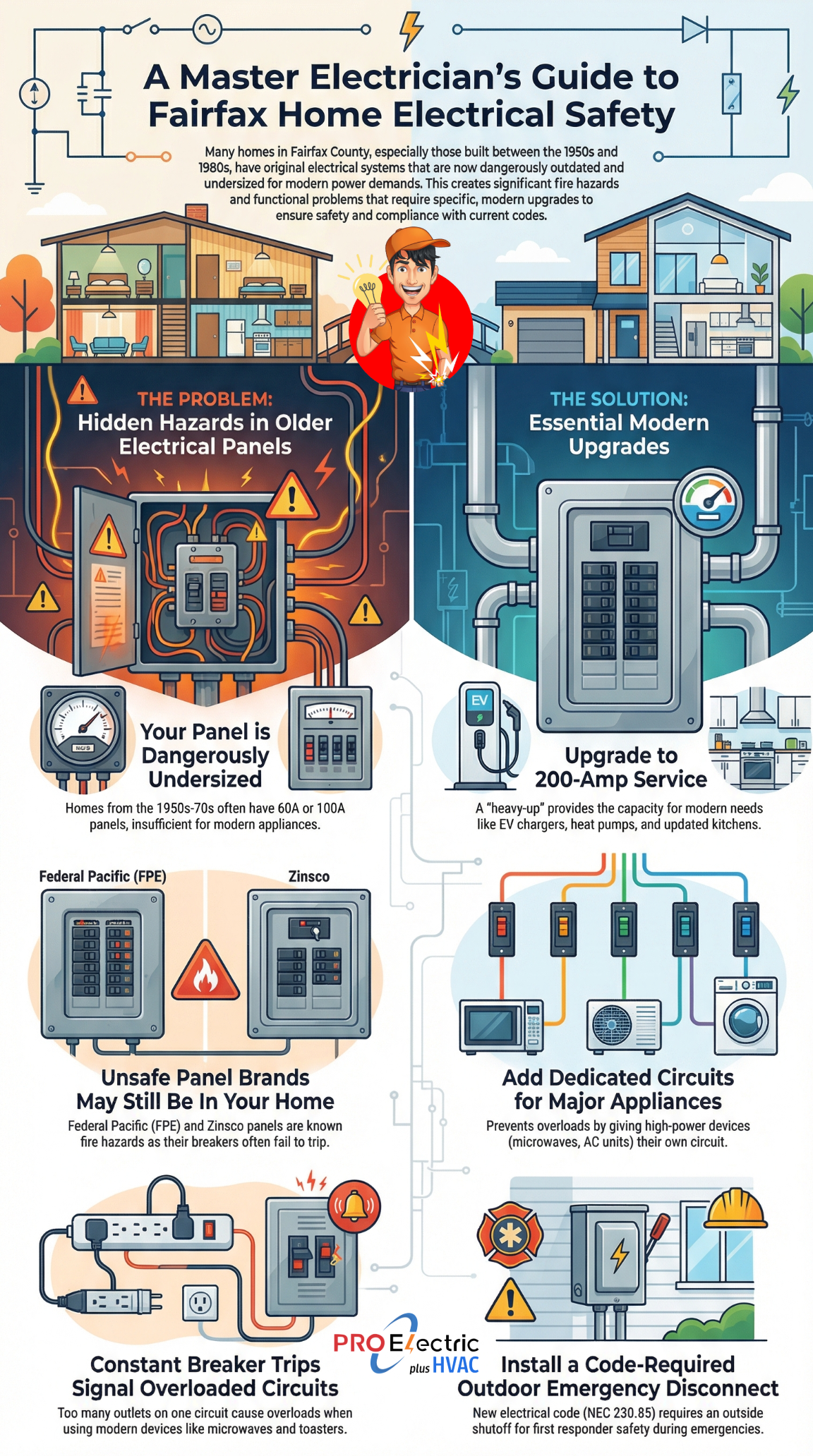
Do I need a panel upgrade for a house in Fairfax County? If your Fairfax home was built in the 1950s–1980s (like in Annandale or Burke) and still has a 100-amp service, you likely need an upgrade. Modern loads like heat pumps and home offices often push these older panels to the limit, causing breakers to trip.
Fairfax County is a big, diverse area with homes ranging from 1940s bungalows to brand-new McMansions. That means the electrical challenges vary by neighborhood and era.
In older communities inside the Beltway – places like Annandale, Springfield, Burke, and Fairfax City – many houses were built in the 1950s–70s. These homes often still have their original 60-amp or 100-amp electrical panels, which are woefully undersized for modern needs. Even homes built in the 1980s in areas like Reston or Oakton might have 150A service at most.
1. Old Panels & Overloaded Circuits in Fairfax
In those mid-century and 1970s homes, it’s common to find outdated breaker boxes that struggle to meet today’s standards. For instance, many Fairfax houses from the ’60s still had Federal Pacific Electric (FPE) Stab-Lok panels or split-bus panels (the kind with no single main breaker).
FPE panels were standard back then, but the scary part is that they’re known for breakers that often fail to trip when they should, leading to overheated wires and potential fire. Split-bus panels (used in homes before the late ’70s) are another hazard – they have 5–6 “main” breakers instead of one shutoff.
Not only are these panels 40+ years old (past their life expectancy), but modern electrical code no longer allows that design because there’s no single quick way to disconnect power in an emergency. If your Fairfax home still has an FPE panel or a split-bus panel, replacing it is critical for safety, not just convenience.
Another issue is too few circuits in older Fairfax homes. Builders decades ago often wired an entire floor or several rooms on one circuit to save money.
As a result, I often hear homeowners in Fairfax County say their breakers trip constantly – e.g., the kitchen and dining room lights go out whenever they run a microwave and a toaster simultaneously.
This happens because too many outlets and lights were wired onto a single breaker back in the day, so modern appliance use easily overloads it. I’ve seen houses in Burke and Annandale where the homeowner had resorted to stringing extension cords and power strips to different outlets to avoid trips, which only creates new hazards.
The proper solution is to add more dedicated circuits and upgrade the panel, so each high-power device (fridge, microwave, hair dryer, AC, etc.) has its own supply and won’t trip other areas.
2. Builder Practices & Panel Brands
Fairfax County had a massive building boom in the mid-20th century (think Levittown-style tract developments in the 60s and suburban expansions in the 70s). The electrical systems in those homes met the code of the time, but were not exactly future-proof.
Many were built with the absolute minimum capacity allowed by the code. For example, a small rambler in 1965 might get a 60A fuse panel if it had gas heat, or a 100A breaker panel if electric baseboard heat – but nothing larger.
And the circuits were often loaded up: maybe one 15A circuit for all receptacles in two bedrooms and a hallway, etc. Fast-forward to today: the same house likely has central air conditioning (drawing 20–30 amps itself), a modern refrigerator, and multiple TVs and computers. It’s a recipe for nuisance trips and even overheated wiring.
Builders also commonly used certain panel brands that are now known liabilities – FPE Stab-Lok was one (cheap and widely installed in the 60s-70s) and Zinsco (Sylvania) panels in the 70s. Both brands have a documented history of failure (breakers that appear off but still let power flow, or breakers that never trip at all).
If you see those names in your Fairfax home’s electrical box, know that many home inspectors and electricians consider them unsafe. (In fact, the Consumer Product Safety Commission investigated FPE panels and found serious design flaws.)
Other outdated panel types, such as old Pushmatic breaker panels (from the 1950s) or early Challenger panels (1980s), might also be present in some Fairfax homes – these have issues with breakers sticking and problematic bus bar connections.
The bottom line is that aging panels and breakers become unreliable after decades of service. Connections loosen, internal springs wear out, and the risk of a breaker not tripping during an overload increases, which can lead to fire.
3. Modern Upgrades Stressing Fairfax Panels
Fairfax County homeowners are also adding new heavy loads that tax older electrical systems. A typical example is installing a Level 2 EV charger for an electric car. This typically requires a 240V dedicated circuit that draws 40–50 amps.
On a house with a 100-amp panel, that’s almost half the panel’s entire capacity for one car charger! Add an existing central AC (another ~30 amps) and an electric dryer (25 amps), and you can see how quickly a 100A or even 150A service gets maxed out.
I frequently have to tell homeowners in Fairfax: we need to upgrade your service to 200 amps before we can safely install that EV charger. It’s often not feasible to add an EV circuit to a 100A panel without sacrificing other appliances or risking constant trips.
Fairfax County’s permit process actually enforces this – when you pull a permit for an EV charger or a big appliance, the county will ask for a load calculation. If your existing panel is too small, they’ll require a service upgrade (and now an outdoor disconnect – more on that shortly) before approving the work.
Even without an EV, consider the cumulative load in a modern Fairfax home: air conditioning, electric heat pumps, maybe a second refrigerator in the garage, multiple large TVs, etc. 100 amps isn’t sufficient for many households today.
That’s why 200-amp service upgrades (sometimes called a “heavy-up”) have become so common in Fairfax County. In newer, larger homes (say built in the 1990s in areas like Chantilly or Centreville), 200A was typically installed initially, but even those can get strained if the house has been outfitted with every modern convenience (think finished basement with home theater, plus a kitchen upgrade with double wall ovens and high-end appliances, plus an EV in the garage).
I’ve seen cases in Fairfax Station where a large 1980s house with two AC units and a Tesla charger actually needed a 400A service (two 200A panels) to be comfortable and future-proof truly. While that’s an extreme, it underscores that panel capacity needs to match the lifestyle. If you find your breakers are tripping whenever multiple big appliances run, it’s a sign the panel might be undersized for your needs.
4. New Code: Emergency Disconnect Requirement (Fairfax County)
One new wrinkle Fairfax homeowners are encountering is the 2020–2021 code update requiring outdoor emergency disconnects. As of 2022-2023, Virginia adopted the latest National Electrical Code rules, so that any new home or major electrical service upgrade in Fairfax must include a readily accessible outdoor disconnect switch.
Fairfax County’s inspectors now enforce this law: if you upgrade from, say, 100A to 200A, you’ll be required to put the main shutoff outside (usually in a meter-panel combo or an exterior disconnect box) before the panel indoors.
The reason is safety – it gives firefighters an easy way to cut all power without entering the house in an emergency. Many older Fairfax homes have only the main breaker inside; if there’s a fire, firefighters used to have to wait for the utility to cut power or risk cutting it themselves.
No more – now the first responder can flip the external switch. This “outside main” rule (NEC 230.85) applies to all Northern VA jurisdictions, but Fairfax was one of the first to roll it out. So, if you’re planning a panel replacement or installing an EV circuit in Fairfax County, expect to add an outdoor disconnect to pass inspection.
It’s a bit of extra cost, but it’s now part of staying code-compliant (and frankly, it’s a good safety upgrade for your home).
In summary, for Fairfax: Many homes here have outgrown their original electrical systems. The combination of aging infrastructure (old panels that may not trip or have no spare capacity) and increased power usage (HVAC, kitchen, EVs) can lead to circuit tripping and even fire hazards if unaddressed.
Upgrading to a modern 200A panel with more circuits isn’t just about convenience – it’s about preventing overheating and fires. If your Fairfax home still runs on an old 100A panel or has an FPE, Zinsco, or fuse box, it’s time to consider upgrading seriously. It’ll not only stop those annoying breaker trips, but also bring you up to current safety standards (including that handy shutoff outside).
Loudoun County – Newer Homes, Bigger Demands (and Some Hidden Old Wiring)
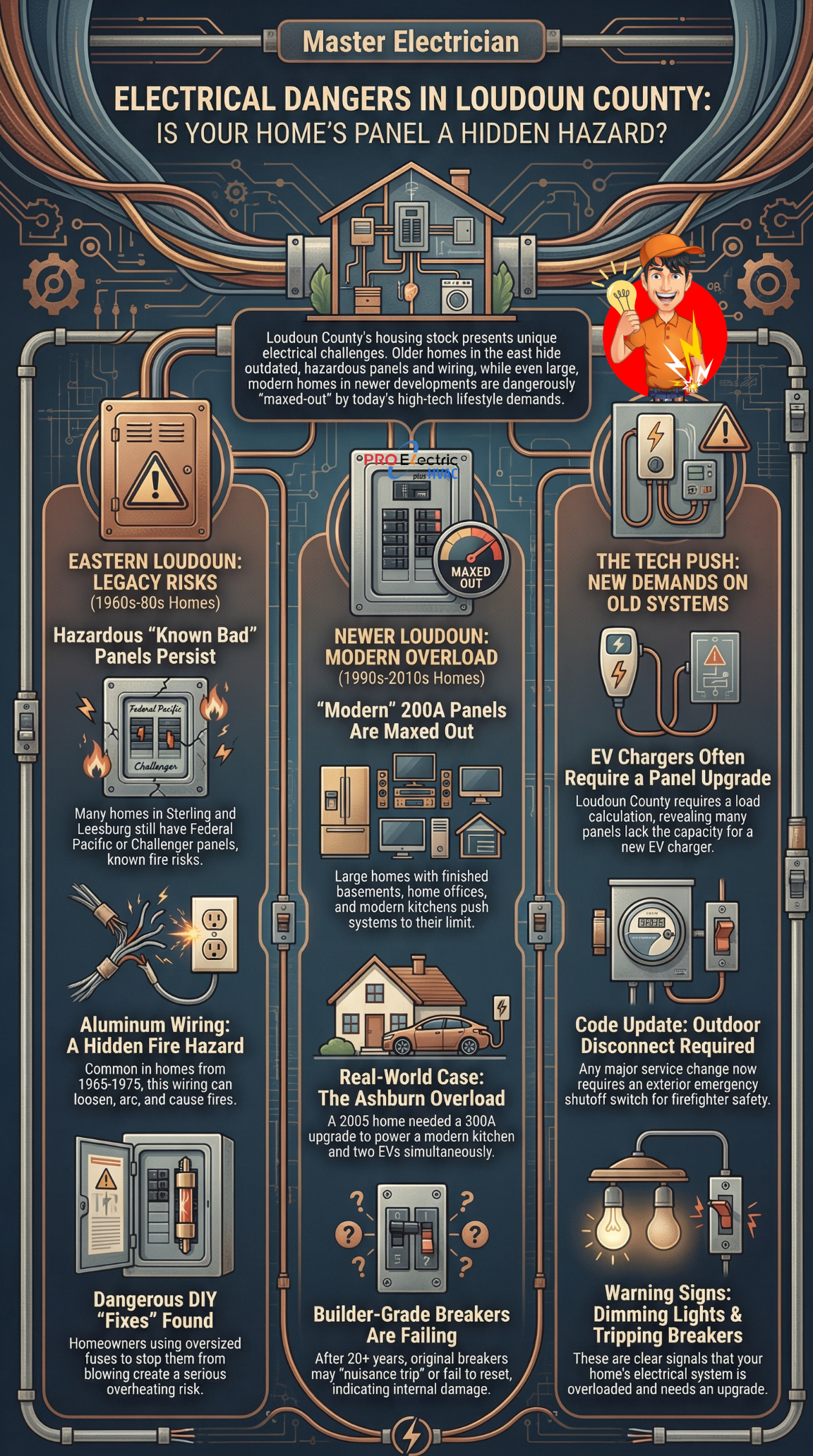
Common electrical problems in Loudoun County homes While many Loudoun homes are newer, common issues include “maxed-out” 200-amp panels in large homes (Ashburn/Brambleton) due to finished basements, hot tubs, and EVs. Additionally, older homes in Sterling may still have hazardous aluminum wiring or Federal Pacific panels that need replacement.
Moving west to Loudoun County, the situation is a bit different. Loudoun is known for its rapid growth in the 1990s and 2000s – vast communities in Ashburn, Sterling, South Riding, Brambleton, and beyond sprang up, filled with large modern homes.
On average, Loudoun’s housing stock is newer than Fairfax’s, so fewer homes have 60A fuse panels or 50-year-old breakers. However, Loudoun has its own mix of challenges: aging rural properties on one end, and very large contemporary homes on the other.
In fact, some of the panel issues I see in Loudoun are from homes that technically already have 200-amp service, but the sheer size and outfitting of the house push that 200A to its limits.
1. Eastern Loudoun – 1960s–80s Legacy Panels
Not all of Loudoun is new. In eastern Loudoun, places like Sterling Park were developed in the 1960s as some of the county’s first D.C. suburbs. A lot of those houses were modest ranch and split-level homes built with then-standard electrical setups: often 100-amp Federal Pacific panels (since FPE was popular in that era) or even fuse boxes in the very early ’60s.
Many Sterling Park homes also used aluminum branch-circuit wiring, which was common in this region from about 1965 to 1975. Aluminum wiring tends to loosen and cause hot connections at devices, which can lead to arcing and breaker trips or failures. So if you have a house in Sterling or older parts of Leesburg, it’s worth checking when the electrical system was last updated.
I’ve encountered townhouses in Sterling from the early 70s that still had Challenger panels (an 80s brand known for overheating issues) and aluminum-wired outlets – a combination ripe for trouble. These older Loudoun homes face problems similar to Fairfax’s older homes: undersized panels and outdated breakers.
Breakers that don’t trip when they should, or fuses that blow often, are common complaints. In some cases, I’ve found an old fuse box where a homeowner had put in oversized fuses to stop them from blowing – a dangerous “fix” that can allow wires to overheat (essentially defeating the safety of the fuse).
If you see any evidence of such quick fixes – like a 30-amp fuse where a 15 should be – it’s a red flag that the panel needs replacement and the wiring needs evaluation.
Even some historic homes in Loudoun’s small towns (like Leesburg’s downtown, Waterford, and Middleburg) still have very old electrical systems. I’ve worked on a farmhouse near Purcellville that had knob-and-tube wiring feeding an old 60A fuse panel – truly a museum piece electrically.
Those kinds of properties absolutely need an overhaul to be safe for modern use. The charm of a historic Loudoun home can hide serious fire hazards behind the walls if the wiring and panels haven’t been updated. For any Loudoun house built before 1970, I always recommend a thorough electrical inspection – check whether the panel is among the “known bad” brands and whether the wiring is copper and properly grounded.
Often, the solution is a full heavy-up (to 200 amps) and a new breaker panel, plus mitigation of any aluminum wiring with proper connectors or rewiring segments. It’s an investment, but it brings immense peace of mind.
2. Western Loudoun – Rural Electrification Quirks
Western Loudoun County has a different vibe – it’s rural, with many homes on well water and electric heat. Some of these homes, especially if built mid-century or earlier, had minimal electrical service initially (maybe a 60A service for a farmhouse).
Over the years, many have been added onto or partially updated. It’s not unusual out in Lovettsville or Round Hill to find a house where someone tacked a newer subpanel onto an old service instead of replacing it.
I’ve seen scenarios like an older 100A main panel feeding a newer subpanel for an addition, but the homeowner still trips the main when running too many things because the overall service is maxed out.
Additionally, in rural areas, you might encounter more generator hookups or solar panels being added, which can complicate the load on the original panel if not done carefully. Western Loudoun folks who add a Tesla Powerwall or a solar array often discover that their original service equipment needs upgrades (and code requires the proper disconnects and interlocks for those systems).
3. Newer Loudoun Developments – “Maxed-Out” 200A Panels
The bulk of Loudoun County’s population lives in houses built in the 1990s through the 2010s – think Ashburn Farm (90s), Broadlands (early 2000s), Brambleton (2010s), etc. These homes typically came with 200-amp panels from the start, which is good.
However, builders in that era often designed the electrical system to meet immediate needs, not necessarily with much spare capacity. A large 3000+ sq. ft. house with all-electric appliances and HVAC will definitely use a good chunk of a 200A service.
Now add what people have done since: finished the basement (adding media rooms, extra refrigerators, or a wine cooler), installed a high-end kitchen, possibly a level 2 EV charger or two. Suddenly, even a newer Loudoun home can start tripping breakers or running out of breaker slots.
A real-world example: In Ashburn, I had a client whose home was built in 2005 with a 200A panel. By 2023, they had a home office with multiple computers, an updated kitchen with a double oven and induction cooktop, and two electric cars. They kept overloading the main panel – the breakers for the kitchen and EV would trip on hot days when everything ran at once.
The solution was to upgrade them to a “heavy-up” 300A service with dual panels. We installed a subpanel solely for the EV circuits and some dedicated lines for the kitchen appliances. This relieved the stress on the original panel. They also opted for a whole-home surge protector at that time (which is another code requirement nowadays for panel changes, as an aside).
Another thing with these 1990s–2000s houses: many came with builder-grade circuit breakers that may be more prone to nuisance tripping or even failure after a couple decades. I’ve replaced a surprising number of “failed” breakers in Loudoun homes from ~2000 – they either trip at too low a load or, worse, they get stuck and won’t reset properly (often a sign of internal damage or overheating).
If your panel is relatively modern (e.g. Square D or Eaton from 2000s) and you’re seeing one circuit act flaky, it could be just a bad breaker. But it’s important to investigate why it failed – sometimes it’s because the circuit was overloaded for a long time or there’s a loose connection causing heat. Those conditions might mean the overall load is too high for the panel as configured.
4. Loudoun EV and Solar Push
Loudoun County, being part of the tech corridor, has a high adoption of electric vehicles and solar panels. This is great for the environment but can be tough on an older electrical setup. Installing a Tesla charger in Loudoun will absolutely require a permit and load calc – the county will ensure your panel can handle it.
Many Loudoun homeowners are surprised that they need a panel upgrade along with their EV charger, especially if they also have, say, an electric tankless water heater or other big loads.
Also, the new code requiring outdoor emergency disconnects applies in Loudoun too: if you upgrade your panel or install solar panels with an inverter, inspectors will check that you have a proper outside service disconnect switch for safety.
Loudoun follows the 2021 Virginia Uniform Statewide Building Code just like Fairfax, meaning any significant electrical service change requires that exterior shutoff now. I often install what’s called a meter-main combo panel on the outside of Loudoun homes during upgrades – it serves as the meter base and has a main breaker outside (meeting the disconnect rule), then feeds the big interior subpanel.
5. Common Issues & Solutions in Loudoun
In summary, Loudoun has fewer truly ancient panels but plenty of homes at risk of overload due to lifestyle growth. Here’s what I see most: in older pockets (Sterling, etc.), FPE or Zinsco panels that should be replaced – they’re the same fire hazard issues we discussed, with breakers that might not trip and can overheat.
In newer areas, panels with no spare space, homeowners open the panel cover to find every slot filled and double-taps everywhere from quick additions. This is a sign that the electrical system is at capacity; adding any new circuit (for a freezer, EV, pool, whatever) means it’s time for a subpanel or larger panel.
If you’re in Loudoun and your lights dim or breakers trip when multiple big appliances run, don’t ignore those warnings. It’s easier (and safer) to upgrade your panel before it fails. Also, consider that many home insurance companies are wary of old panels – some insurers even charge higher premiums or refuse coverage for homes with FPE or Zinsco panels due to the fire risk. So upgrading can protect your home value and insurability, too.
Loudoun County takeaway: Most homes here were built with at least middling electrical capacity, but the march of technology means even 200 amps can fall short. Ensure your home’s panel matches your current and future needs – especially if you’re adding EV chargers or finishing new spaces. And if your Loudoun home hides a legacy panel from decades past, swap it out for a modern, safe panel before it becomes the weakest link in an otherwise beautiful home.
Arlington County – Old Urban Homes with Outdated Wiring and Limited Service
FAQ
Why are lights flickering in my Arlington VA home?
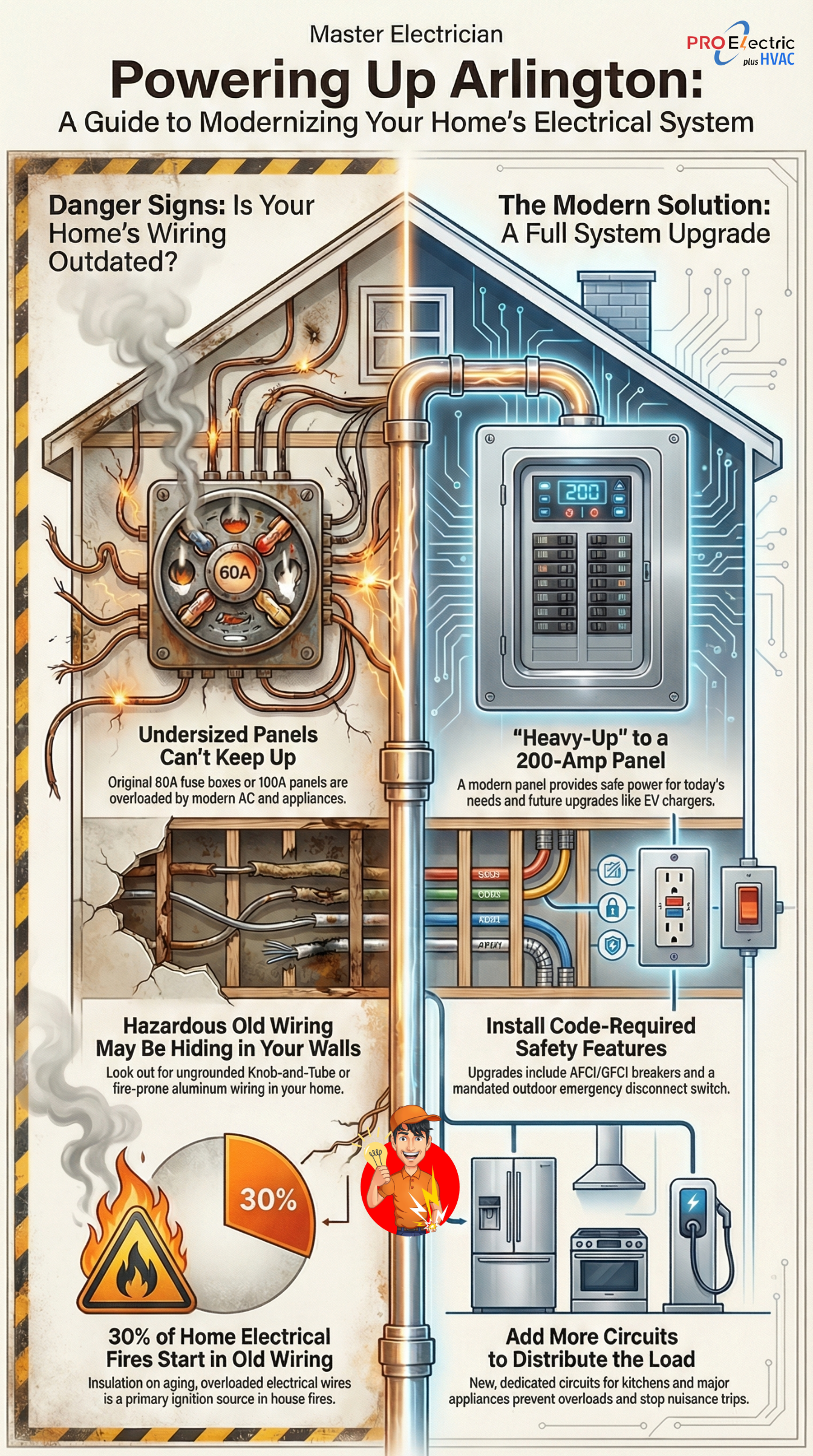
Flickering lights in Arlington often indicate loose connections in old wiring (such as aluminum wiring used in the late 60s) or an overloaded 60-amp fuse box common in older neighborhoods like Ashton Heights. It is a warning sign of arcing or voltage drops that requires a professional electrical inspection.
Arlington County is unique in Northern Virginia: it’s an older, densely populated area with many houses dating back to the 1940s, ’50s and ’60s. Many Arlington homes are smaller brick colonials or bungalows that have been remodeled over time.
The county also has lots of duplexes and some townhomes, plus high-rise condos (though we’ll focus on houses here). The main challenge in Arlington is that many homes still have very old electrical infrastructure – sometimes even original knob-and-tube wiring (from the 1930s-40s) or early 60-amp fuse panels that were never fully upgraded.
As a result, Arlington residents often experience frequent blown fuses, flickering lights, or insufficient outlets, especially in older neighborhoods near Clarendon, Ballston, or South Arlington’s historic districts.
1. Small Houses, Big Problems
A typical post-WWII Arlington house might be under 1500 sq. ft. and heated initially with oil or gas and no central air. These homes were often built with just a 60-amp fuse box or maybe a 100-amp breaker panel if built in the 60s.
Today, almost every one of those homes has had an air conditioner added, plus many have expansions or finished basements. If the electrical system wasn’t comprehensively upgraded, you end up with an old panel feeding a much heavier load than it was meant for.
For example, I’ve seen an Arlington Cape Cod where the original 60A fuse box was still in use alongside a subpanel – the homeowner didn’t realize it, but every time their central AC and microwave ran together, a fuse would blow plunging the house into darkness. They had been replacing fuses for years as a workaround!
Fuse boxes themselves can work fine when circuits are appropriately sized, but many are unsafe due to modifications – like using larger fuses than the wire gauge supports, or even the classic “replace the fuse with a penny” trick from the old days. These hacks defeat the safety mechanism and create a real fire hazard by allowing wires to draw far more current than they should.
If your Arlington home still has screw-in fuses and you’ve had to tamper with them to keep power on, that’s a sure sign the whole panel needs to go for your family’s safety.
2. Knob-and-Tube and Aluminum Wiring in Arlington
Arlington’s oldest homes (especially in areas like Ashton Heights or Aurora Hills) sometimes still have knob-and-tube (K&T) wiring in parts of the house. This wiring, from the early 20th century, uses no ground and insulated wires run separately – it’s not inherently dangerous by itself if untouched, but it cannot handle high amperage safely and it becomes hazardous if covered by insulation or altered.
Modern panels with K&T wiring downstream can be problematic because new breakers may trip unexpectedly if the wiring is deteriorating, or conversely, the old circuits lack proper grounding and GFCI/AFCI protection, which is now required for safety.
Additionally, many Arlington homes built in the late 1960s had aluminum branch wiring when copper prices spiked. As mentioned earlier, aluminum-wired circuits tend to loosen at connections and can overheat, causing flickering lights and even burnt outlets. The breakers on those circuits might trip if they detect a short, but often the issue is a smoldering connection that doesn’t immediately trip a breaker.
I’ve opened panels in Arlington houses and found signs of melted insulation and scorched wires from where aluminum conductors were improperly attached to breaker lugs or switches. This is why any panel upgrade in an older Arlington home should include checking the wiring and possibly adding special connectors (Al/Cu rated connectors) or pigtailing copper onto aluminum wiring with the proper procedure.
The fire risk from old wiring is very real – statistics show that the insulation on electrical wires is the first item ignited in about 30% of home electrical fires, often due to overloads or faults in outdated wiring. Upgrading the panel alone isn’t a silver bullet if the circuits themselves are old and undersized, but it’s a crucial first step that often forces a look at the whole system.
3. Limited Space and Overloaded Circuits
Many Arlington houses are physically small, which oddly can make electrical upgrades more challenging. The panels are often in tight utility closets or basements with limited wall space. Older panels had maybe 12 or 16 circuits; new ones we install typically have 30–40 circuits.
I often have to find creative solutions to fit a larger panel or split circuits between a main panel and a subpanel in these homes. Arlington’s building codes (and practical space constraints) sometimes mean the new panel location has to shift or an exterior meter/panel combo is used to gain space.
Homeowners in Arlington also often lament the lack of outlets – it’s common to have just one or two per room in older designs. This leads to heavy reliance on power strips, which can overload a single receptacle/circuit.
Part of upgrading the panel is usually adding more circuits and outlets to distribute the load. For instance, an Arlington kitchen from 1950 might have originally had just one circuit for all countertop outlets and the fridge. Modern code would require at least two 20A circuits for countertops alone, plus dedicated circuits for fridge, dishwasher, microwave, etc.
So when we upgrade an Arlington home’s panel, we often split up old circuits to meet current standards and homeowner usage. The result is far fewer breaker trips and a much safer system overall.
4. Code and Permit Considerations in Arlington
Arlington County, like the others, has adopted the requirement for an outdoor emergency disconnect on new or upgraded services. The county inspectors have been diligent about this – in practice, whenever I do a “heavy-up” in Arlington (say going from 100A to 200A service), they insist on installing that exterior shutoff if it’s not already there.
This sometimes surprises homeowners who are used to everything being indoors, but it’s now standard. Also, Arlington’s older housing stock means if you’re doing a major renovation (common in Arlington where people expand up or back on small lots), the county will require the electrical system be brought fully up to code.
That can include AFCI breakers on all circuits, GFCI protection where needed, tamper-resistant outlets – essentially a thorough modernization. The panel is the heart of that. It’s worth noting that Arlington is quite strict on permits for electrical work (as they should be).
Don’t try to sneak a panel upgrade or new circuit past without a permit here; not only is it illegal, but if something goes wrong, insurance can deny a claim for unpermitted work. The good news is that, once upgraded, Arlington homes that might be 70+ years old can finally have the capacity and safety features of a brand-new house.
5. Example – Arlington Bungalow
Let me illustrate with a quick real example. I worked on a 1950s Arlington bungalow in the Lyon Park area. It had a 100-amp panel from the 1980s (which itself was an upgrade from the original fuse box) and most of the wiring was two-prong ungrounded.
The family constantly had breakers tripping whenever they used the microwave and toaster together, or if the window AC upstairs was on the same time as the vacuum cleaner. We upgraded them to a 200A panel, dedicated several new circuits for the kitchen and AC units, and added GFCI/AFCI protection as required.
We also installed the outdoor disconnect next to the meter during this heavy-up. After the upgrade, no more nuisance trips – and they have the capacity to potentially install central AC or an EV charger down the road. The homeowner said the lights don’t dim anymore when appliances kick in, and they feel safer knowing the old, potentially hazardous wiring connections have been updated.
This is typical of the transformative effect a proper panel and wiring upgrade can have on an Arlington home.
Arlington summary: If you live in Arlington and your home still has an old panel (or you’re not sure what you have), pay attention to the signs. Frequent blown fuses, warm or buzzing breaker boxes, flickering lights, outlets that don’t hold plugs well – these all hint at outmoded electrical systems.
Given the age of Arlington’s housing, chances are your panel is undersized or past its prime if it hasn’t been replaced in recent decades. Upgrading to a larger, modern panel (with an exterior disconnect) will not only handle your current needs safely but also allow for any future improvements (like that electric car or new HVAC) without headaches. It’s part of the price of preserving these wonderful older homes – behind those 1950s walls, you need 2020s tech to keep everything running reliably.
Prince William County – Diverse Housing Ages from Historic to Modern Mega-Homes
Top FAQ for Prince William County:
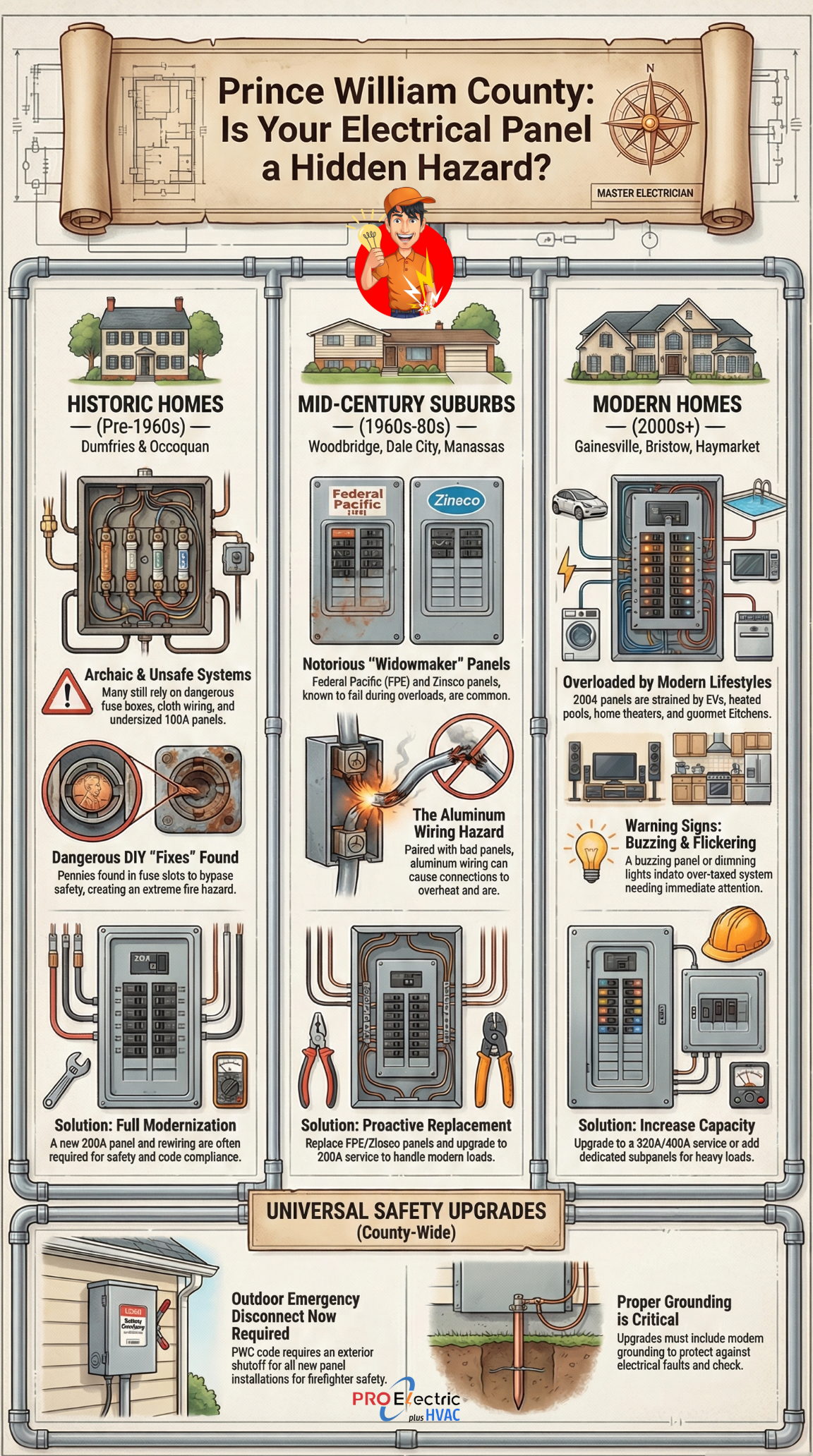
Electrical code requirements for renovations in Prince William County Prince William County enforces the 2020 NEC, meaning any major renovation or heavy-up requires installing an outdoor emergency disconnect. Historic homes in areas like Dumfries or Occoquan may also require grounding upgrades and the removal of dangerous “penny” fuse fixes to meet safety standards.
Heading south and west, Prince William County presents a blend of scenarios from all of the above. Prince William has some of the oldest homes in the region (in towns like Dumfries and Occoquan, which date back to the 18th–19th century) and some of the newest large developments (e.g. Gainesville, Bristow boom in the 2000s).
This wide range means electrical panel issues here can run the gamut from ancient fuse boxes to overtaxed 200A panels in McMansion-sized homes. Let’s break it down by area and era, as each has its own challenges:
1. Historic Towns (Dumfries, Occoquan, etc.)
Dumfries, for example, is one of Virginia’s oldest towns, and many homes in and around Dumfries are quite old. A lot of these houses still rely on unsafe fuse boxes, Federal Pacific or Zinsco breakers, or tiny 100-amp panels that have never been upgraded.
Behind a quaint historic facade, you might find cloth-insulated wiring from the 1940s and a service panel that predates color TV! In these cases, homeowners might experience not just tripped circuits but also frequent electrical failures or even burn marks at outlets.
I’ve helped Dumfries families who reported outlets getting hot or lights that constantly flicker; on inspection, we found things like over-fused circuits (20A fuses on 14-gauge wire) and corroded fuse holders that were arcing. The fix is typically a full rewire of at least the main circuits and a new 200A panel upgrade, given that many of these homes eventually add central air or other modern loads.
It’s a big job in a historic home, but it’s necessary for safety and for compliance if any renovations are done. Prince William County authorities do require that if you’re renovating these older homes, you bring certain things up to code. Many owners are proactive – they don’t want to lose their lovely old house to an electrical fire that could have been prevented.
As Peter from PRO Electric, I often frame it this way: preserving a historic home includes updating the hidden systems so the home remains around for another 100 years.
To illustrate, Occoquan has many 100+ year-old buildings. During an upgrade in one Occoquan home, we removed an old fuse panel and found multiple “penny” fuses – yes, literal pennies had been placed under Edison-base fuses to bypass blown fuses.
It was a minor miracle that house hadn’t had a fire. We installed a modern panel, and now every circuit has proper breakers that trip when they should. If you have an old property in Prince William (or anywhere), never resort to those tricks – it’s like deliberately removing the brakes from your electrical system.
2. 1960s–1980s Suburban Developments (Woodbridge, Manassas area, Dale City)
Prince William experienced a suburban boom mid-century as well – areas like Woodbridge, Manassas Park, Dale City filled with tract housing and starter homes for families and military personnel. Many of these homes were built in the 60s and 70s using (stop me if you’ve heard this) Federal Pacific Stab-Lok panels and sometimes Zinsco.
In fact, entire neighborhoods in Woodbridge and Marumsco Acres were outfitted with FPE panels in the late 60s. These panels are now 50+ years old, and many are still in place. I often get calls from Woodbridge homeowners complaining of a burning plastic smell or that a particular breaker won’t reset.
Upon inspection, it’s not uncommon to find the breaker never tripped during an overload, and the bus bar is discolored or charred from heat. Indeed, Woodbridge’s significant housing expansion in the 1970s and 80s means many homes still have their original 100–150A panels from that era – often now undersized after decades of additions.
For instance, Montclair, a popular planned community developed in the 1970s, was known to have many homes with 150A service and aging panels. People have since added larger HVAC systems, finished garages, etc., and those panels (sometimes Zinsco-branded in Montclair’s early phase) are straining.
I’ve helped several families in Montclair replace those outdated 100–150A panels with 200-amp upgrades, especially when they want to add new appliances or just because the old panels were becoming unreliable. It’s often a proactive choice once they learn the panel brand has a bad safety reputation.
Aluminum wiring was also prevalent in many Prince William houses built in the late 60s (e.g., parts of Dale City and Manassas Park subdivisions). So not only do we have breaker panels that might fail to trip, but the branch circuits themselves can overheat at connections.
This one-two punch can result in weird breaker behavior – I’ve seen breakers trip after an outlet started melting, instead of before, because the connection arced and finally shorted. With aluminum-wired homes, I recommend a thorough mitigation (special connectors or copper pigtails at all device terminals) in addition to any panel replacement. It goes hand-in-hand: you install a safe new panel, you want to ensure the wires attached to it are safe too.
3. Modern Large Homes (Bristow, Gainesville, Haymarket)
In the 2000s and 2010s, Prince William County’s western end (around Gainesville, Bristow, and Haymarket) saw an explosion of big, upscale homes. These houses often came with 200A service by default, and sometimes two panels (one for each level or for specific high-load areas). You’d think a 200-amp panel in a 10–15 year old home would have no issues – and if everything was done right, generally they’re fine.
However, I’ve encountered many cases where these newer luxury homes exceed even the robust electrical service they have. For example, I wrote about a case in Gainesville where the combination of multiple high-end amenities was “burning through breakers” faster than expected.
In communities around Virginia Gateway and Linton Hall, there are 5,000+ sq. ft. houses with gourmet kitchens (dual ovens, wine fridges), home theaters, heated pools or spas, and EV chargers – all in one property. The original builder might have installed a standard 200A panel, thinking it was enough, but all those loads stacked up push the panel beyond what the builder anticipated.
I routinely find in these homes that breakers run hot, the panel bus bars discolor from heat, and main breakers sometimes operate at near capacity for long periods. Homeowners might notice lights dimming or flickering when large appliances cycle, or that specific breakers trip occasionally for no obvious reason – signs of a strained electrical system.
In Gainesville and Haymarket, especially, I’ve recommended some owners to upgrade to a 320A service (400A class), which allows for two 200A panels, or to add a subpanel dedicated to heavy loads like EV charging or a basement suite. It’s a bit ironic: these houses are new and expensive, yet their electrical system can be a weak link because of just how many gadgets and appliances modern life has introduced.
In one case at Heritage Hunt (Gainesville), the homeowner already had a 200A main panel and a 125A subpanel, and we ended up installing another 100A subpanel in the garage solely for workshop tools and an EV charger to spread the load and avoid overheating the main panel.
The symptoms in these newer Prince William homes aren’t due to old wiring, but rather to breakers tripping under heavy use or even buzzing sounds from the panel when multiple large loads run. A buzzing could indicate a loose breaker connection or an overcurrent that’s right below trip threshold (in some cases, a failing breaker will buzz).
These should be addressed immediately – sometimes it’s as simple as tightening connections, but often it’s a sign the breaker or panel bus is deteriorating from heat. Replacing a couple of breakers might fix a single circuit issue, but it won’t solve an overall capacity problem. For that, we either upgrade the service or manage the load (e.g., using load-shedding devices for EV chargers or staggering appliance use, though relying on memory isn’t very fail-safe).
4. Outdoor Disconnects and Code in Prince William
Prince William County has fully adopted the 2020 NEC changes, so, like Fairfax and Loudoun, any panel replacement or new service in PWC now requires an outdoor emergency disconnect. In fact, local inspectors in Prince William have been interpreting the code to mean that even if you’re just moving the meter or doing a heavy-up, you must add that exterior shutoff to meet today’s standard.
I’ve had customers in Manassas surprised that after decades of having the main breaker inside, their new setup includes a big gray box outside with “EMERGENCY DISCONNECT” on it. It’s now standard practice. This is important for Prince William homeowners to know because the county won’t pass your inspection without it – and it’s a good thing overall.
Prince William’s mix of home ages means firefighters really appreciate having that outside shutoff; I recall a case of a fire in an older Woodbridge home where the responders had to pull the meter because there was no single main breaker – not ideal or safe for them. The new code fixes that situation going forward.
5. Summing Up Prince William’s Challenges
In Prince William County, you might live on a street where one house has a 100-year-old panel and the neighbor has a brand-new Tesla in the driveway, stressing the modern panel. In either case, the key is understanding the limits of your electrical system.
Older homes (Dumfries/Occoquan area or older parts of Manassas/PWC) almost certainly need panel upgrades if not already done – they are likely unsafe or not up to code, as many still have fuse boxes, FPE, Zinsco, or just an insufficient 100A service. Mid-aged homes (60s–80s builds in Woodbridge/Dale City) should, at a minimum, have their panels inspected – if it’s an FPE or Zinsco, change it; if it’s a 40-year-old panel of any brand, consider replacement because components wear out.
And they should be upgraded to 200A if the home has central AC or other big loads, because 150A or less might be marginal today. Newer large homes are generally in good shape wiring-wise, but homeowners shouldn’t be complacent – keep an eye on your panel’s performance.
If you frequently trip breakers in a 10-year-old house, it’s telling you something: either a specific circuit is overloaded (maybe the kitchen needs an extra circuit) or your overall usage is approaching the panel’s capacity and a second panel or larger service might be warranted. It’s also wise to invest in whole-house surge protectors for these homes (code actually now requires surge protection on new or replaced panels) because surges can damage sensitive electronics, and a panel upgrade is a perfect time to add that protection.
Before leaving Prince William, I want to highlight one more often overlooked aspect: Electrical Service Grounding. Many older homes I’ve seen in PWC (and elsewhere) lack proper grounding and bonding – e.g., the panel isn’t well-grounded to earth or the water pipes. This can exacerbate the risk of electrical faults and also cause subtle issues like flickering lights or electronics behaving oddly.
When upgrading an old panel, we always bring the grounding up to current code (ground rods, bond the water line, etc.). It’s not something homeowners think about, but it’s crucial for safety. If you have an old panel with no obvious ground wire going to rods or a water pipe, that’s another reason to have an electrician out.
Prince William bottom line: Whether you’re in a historic Dumfries cottage or a huge Gainesville villa, your electrical panel needs to match your home’s demand and meet today’s safety standards. Many PWC homes built in the 1970s–80s are overdue for panel replacement – they’re likely sporting original breaker panels that are beyond their service life (and may be fire-prone models). And newer homes, while equipped with better technology, can still suffer from capacity issues as families load them up with technology. The solution, across the board, is a combination of panel upgrades, dedicated circuits, and adherence to new safety codes. It’s about keeping your family safe and your home’s electrical system reliable for the long haul.
Staying Safe and Up-To-Code: Final Thoughts from Peter
As a Master Electrician, I can’t overstate the importance of a healthy electrical panel. It’s truly the heart of your home’s electrical system. When it’s undersized or a known defective type, it’s like a ticking time bomb quietly lurking behind the door of your utility room.
The scenarios we’ve discussed – breakers that don’t trip during overloads, circuits overheating unbeknownst to you, or panels literally cooking themselves from the inside – are more common in Northern Virginia than many people realize. The good news is, all these problems are solvable with the right upgrades and precautions.
Here are a few key takeaways and tips moving forward:
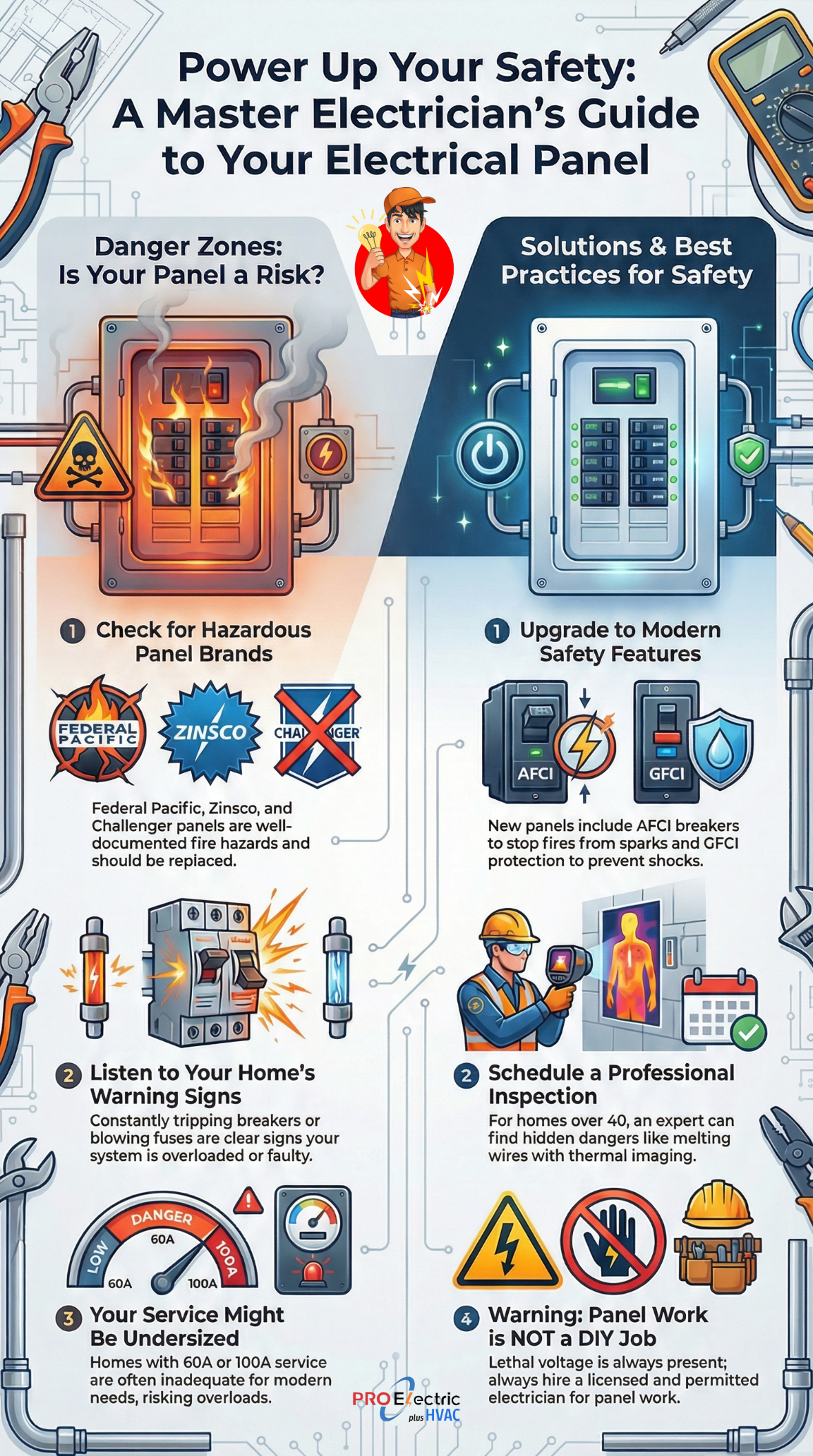
- Listen to Your Home’s Clues: If breakers are tripping frequently or fuses are blowing, don’t ignore it or keep resetting them. That’s your home screaming for help. Constant trips mean the circuit or panel is overloaded or faulty. It’s far safer to call a professional to evaluate than to keep replacing fuses or holding off forever on an upgrade.
- Identify Your Panel Type: Take a moment to check your electrical panel’s brand and age. If you see names like Federal Pacific, Federal Pioneer, Zinsco, Sylvania (older logo), Challenger, or Pushmatic, or if it’s a fuse box, consider replacing it. Federal Pacific (Stab-Lok) panels and Zinsco panels are well-documented fire hazards (breakers fail to trip, or parts melt). They’ve caused countless home fires across the country, and many insurance companies won’t insure a house with them. Upgrading to a new Siemens, Square D, or Eaton panel eliminates that risk.
- Upgrade to Adequate Amperage: In today’s world, 200 amps is generally the minimum service size for a single-family home with modern amenities. If you’re sitting on a 100A service (or god forbid 60A), you will almost certainly benefit from upgrading. Not only will this allow you to run all your appliances simultaneously without worry, but it also prepares your home for future tech (electric vehicles, electric heating, etc.). The process of upgrading involves coordinating with the power company and county for permits, but a licensed electrician will handle that. The result is peace of mind and often improved resale value – buyers know an upgraded panel is one less thing to negotiate.
- Embrace Safety Upgrades (GFCI, AFCI, Disconnects): When you do a panel upgrade in VA now, you’ll be getting arc-fault (AFCI) breakers on many circuits and surge protection on the panel due to code – these are good things. AFCIs can detect sparking (like from a damaged wire or loose connection) and shut off the circuit before it causes a fire. Ground-fault (GFCI) protection will prevent shocks in wet areas. And the outdoor emergency disconnect we discussed is there to protect you and first responders. Yes, it adds a box outside, but in a crisis like a house fire, that could save crucial minutes. All these features collectively bring your home up to today’s safety standards, which drastically reduce the risk of electrical fires and injuries. It’s worth it.
- Periodic Professional Inspections: If your home is over 40 years old and you’ve never had an electrical inspection, it’s wise to get one. A pro can use thermal imaging to check whether any breakers or connections are running hot, verify that everything is tightened and corrosion-free, and confirm that the system is balanced load-wise. Sometimes we catch things like a partially melted neutral wire or an oxidized main breaker that the homeowner had no idea about – potential fire starters that can be fixed on the spot. Think of it like a doctor’s check-up for your house.
- Don’t DIY Main Panels: I have to add – while it’s fine for homeowners to change their own light switches or outlets (with power off), the main panel is not a DIY job. There is lethal voltage coming from the service lines even with the main breaker off. Plus, wiring a panel involves many code details (torque specs, load calcs, grounding rules). Always use a licensed electrician for panel work. In Northern Virginia, we pull permits and get inspections, which ensures a second set of eyes on the work. It’s just not worth the risk to save a few bucks by attempting it yourself.
At the end of the day, investing in your electrical panel and system is investing in your family’s safety and your home’s longevity. We’ve seen tragically what can happen when these issues are ignored – house fires that started because an old breaker didn’t trip or because someone bypassed a fuse.
On the flip side, I’ve also seen the relief and confidence homeowners have after we modernize their electrical system. One client told me they finally slept through a thunderstorm without worrying about the flickering lights or that faint burning smell they used to notice – because we had replaced the suspect panel that was arcing in the rain. That peace of mind is priceless.
If you’re in Fairfax, Loudoun, Arlington, or Prince William and dealing with any of the challenges we covered, or even if you’re not sure what you have behind your electrical panel door, feel free to reach out to a professional for guidance.
As Peter at PRO Electric plus HVAC, I’m always happy to inspect and give an honest assessment.
Sometimes the solution is as simple as redistributing circuits or tightening connections, and sometimes it’s indeed a full-panel upgrade.
Get a free electrical panel estimate.
Either way, you’ll be safer, code-compliant, and ready for the future.
Stay safe, and remember: your home’s electrical system is out of sight, but don’t keep it out of mind.
A little proactive attention now can prevent major problems down the road. ⚡🏠
References (APA)
- Paschal Air, Plumbing & Electric. (2025, December 15). Electrical Panel Safety: Which Brands Are Risky and What Homeowners Should Do. Retrieved from https://gopaschal.com/resources/hazardous-electrical-panels-to-avoid/
- Cool Today. (n.d.). 4 Outdated and Unsafe Electrical Panels That Could Be Hiding in Your Home. CoolToday Plumbing, HVAC & Electrical Blog. Retrieved from https://www.cooltoday.com/blog/4-outdated-and-unsafe-electrical-panels-that-could-be-hiding-in-your-home
- Schroeder Design Build. (2025, May 7). Important Electrical Code Changes That Could Impact Your Virginia Remodel. Retrieved from https://schroederdesignbuild.com/blog/remodeling-industry/important-electrical-code-changes-that-could-impact-your-virginia-remodel/
- U.S. Fire Administration. (2008, March). Residential Building Electrical Fires (Topical Fire Report Series, Vol. 8, Issue 2). Emmitsburg, MD: USFA/NFDC. Retrieved from https://apps.usfa.fema.gov/downloads/pdf/statistics/v8i2.pdf