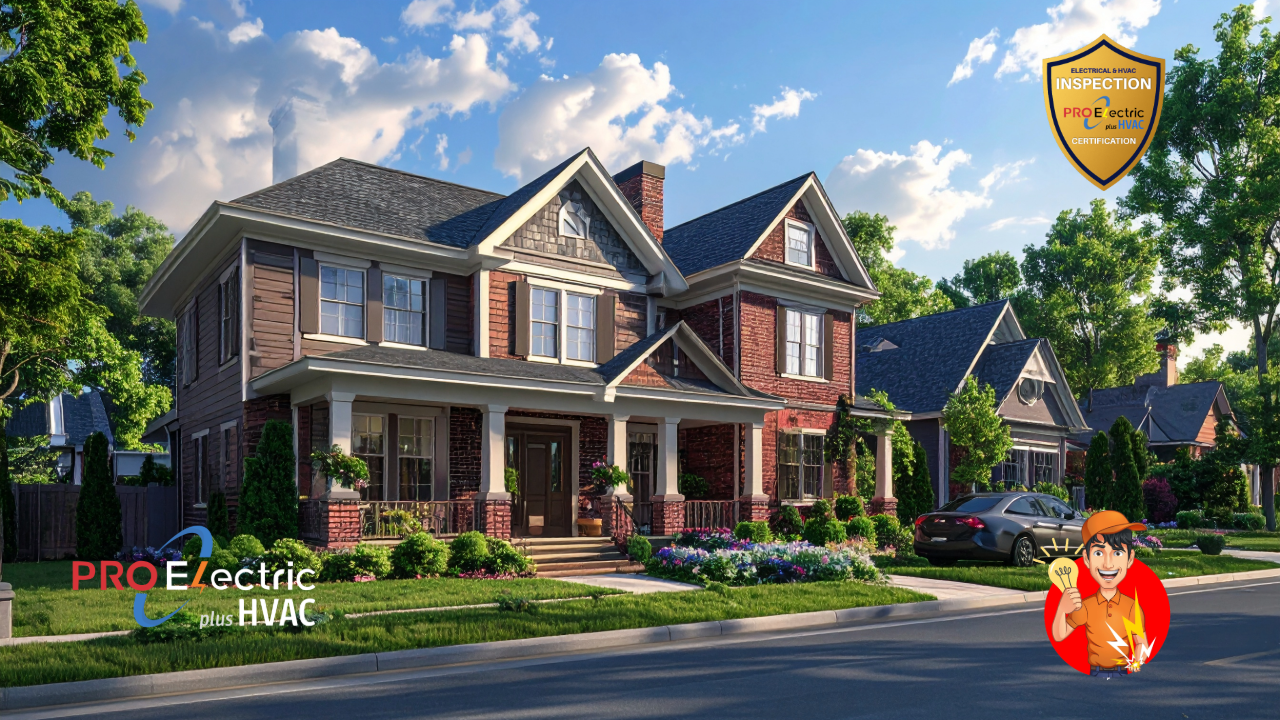
Arlington Ridge was developed in the 1940s and 1950s on land that sloped from the Pentagon toward the Potomac — a neighborhood of brick colonials and Cape Cods built for government workers and military families who intended to stay. Many of those families did stay, and many of those homes have been in the same family for two or three generations. The electrical panels in many of those homes have also stayed — which is the part of this story that requires an honest conversation.
What a 70-Year-Old Panel Actually Is
A residential electrical panel installed in Arlington Ridge in 1952 has been energized continuously for over 70 years. Its main breaker has cycled on and off thousands of times. Its bus bars have experienced 70 years of thermal expansion and contraction under daily load cycling. Its breakers — some original, some replaced at various points over the decades — have aging thermal trip elements, oxidized contact surfaces, and a mechanical history that no visual inspection alone can fully characterize. The panel as a whole has been subjected to conditions — moisture from condensation, vibration from mechanical systems, rodent intrusion in unfinished utility rooms — that production panels were never designed to withstand indefinitely. The question is not whether a 70-year-old Arlington Ridge panel has experienced some degree of degradation. It is whether that degradation has crossed the threshold where the panel is no longer reliably performing its fundamental safety function.
The Pushmatic and Bulldog Panel Problem in Arlington Ridge
Two panel brands are particularly common in Arlington Ridge’s 1940s-1960s housing stock: Pushmatic (manufactured by ITE) and Bulldog. Both are recognizable by their distinctive pushbutton-style breakers that reset by pushing the button rather than toggling a switch. Pushmatic breakers are known for thermal elements that deteriorate with age, requiring progressively firmer pushes to reset as the internal components wear — a fact that many Arlington Ridge homeowners interpret as confirmation that the breaker “works” when it may actually be indicating that the mechanism is failing. Bulldog panels, similarly, have documented reliability concerns around contact resistance that develops over time. Neither brand is manufactured anymore. Replacement breakers, where available, do not always restore the original performance specifications of a brand that stopped manufacturing 40 or more years ago.
What an Arlington Ridge Panel Assessment Evaluates After 70 Years
- Main breaker condition — mechanical operation, contact resistance, and heat signature
- Bus bar oxidation and corrosion at breaker contact surfaces
- Pushmatic or Bulldog breaker mechanical condition and trip reliability
- Neutral bar connections — torque integrity after decades of thermal cycling
- Evidence of prior overcurrent events — heat-discolored conductor insulation at terminals
- Panel enclosure condition — moisture evidence, rodent intrusion, mechanical damage
The 60-Amp and 100-Amp Service Limitation
Homes built in Arlington Ridge in the 1940s and 1950s were often served by 60-amp electrical service — appropriate for the electrical loads of post-war domestic life and wholly inadequate for a 2026 household. Some were upgraded to 100-amp service in subsequent decades. Even 100-amp service is considered minimum-adequate for a lightly loaded modern home with no EV charging, no dedicated home office circuits, and no significant additions to the builder’s original load profile. Arlington Ridge homes that have added central air conditioning, a remodeled kitchen, a finished basement, and a home office since original construction may be running on service that was never sized for what it is being asked to deliver. A load calculation by PRO Electric plus HVAC tells the homeowner exactly where the system stands — and whether a 200-amp or 400-amp service upgrade is the answer.
What the Neighbors’ Renovations Mean for Your Panel
Arlington Ridge has experienced sustained renovation activity over the past 20 years, driven by the neighborhood’s proximity to the Pentagon, its excellent walkability scores, and its status as one of Arlington County’s last neighborhoods with significant numbers of original mid-century homes available for purchase. Homeowners who have renovated — additions, kitchen expansions, finished basements — typically received an electrical permit for the new work. The permit for the new work does not, however, require the assessment or upgrade of the pre-existing panel unless the new work triggers a specific code requirement. The result is that many Arlington Ridge homes have new, fully code-compliant kitchen wiring, a beautifully finished basement, and a 70-year-old Pushmatic panel quietly serving all of it from the utility room.
Related Articles
The Resale Conversation Every Arlington Ridge Seller Should Have First
Arlington Ridge homes sell at premium prices for Arlington County — and buyer electrical inspections in this neighborhood routinely surface panel age, Pushmatic brand concerns, and 60-to-100-amp service limitations as negotiation items. A seller who addresses the panel before listing — and who can show buyers a documented replacement with an Arlington County inspection sign-off — eliminates this negotiation point entirely. The cost of a proactive panel upgrade is consistently recovered in the avoided price reduction, the cleaner buyer inspection, and the significantly reduced transaction risk. PRO Electric plus HVAC has worked with Arlington Ridge homeowners preparing properties for sale across a wide range of panel conditions, and the pre-listing upgrade path is reliably more straightforward and cost-effective than the post-inspection negotiation path.
Serving Arlington Ridge, Pentagon City, Shirlington, and All of Arlington County
PRO Electric plus HVAC performs comprehensive panel assessments for Arlington Ridge’s mid-century homes — with honest findings reports, load calculations, and full Arlington County permitting for panel replacements and service upgrades.
Schedule a Panel Assessment
703.225.8222
Frequently Asked Questions
Are 70 year old electrical panels still safe in Arlington Ridge homes?
Electrical panels that are 70 years old have experienced decades of wear, including thermal cycling, breaker use, and environmental exposure. While some may still function, aging components such as breakers and bus bars can degrade to the point where they no longer provide reliable protection, making a professional assessment critical.
What is the issue with Pushmatic and Bulldog panels?
Pushmatic and Bulldog panels are outdated systems no longer manufactured. Their breakers can lose reliability over time due to aging internal components and increased contact resistance. Replacement parts are limited and may not restore original performance, making full panel replacement the safer long term solution.
Is 60 amp or 100 amp service enough for modern homes?
Most modern homes require more electrical capacity than 60 amp or even 100 amp service can provide. With added loads like HVAC systems, kitchen upgrades, home offices, and electric vehicle chargers, many Arlington Ridge homes benefit from upgrading to 200 amp or higher service.
Why do renovations not always trigger a panel upgrade?
Electrical permits for renovations typically cover new work only and may not require upgrading the existing panel unless capacity or code violations are identified. This means homes can have modern wiring additions while still relying on outdated panels that were never evaluated or upgraded.
Should Arlington Ridge homeowners replace their panel before selling?
Replacing an outdated panel before listing a home can eliminate a common negotiation point during buyer inspections. A new panel with proper permits and inspection approval increases buyer confidence, reduces transaction risk, and often prevents price reductions during the sale process.
References
National Fire Protection Association. (2023). NFPA 70: National Electrical Code, 2023 edition. National Fire Protection Association.
Arlington County Department of Community Planning, Housing and Development. (2024). Residential electrical panel replacement and service upgrade permits. Arlington County Government. https://www.arlingtonva.us/building
U.S. Consumer Product Safety Commission. (2012). Electrical safety in the home. CPSC. https://www.cpsc.gov
Underwriters Laboratories. (2023). UL 489: Molded-case circuit breakers. UL Standards. https://www.ul.com/standards