
Peter, Master Electrician at PRO Electric plus HVAC
How breakers are numbered, the 2-person method and the solo method, a room-by-room checklist so nothing gets missed, what the code says a label has to say, a blank directory you can print, and the handful of things you might find that mean stop and call. A safe afternoon with a helper and a lamp.
Print the blank directory Call 703.225.8222- Licensed Master Electrician
- Virginia license 2705181607
- Fairfax, Loudoun, Arlington, Prince William
Quick answer
How to map a breaker panel
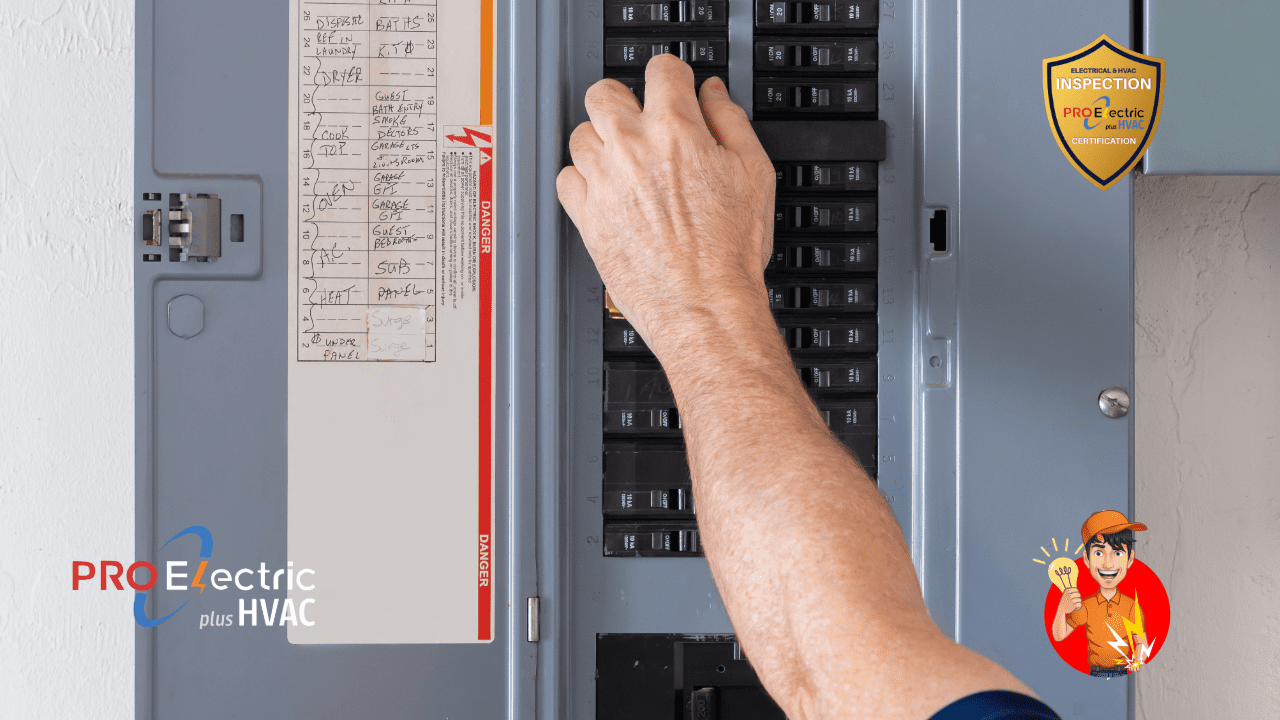
Number the breakers top to bottom, odd on the left and even on the right. Turn off one breaker at a time and have a helper walk the house with a plug-in lamp, noting every outlet, light, switch, and appliance that went dead. Write it in pencil on a directory, breaker by breaker, then go over it in ink or print it and tape it inside the door. Shut down computers first, leave the heating and cooling breaker for last, and never take the cover off. A plug-in breaker finder lets one person do it alone. The whole thing takes about an hour for a typical panel, and it's the hour that matters when water is running toward an outlet at 2 a.m.
Stop the project and call if you find any of these
Mapping is safe because you never touch anything inside the panel. These are the things that turn an afternoon project into a service call. Leave the breaker off, keep the cover on, and call 703.225.8222 for 24/7 emergency electrical service.
Why a labeled panel matters more than it seems
Hi, I'm Peter, the Master Electrician at PRO Electric plus HVAC. Most panels I open have a directory that's faded, wrong, or blank, and most of the time nobody cares. Then a dishwasher supply line lets go and water is running across the kitchen floor toward the outlets, or a light switch starts smoking, or a plumber needs the water heater dead before he touches it, and suddenly the difference between 10 seconds and 10 minutes at the panel is the whole story.
It also matters on ordinary days. Every outlet swap, every fixture change, and every service call starts with finding the right breaker, and an unlabeled panel adds time to all of them. A labeled panel is also the first thing a home inspector photographs, and a good one says something about how the house has been kept.
How a panel is numbered, and what the different breakers are
Open the door, not the cover. What you see is the main breaker, usually at the top, and 2 columns of branch breakers below it. In nearly every residential panel the odd numbers run down the left column and the even numbers down the right, so 1 and 2 face each other at the top, then 3 and 4, and so on. Many panels print the numbers beside the breakers or on the directory card. If yours doesn't, number it that way yourself, so your labels match what an electrician expects.
| What you see | What it is | What it feeds |
|---|---|---|
| One large breaker at the top, by itself | The main breaker | Everything. Leave it alone during mapping |
| A standard single breaker, 1 width | A 120 volt branch circuit, usually 15 or 20 amps | Lights, receptacles, small appliances, one room or part of one |
| Two widths with one handle, or 2 handles tied together | A 240 volt double-pole breaker | Dryer, range, water heater, AC or heat pump, hot tub, EV charger, or a subpanel |
| Two small handles side by side in 1 width | A tandem breaker, 2 circuits in one slot | Two separate circuits; label both. Common in full panels |
| A breaker with a test button, often with a colored label | An AFCI or GFCI breaker | Bedrooms and living areas for AFCI; bathrooms, kitchens, garages, outdoors for GFCI |
| A breaker with nothing written and no wire visible from the front | Possibly a spare | Nothing, if it is truly spare. The code says to label it spare |
If the handles in your panel are 2 or 3 different colors or shapes, someone has added breakers over the years, and some of them may not be listed for the panel. That's a separate problem from labeling and it's covered on the mismatched breakers page.
What you need
- A helper with a phone. One person at the panel, one walking the house, talking on speaker. This is what makes it an hour instead of an afternoon.
- A plug-in lamp or night light. Something with an obvious on and off. A small radio works too, and it lets one person hear the result from the panel.
- A plug-in circuit breaker finder, if you are doing it alone. A transmitter plugs into the outlet, a receiver sweeps across the breakers and beeps at the right one. Reliable on receptacles, and worth owning if the panel is in a detached garage.
- Pencil, paper, and the blank directory below. Pencil while you map, ink or a printout once you are sure.
- Masking tape and a marker. To tag each breaker with its number if the panel has none, and to mark outlets you have already tested.
Before you flip anything
Five minutes of prep saves a computer and a compressor
Shut down computers, game consoles, and anything mid-task; a sudden cut isn't good for a hard drive or an open document. Tell everyone in the house what you are doing so nobody is on a ladder or in the shower with the light on. Note what is on medical equipment, an aquarium, or a sump pump, and plan to test those breakers quickly. Leave the heating and cooling breaker for last, and when you turn it back on, wait 5 minutes first so the compressor does not restart against pressure. Expect to reset the range, the microwave, and any plug-in timers when you're done. And keep the cover on: you are switching breakers, not touching them.
The 2-person method, step by step
- Number every breaker. Odd down the left, even down the right, top to bottom. Tape numbers beside them if the panel has none. Note which are double-pole and which are tandems on your sheet before you start.
- Turn off breaker 1. Just that one. Your helper walks the house with the lamp and calls out everything that went dead: which outlets, which lights, which switches, which appliances. Plug the lamp into both halves of any receptacle that looks like it might be split.
- Write it down before you move on. Location plus load, specific: kitchen counter east wall receptacles, not kitchen. If the breaker killed 2 rooms, write both. If it killed nothing, write nothing yet, and come back to it at the end.
- Turn breaker 1 back on, then turn off breaker 2. One at a time, always. Two breakers off at once and you can't tell which one did what.
- Work through every breaker the same way. Double-pole breakers get tested at the appliance: the dryer, the range clock, the water heater, the AC. Test the AC last and wait 5 minutes before restoring it.
- Go back to the breakers that killed nothing. Test the places people forget, listed in the next section. What is still unexplained gets written as unknown for now.
- Walk the house with every breaker on. Every outlet you tested should have power again, every light should work. Anything still dead is a note for the electrician.
- Write the final directory. Ink or print, taped inside the door, spares marked spare, unknowns marked unknown until they are settled. Take a photo of it and keep it on your phone.
Doing it alone: plug a radio into the outlet you want to identify, turn it up, and switch breakers until it goes quiet, then walk the room for the lights. Or use a breaker finder, which takes the guessing out of the receptacle half of the job. Either way you still walk the house after each breaker, so budget more time.
The places people forget to test
Almost every unexplained breaker on a first pass turns out to feed one of these.
Outside and out of the way
- Outdoor receptacles, front and back, and the one behind the shrubs
- Garage receptacles and the garage door opener, which is usually on its own ceiling outlet
- Attic light and any attic fan
- Crawl space or basement lights and the sump pump receptacle
- Shed, deck, and yard lighting
- The doorbell transformer, often on a lighting circuit, and the well pump on a well lot
Inside, but easy to miss
- Both halves of every receptacle; a switched half or a split kitchen receptacle can be on a different breaker from the other half
- The disposal, the dishwasher, and the microwave, which are often on their own circuits and may be hardwired
- The furnace or air handler, which usually has its own switch and its own breaker
- Hardwired smoke and carbon monoxide detectors, usually on a bedroom lighting circuit
- Bathroom receptacles that go dead together because they share one GFCI, which is a good moment to read about GFCI outlets that trip
- Closet lights, the range hood, under-cabinet lights, and the light in the stairwell
A blank circuit directory you can print
Forty positions, numbered the way most panels are. Print it, fill it in pencil while you map, then write it in ink or type it up and tape it inside the panel door. Add rows or ignore the extras to match your panel.
| No. | Location and load | Amps |
|---|---|---|
| 1 | ||
| 3 | ||
| 5 | ||
| 7 | ||
| 9 | ||
| 11 | ||
| 13 | ||
| 15 | ||
| 17 | ||
| 19 | ||
| 21 | ||
| 23 | ||
| 25 | ||
| 27 | ||
| 29 | ||
| 31 | ||
| 33 | ||
| 35 | ||
| 37 | ||
| 39 |
| No. | Location and load | Amps |
|---|---|---|
| 2 | ||
| 4 | ||
| 6 | ||
| 8 | ||
| 10 | ||
| 12 | ||
| 14 | ||
| 16 | ||
| 18 | ||
| 20 | ||
| 22 | ||
| 24 | ||
| 26 | ||
| 28 | ||
| 30 | ||
| 32 | ||
| 34 | ||
| 36 | ||
| 38 | ||
| 40 |
What a label has to say, according to the code
The National Electrical Code has a rule for this, and it is short. Section 408.4(A), in the 2020 edition Virginia enforces, requires every circuit to be legibly identified as to its clear, evident, and specific purpose, with enough detail to tell each circuit from all the others; spare positions have to be marked as spare; the directory goes on the face or inside of the panel door; and no circuit may be described in a way that depends on who is living there (NEC 408.4(A), as summarized at Electrical License Renewal, n.d.; Virginia DHCD, n.d.).
| Do not write | Write instead | Why |
|---|---|---|
| Lights | Second floor hall and bath lights | Every panel has 6 breakers that could be called lights |
| Outlets | Kitchen counter, east wall receptacles | Location plus load is what lets someone find it fast |
| Emma's room | Second floor northeast bedroom | Emma moves out; the room stays where it is. The code bans occupancy-based labels |
| Blank | Spare | The code requires spare positions to be labeled |
| Basement | Basement sump pump | A pump is the circuit you most need to find in a hurry |
| AC | Heat pump outdoor unit, 240 volt | Names the equipment and warns the next person it is 240 |
Handwritten is fine on a house as long as it's legible. Pencil while you work, ink or print when you are done, and a photo on your phone for the day the door gets painted over.
What mapping usually turns up, and what to do about it
- A breaker that controls nothing. A spare, something you did not test, an abandoned circuit from a remodel, or a breaker that has failed inside. Test the forgotten places first. If it's still nothing, label it unknown and mention it next time an electrician is at the panel.
- Two breakers on the same outlets. Usually a multi-wire branch circuit sharing a neutral, common in kitchens and baths, with each half of a receptacle on a different breaker. Label both. If they aren't tied together at the handle, that's worth a look.
- One breaker feeding half the house. Normal in a 1960s house, where one 15 amp circuit ran 2 bedrooms and a hall. It explains the trips, and the fix is on our page about breakers that keep tripping. If the panel is out of room for the circuits it needs, my panel is full, can I add circuits answers that.
- Bathroom and outdoor outlets that die together. One GFCI protecting a chain of receptacles. Expected, and useful to know.
- An AFCI breaker that trips when you turn it back on. It may be doing its job on a real arc, or reacting to a device on the circuit. Our page on AFCI breakers that keep tripping works through it.
- Two-prong outlets in a room. No ground on that circuit, which changes what you can plug in safely; see two-prong and ungrounded outlets.
- Breakers of 3 brands in one panel. Someone has been adding, and some of them may not be listed for the panel. Nothing to do today; it goes on the list.
- Something warm, buzzing, or scorched. Stop. That's the box at the top of this page.
When you would rather we did it
- We map the panel with a tracer and a load test, not just a lamp, so the unknowns get settled.
- We print a directory to the code standard and mount it inside the door.
- We flag double-tapped breakers, breakers not listed for the panel, a full panel, warm connections, and anything the last person left behind.
- We do it as part of an electrical inspection or a safety assessment, so the wiring, the grounding, and the devices get a look on the same visit.
That is our electrical inspection and safety assessment work, with circuit breaker replacement when a breaker turns out to be the problem and panel repair and upgrade when the panel does. Veteran and military discounts apply.
Call 703.225.8222 Book an inspectionQuestions I get about mapping and labeling a panel
How do I find out which breaker controls what?
Number the breakers, turn them off one at a time, and have a helper walk the house with a plug-in lamp to see what went dead. Write down every outlet, light, switch, and appliance that lost power before you move to the next breaker. Two people with phones can map a 30 circuit panel in about an hour. A plug-in circuit breaker finder does the same job for one person: plug the transmitter into an outlet, sweep the receiver across the breakers, and it tells you which one.
How are breakers numbered in a panel?
In almost every residential panel the odd numbers run down the left column and the even numbers down the right, starting at the top: 1 and 2 across from each other, then 3 and 4, and so on. Many panels have the numbers printed beside the breakers or on the directory card. If yours has none, number it that way yourself and write the numbers on the directory, so your labels match the convention an electrician expects.
What is a breaker map or circuit directory?
A list, on the panel door, of what every breaker controls. The National Electrical Code calls it a circuit directory, and it requires one on every panel: each circuit legibly identified with a clear, evident, and specific purpose, spare positions marked as spare, and no description that depends on who happens to live in a room. A blank directory you can print is on this page.
Is it safe to map my own breaker panel?
Yes. You are switching breakers on and off from the outside of the panel and plugging a lamp into outlets. What is not a homeowner job is removing the panel cover, touching breakers inside the dead front, or flipping the main breaker repeatedly. Keep the cover on and keep the main alone, and the project is as safe as turning off a light.
Can I map the panel by myself?
Yes, with either a plug-in breaker finder or a radio. Plug a radio into the outlet you want to identify, turn it up so you can hear it from the panel, and flip breakers until it stops. Repeat outlet by outlet. It is slower than the two-person method, and it does not find lights and hardwired appliances, so you still walk the house after each breaker. A finder is faster and finds everything you can plug it into.
Why does one breaker seem to control nothing?
Four possibilities. It is a spare, which the code says to label as spare. It feeds something you did not test: an outdoor outlet, the garage door opener, the attic, the doorbell transformer, the furnace switch, a sump pump, or a smoke detector circuit. It feeds an abandoned circuit that was cut off in a remodel and never removed. Or it has failed inside and is not passing current at all. The first two you can settle by testing more. The last two are a call.
Why do two breakers seem to control the same outlets?
Usually a multi-wire branch circuit, which is 2 circuits sharing one neutral, often on a 2-pole breaker or 2 breakers tied with a handle tie, feeding a kitchen or a bathroom. The top half of a receptacle can be on one and the bottom half on the other. Sometimes it is a mistake: a circuit that was extended from a different breaker in a remodel. Label both breakers with the same location and note that they share, and mention it to an electrician the next time one is at the panel.
What does a double-pole breaker control?
A 240 volt appliance: the electric dryer, the range, the water heater, the air conditioner or heat pump, a hot tub, an EV charger, or a subpanel. It is 2 breaker widths with one handle, or 2 handles tied together. Test it by checking that appliance, and leave the HVAC one for last so the compressor is not short cycled.
Should I turn off the main breaker to map the panel?
No. The main is not part of the map, and cycling it repeatedly wears it and restarts every load in the house at once. Leave it on and switch the branch breakers one at a time. The only time you touch the main during this project is if you find something dangerous and need everything off.
What should the labels say?
Location plus load, specific enough to tell every circuit apart: kitchen counter east wall receptacles, second floor hall and bath lights, garage receptacles and door opener, basement sump pump, master bedroom southeast receptacles. Not just receptacles or lights, and not a person's name or a room use that will change. Mark spares as spare. That is the standard the code sets, and it is also what a firefighter or a plumber needs at 2 a.m.
Can I use handwritten labels?
On a house, yes. Legible is the requirement. Write the directory in pencil first while you are mapping, then go over it in permanent ink or print it once you are sure. A printed directory taped inside the door outlasts a handwritten one, and a label maker on the breaker face beside each number is the belt and suspenders version.
Will mapping the panel hurt my electronics or appliances?
Shut down computers and anything with a hard drive or an active session first, since a sudden cut is not good for them. Expect to reset clocks on the range, the microwave, and a few timers. Leave the HVAC breaker for last and wait 5 minutes before turning it back on so the compressor is not restarted against pressure. A refrigerator and a freezer are fine off for the minute the test takes.
What if I find something wrong while mapping?
A breaker that is warm to the touch, one that will not stay on, buzzing, a burning smell, scorching on the cover, a breaker that trips when you turn it back on, or an outlet that stays live with every branch breaker off: stop the project and call. The last one means something is wired ahead of the breakers, which should not exist in a house. Everything else is on the list a licensed electrician should look at, and a labeled panel makes that visit shorter.
Do you map and label panels as a service?
Yes. We map the panel, print a proper directory, flag double-tapped breakers, breakers not listed for the panel, a full panel, and anything running warm, and we do it as part of an electrical inspection or a safety assessment so the whole system gets a look at the same time. For a house you are buying, or one where nobody has opened the door in 20 years, that is the visit to book.
Related reading
Fairfax, Arlington, Loudoun, and Prince William Counties
Panel a mystery? Book an inspection.
Send a photo of the panel with the door open and the cover on, and tell us what you found. A Master Electrician will tell you what needs a second look. Or call 703.225.8222.
Found a warm breaker or a burnt smell while mapping? That is now.
A connection that is already hot gets hotter with every load. Our emergency line answers 24 hours a day.
24/7 emergency electrical serviceSources
The labeling rule is quoted from the 2020 National Electrical Code as adopted in Virginia. Field guidance comes from panel work across the 4 counties.
- Electrical License Renewal. (n.d.). NEC 408.4(A) Circuit directory or circuit identification, 2020 edition. https://www.electricallicenserenewal.com/Electrical-Continuing-Education-Courses/NEC-Content.php?sectionID=914
- Virginia Department of Housing and Community Development. (n.d.). Codes. https://www.dhcd.virginia.gov/codes
An hour with a helper and a lamp. Then you know your house.
Licensed Master Electricians serving Fairfax, Loudoun, Arlington, and Prince William Counties. If the map turns up something that needs a professional, we are the call. Veteran and military discounts available.
Call 703.225.8222 Contact usPRO Electric plus HVAC. Virginia Electrical and HVAC Contractor License 2705181607. 800 West Broad Street, Falls Church, VA 22040.