
By Peter, Master Electrician | PRO Electric plus HVAC | Electrical Panel Upgrades
BOTTOM LINE UP FRONT (BLUF)
Lake Ridge homes are seeing their electrical panels overheat and struggle because older 100-amp systems weren’t built to handle modern summertime electrical demand. Heavy air-conditioning loads, dual HVAC systems, dehumidifiers, kitchen appliances, and other continuous high-draw devices push panels beyond their safe limits, leading to frequent breaker trips, warm panel surfaces, and safety hazards if not adequately addressed.
If you live in Lake Ridge, you already know this community is different from the rest of Prince William County. The homes are tucked into the hills, built on slopes that run toward the Occoquan, and packed with families running dual-zone HVAC systems, basement dehumidifiers, heavy laundry loads, and modern kitchen appliances that pull more power than anything the original builders ever planned for.
Lake Ridge Electrical Panel Overheating Fix by Local Master Electrician
As the Master Electrician at PRO Electric plus HVAC, I have been inside homes across all five Lake Ridge HOA sections. From Mohican Drive and Hedges Run to Harbor Drive, Cotton Mill, and the older townhomes near Old Bridge Road, one pattern stands out: your electrical panels were not designed for the type of power your homes use today.
Lake Ridge families feel this every summer when temperatures climb and the AC units run nonstop. I’m seeing more overheating panels, burnt breaker stabs, melted main lugs, and failing 100-amp services than anywhere else in Prince William County.
The Hidden Electrical Problem Inside Lake Ridge Homes
Lake Ridge homes fall into a few main categories: 1970s and early 1980s colonials and split-levels, 1990s and early 2000s townhomes, newer builds with dual-zone HVAC and finished basements, and condos clustered closer to the water. The older the home, the more likely the panel is outdated, undersized, or worn out.
Lake Ridge homes run hot on the electrical side because: almost all homes use two large HVAC units in the summer, basement dehumidifiers run nearly all day because humidity rises off the lake, families cook daily with double ovens or induction cooktops, laundry runs two or three cycles per day, and a growing number of homeowners plug in EV chargers or portable AC units.
Why Overheating Happens More in Lake Ridge Than Other PWC Towns
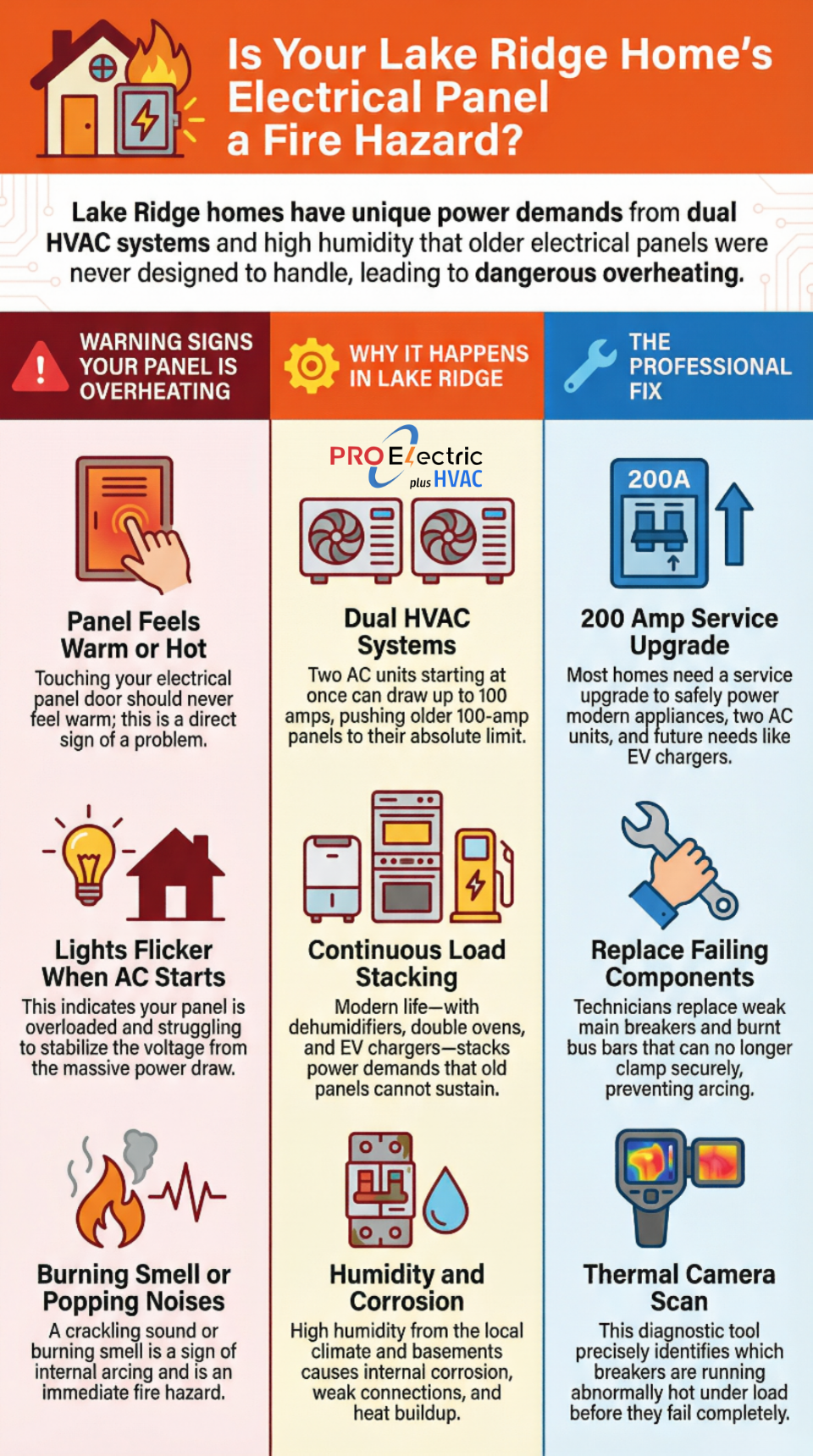
Nearly every Lake Ridge house has a basement, a main level, bedrooms on the top floor, attic air handlers or dual HVAC, and exterior condensers on sloped ground. Two AC systems turning on at once can draw between 60 and 100 amps across the home. Many Lake Ridge homes still have 100-amp services with aging SE cables, old main breakers with weak tension, and bus bars that have hot spots from decades of expansion and contraction.
The tree coverage in Lake Ridge traps humidity. Homes run more dehumidifiers, and more moisture means more corrosion on breakers and bus bars inside older panels. I’ve opened panels near Cotton Mill Drive that were nearly rusted through from years of exposure.
Warning Signs Your Lake Ridge Panel Is Overheating
If you live in Mohican, Hedges Run, Harbor Point, The Knolls, Thousand Oaks, The Tides, Oakwood, or Westridge, you’ve likely seen at least one of these warning signs even if you didn’t realize it.
Hot electrical panel door — If you touch the front of your panel and it feels warm or hot, that is not normal.
Lights flickering when AC kicks on — When both HVAC units start at the same time, an overloaded or weakened panel struggles to stabilize voltage.
Frequent main breaker trips — Your main breaker tripping is a sign of overheating or a failing main.
Burning smell or popping noises — Crackling, sizzling, or popping from a panel is a sign of loose connections or a failing breaker trying to extinguish internal arcing.
What I See Inside Most Lake Ridge Panels
Burnt bus bars from continuous high load, weak breakers whose jaws no longer clamp tight (leading to arcing and heat buildup), double-tapped circuits everywhere where homeowners added basement outlets and outdoor lighting into existing breakers with no more space, melted or discolored main lugs from high summer draw, and panels installed in humid garages and basements where sweating concrete walls send moisture right into the electrical equipment.
How I Fix These Overheating Issues
I start with a full diagnostic of all circuits, then a thermal camera scan to see which breakers are running abnormally hot under load. I replace any failing breakers or the main with modern, correctly torqued units rated for continuous load. Nine out of ten Lake Ridge homeowners benefit from moving up to 200 or 225-amp service so both AC systems, kitchen appliances, basement equipment, and future EV chargers can run safely. I also upgrade grounding and bonding on older homes and add whole-home surge protection for the constant Lake Ridge storms.
The Bottom Line for Lake Ridge Homeowners
If your home is more than 20 years old, has dual HVAC, or feels like it struggles during the summer heat, your electrical panel needs a professional inspection. This exact problem is happening all over Lake Ridge — near Old Bridge, throughout Westridge, in Harbor Point, inside older clusters near Cotton Mill, and across the ridge-top colonials overlooking the river.
Summer loads are getting heavier, AC systems are pulling more power, and older panels simply can’t keep up. I’m right here in Prince William County and I’ve been working in Lake Ridge for years.
📞 Call 703-225-8222 now or book online.
🔗 Related reading: The overheating panels and AC-related overloads you’re seeing in Lake Ridge are part of a wider pattern across Northern Virginia. For every sign your home’s electrical system may be showing, read: signs your electrical system is failing in Prince William County.