
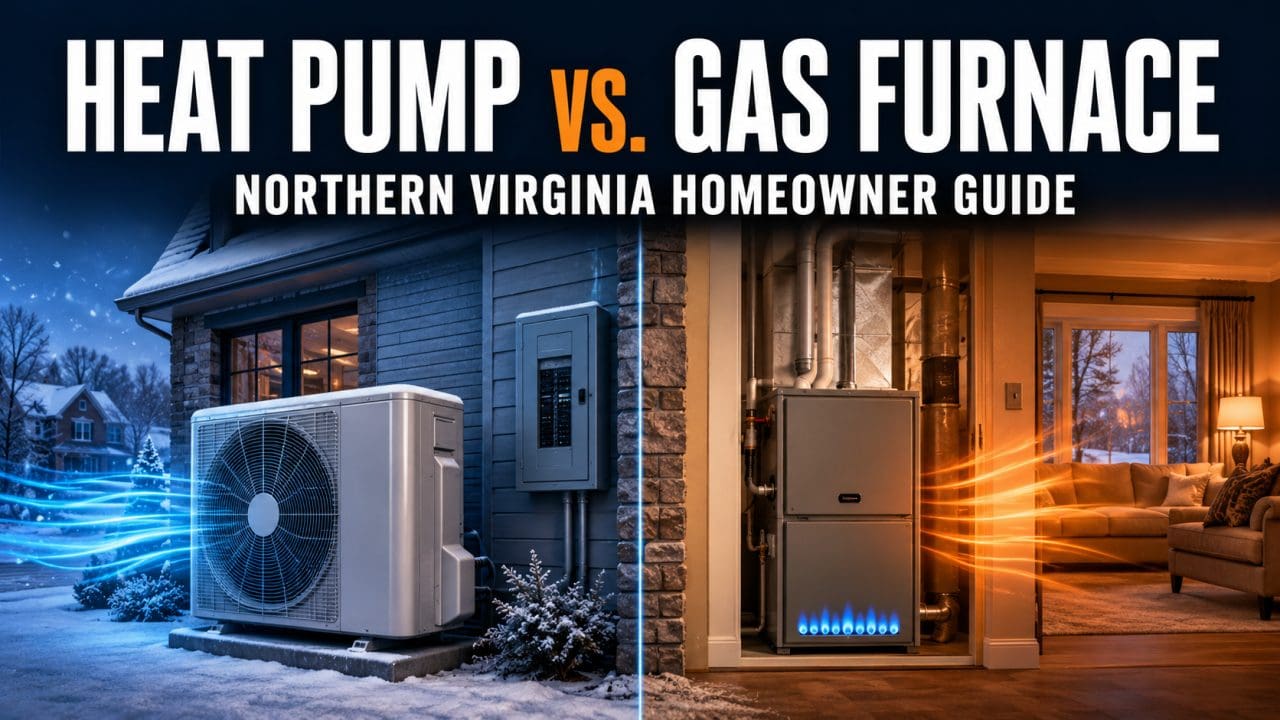
By Peter, Master Electrician and HVAC Technician | PRO Electric plus HVAC | Heat Pump Systems
BOTTOM LINE UP FRONT (BLUF)
If you live in Fairfax, Loudoun, Arlington, or Prince William County and you are deciding between a heat pump and a gas furnace, the honest answer is that both work here and the right one depends on your house, not on the technology. After twenty years of installing and servicing both, the four things that decide it are what you already own and how much life is left in it, what your electrical service can carry, what your ducts are doing, and how long you plan to stay. Fuel prices matter, but they are further down the list than most articles admit.
The option I recommend most often is the one homeowners are least often shown: a dual fuel system, a heat pump outside paired with the gas furnace you already have inside. And the most valuable thing I tell some people is that their equipment is fine and they should wait.
This is the guide I wish every homeowner had before they signed anything. If you are asking any of these, you are in the right place.
- Do heat pumps actually work through a Northern Virginia winter?
- Can my 100 amp panel carry a heat pump, or do I need a service upgrade?
- Is it cheaper to run a heat pump or a gas furnace on my utility rates?
- What is a dual fuel system and why has nobody offered me one?
- Is there still a federal tax credit for a heat pump in 2026?
Table of Contents
- 1. Why This Decision Is Different in Northern Virginia
- 2. What a Heat Pump Actually Does
- 3. What a Gas Furnace Actually Does
- 4. The Question Nobody Asks First: Can Your Panel Carry It
- 5. Dual Fuel, the Option Most People Are Never Offered
- 6. Find Your Answer: The Decision Tool
- 7. Where the Fuel Math Actually Comes From
- 8. Sizing: Manual J, and Why Bigger Is Worse
- 9. AUX Heat, EM Heat, and the Bill That Scares People
- 10. Ductwork Decides More Than the Equipment Does
- 11. What Changed for 2026: Credits, Refrigerants, and Standards
- 12. What This Costs in Northern Virginia
- 13. Permits, Code, and Inspections
- 14. The Mistakes I See Most
- 15. Frequently Asked Questions
- 16. References
1. Why This Decision Is Different in Northern Virginia
I have been wiring and servicing houses in Fairfax, Loudoun, Arlington, and Prince William counties for twenty years, and the heat pump question has changed completely in that time. Fifteen years ago I told people that a heat pump would struggle here in January and they should keep the furnace. That advice is now out of date, and I have had to change my own mind in public more than once.
What has not changed is the thing almost nobody leads with. Northern Virginia sits in a mixed humid climate with real winter but not a severe one. That is precisely the zone where this is a genuine decision rather than an obvious one. In Minnesota the answer leans one way. In Georgia it leans the other. Here, both technologies work, which means the right answer depends on your specific house rather than on the technology.
The Four Things That Actually Decide It
After hundreds of these conversations, the answer nearly always comes down to the same four inputs, in this order.
- What you have now and how much life is left in it. Scrapping working equipment is the most expensive mistake in this entire article.
- What your electrical service can carry. This is the question I get called about after the HVAC contractor has already left, and it is the one I want you asking first.
- What your ducts are doing. Neither machine can outperform the distribution it is attached to.
- How long you are staying. If you are moving in two years, most of this article does not apply to you and I would rather say so now.
Notice that fuel prices are not on that list. They matter, and I devote a whole section to them, but they are the fourth or fifth consideration and they are the one most articles put first because it is the easiest to write about.
2. What a Heat Pump Actually Does
A heat pump does not make heat. It moves it. That single sentence explains why the numbers look impossible when you first see them.
Your refrigerator is a heat pump. It moves heat out of the food compartment and dumps it into your kitchen, which is why the coils on the back are warm. A home heat pump does the same thing with a reversing valve added, so it can run in either direction. In summer it moves heat out of your house. In winter it runs backwards and moves heat from the outdoor air into your house. As the Department of Energy puts it in its Energy Saver guidance, heat pumps transfer heat rather than generate it, which is what allows them to deliver more heat energy than the electrical energy they consume.
Why Cold Air Still Contains Heat
The objection I hear most is that there is no heat outside in January to move. There is. Cold is not the absence of heat, it is a lower quantity of it, and refrigerant boiling at a low enough temperature will absorb heat from air that feels freezing to you. The engineering problem was never whether it works. It was how much capacity you keep as the outdoor temperature drops.
That is the part that changed. Variable speed compressors and better refrigerant control mean current cold climate equipment holds usable capacity at temperatures where the equipment I installed in 2010 would have given up and handed the job to resistance heat. The Northeast Energy Efficiency Partnerships cold climate specification and product list exists specifically to identify which models actually do this, tested down to 5 degrees Fahrenheit and below. If a contractor recommends a heat pump and cannot tell you whether the model is on that list, that tells you something about the recommendation.
What It Feels Like, Which Is Different
Be ready for this, because it surprises people. A gas furnace blows air at roughly 120 to 140 degrees. It is a hot blast, then it shuts off. A heat pump blows a lot more air at a much lower temperature, often around 90 to 105 degrees, and it runs for far longer stretches. Air at 95 degrees is warmer than your skin, so it is heating you, but it does not feel hot on your hand at the register.
Every winter I get calls from people convinced their new heat pump is broken because the air is not hot. It is not broken. It is doing exactly what it should, and the longer run times are why rooms end up more evenly heated than they were with the furnace. But nobody warned them, and that is a failure of the person who sold it, not of the machine.
3. What a Gas Furnace Actually Does
A gas furnace burns fuel to make heat, then blows air across a heat exchanger to move that heat into the house. It is a simpler machine and there is nothing wrong with it.
Efficiency for a furnace is expressed as AFUE, annual fuel utilization efficiency, which is the percentage of the fuel energy that ends up as usable heat in the house. A modern condensing furnace lands in the 90s. That number can never exceed 100, because a furnace cannot deliver more energy than the fuel contains. This is the mathematical reason a heat pump can post numbers a furnace cannot approach: the furnace is limited by combustion, the heat pump is not, because it is not making the heat in the first place.
What a Furnace Does Better
I install both, so let me be even handed about it.
- It does not care how cold it gets. Output is the same at 5 degrees as at 45. There is no capacity curve to worry about.
- It is simpler to service. Fewer parts, more technicians who know it well, cheaper components.
- It asks almost nothing of your electrical panel. A furnace needs a small circuit for the blower and controls. This turns out to matter a great deal, and it is the subject of the next section.
- It recovers temperature fast. If you set back the thermostat hard overnight, a furnace claws it back quicker.
What Comes With It
Combustion in a house is combustion in a house. That means a flue that has to stay clear, a heat exchanger that has to stay intact, and carbon monoxide as a permanent risk that has to be managed rather than eliminated. This is not an argument against furnaces. It is an argument for annual service and for working detectors on every level, which is the same advice I give whether you burn gas or not.
4. The Question Nobody Asks First: Can Your Panel Carry It
This is the section I most want you to read, because it is the one where being licensed in both trades actually changes the advice you get.
Here is how it usually goes wrong. An HVAC company quotes a heat pump. The quote is competitive. Nobody looks at the electrical panel. The install day arrives, the crew opens the panel, and there is either no room or not enough service to carry the new load plus the backup heat. Now you are having an unbudgeted conversation about a service upgrade while your old system is already in the driveway.
What a Heat Pump Asks of Your Service
A heat pump needs a circuit for the outdoor unit and, on a ducted system, a separate and usually much larger circuit for the air handler and its electric backup heat. That backup heat is the part that moves the number. Electric resistance strips draw serious current, and a load calculation has to account for them even though they only run occasionally.
The load calculation itself is governed by Article 220 of the National Electrical Code, and the equipment circuits by Article 440. Those are not optional and they are what the county inspector will check.
Why 100 Amps Is Not Automatically a No
A great many Northern Virginia homes built between the 1960s and the 1980s have 100 amp service, and I want to be careful here because this is where homeowners get sold things they do not need.
A 100 amp service is not automatically disqualifying. Whether it works depends on what else is in the house, how the backup heat is configured, and what the calculation actually produces. I have put heat pumps on 100 amp services and had them pass inspection without touching the panel. I have also opened 200 amp panels and found the service was fine but there was no physical space left, which is a different and much cheaper problem.
So the rule I would give you is short. Refuse a panel upgrade that arrives without a load calculation, and refuse a heat pump quote that never mentions the panel at all. Both of those are common. Only one of them is expensive on the day, but they are both signs the same corner is being cut.
5. Dual Fuel, the Option Most People Are Never Offered
If you take one practical thing from this article, take this one. It is the answer for a large share of the homes I walk into and it is the one homeowners are least often shown.
A dual fuel system, sometimes called a hybrid system, pairs a heat pump outside with a gas furnace inside. The heat pump does the heating whenever it is the more efficient choice, which in our climate is the large majority of the winter. When the outdoor temperature falls below a set point, the control hands the job to the furnace. You get efficient electric heat most of the time and combustion heat on the handful of genuinely cold nights.
Why It Fits Northern Virginia Specifically
Our winters are mostly mild with short severe stretches. A dual fuel system is built for exactly that shape. You are not asking the heat pump to do the hardest hours of the year, which is where its efficiency falls off and where oversizing gets tempting.
The Situation Where This Is Clearly Right
Your furnace is a few years old and healthy. Your air conditioner has died. You need an outdoor unit either way. For a modest difference over a plain condenser you can put a heat pump out there instead, and your working furnace becomes the backup instead of the primary. You bought equipment you needed anyway and got a second heating system out of the deal.
I will be blunt about what that costs me. A full changeout is the bigger invoice, and when the AC dies that is the direction most companies will steer. Telling you to keep a healthy furnace is a smaller job for us. It is also the right answer, and scrapping working equipment to buy a story about electrification is not a good trade for your money.
The Part That Gets Set Up Badly
Dual fuel lives or dies on the switchover point. Set it too high and the furnace runs when the heat pump should be working, and you paid for a heat pump you are not using. Set it too low and you are pushing the heat pump into conditions where it is straining. Ask for the switchover temperature in writing and ask what it is based on. If the answer is a shrug, that system will not deliver what it was sold on.
6. Find Your Answer: The Decision Tool
Below is the tool I built to run the same eight questions I would ask you standing in your basement. It runs entirely in your browser. Nothing is stored, nothing is sent to us, and there is no email box to get past.
It will not size equipment and it does not pretend to. What it does is tell you which of the five real answers your situation points toward, including the one that says leave it alone for now, and the one thing worth verifying before you talk to anybody.
Interactive Decision Tool
Heat Pump or Gas Furnace: Which One Fits Your House?
Eight questions. No email, nothing saved, nothing sent anywhere. It runs entirely in your browser and tells you where the evidence points for your specific situation, including when the answer is to leave your system alone.
This tool needs JavaScript. If it does not load, call 703.225.8222 and we will walk through the same questions with you.
7. Where the Fuel Math Actually Comes From
I am not going to hand you a savings figure, because anybody who gives you one without seeing your bills is guessing. What I will do is show you how the comparison is actually built, so you can run it on your own numbers or check the one a salesperson shows you.
The Only Fair Way to Compare Two Fuels
Gas is sold by the therm or the hundred cubic feet. Electricity is sold by the kilowatt hour. You cannot compare those directly. You have to convert both to a cost per unit of delivered heat, which means taking the price of the fuel, dividing by the energy it contains, and then dividing by the efficiency of the equipment that burns or moves it.
For the furnace, the efficiency term is AFUE. For the heat pump it is the coefficient of performance at the outdoor temperature you care about, which is not a single number but a curve. That curve is the reason honest comparisons are seasonal rather than a single figure.
Get Your Own Numbers, Not the National Ones
Northern Virginia electricity prices have moved significantly in recent years, and the direction matters to this calculation. Use current figures rather than anything you read in an article, including this one.
- Your own utility bills for the last twelve months are the best source you have. They reflect your rate, your riders, and your actual usage.
- The U.S. Energy Information Administration publishes current state level residential electricity prices in its Electric Power Monthly and residential natural gas prices in its Natural Gas Monthly. Both are free and both are updated regularly.
- Watch for rate structures. Time of use pricing changes the answer for a system that runs long and steady, which a heat pump does.
What the Comparison Usually Shows Around Here
I will give you the honest shape of it rather than a number. Against electric resistance heat, oil, or propane, the heat pump wins and it is not close. Against natural gas in Northern Virginia, it is genuinely competitive and the outcome depends on your rate, your equipment efficiencies, and your house. Anyone who tells you gas always wins or electric always wins is selling, not calculating.
8. Sizing: Manual J, and Why Bigger Is Worse
More capacity is not better. In heating and cooling, oversizing is the single most common cause of a system that never satisfies anyone, and it happens because sizing properly takes an hour of work that nobody bills for.
What a Load Calculation Actually Is
The industry standard is Manual J, published by the Air Conditioning Contractors of America. It calculates how much heat your specific house loses and gains, room by room, based on its orientation, insulation, window area and type, air leakage, and square footage. Manual S then selects equipment to match that load, and Manual D sizes the ducts to carry it.
What most quotes use instead is a rule of thumb based on square footage, or worse, the size of the equipment being replaced. That second one perpetuates whatever mistake was made the last time.
What Oversizing Does to You
- Short cycling. The system satisfies the thermostat fast, shuts off, and restarts. Every start is the hardest moment for the equipment.
- Poor dehumidification in summer. Removing humidity takes run time. A unit that blasts and stops leaves your house cold and clammy.
- Uneven rooms. Short cycles never move enough air to reach the far corners of the duct system.
- Higher bills and shorter life. You paid more for equipment that will wear out sooner.
This matters more for heat pumps than furnaces, because a variable speed heat pump is designed to run long and low. Oversize it and you have removed the exact behaviour you paid extra for.
Ask for the Manual J on paper. Not a promise that one was done. The document. If nobody on your list will produce one, that is useful information about your list.
9. AUX Heat, EM Heat, and the Bill That Scares People
This section exists because of one repeated phone call. Somebody gets a January electric bill that is double what they expected, decides the heat pump is a failure, and calls to ask what replacing it would cost. Most of the time the equipment is fine and the thermostat has been in the wrong mode since November.
They Are Not the Same Thing
Auxiliary heat, usually labelled AUX, is the system working as designed. When the heat pump alone cannot keep up, the control brings in supplemental heat to help, then drops it again. Seeing AUX during a cold snap or during recovery from a setback is normal and is not a fault.
Emergency heat, usually labelled EM HEAT, is a manual override. It shuts the heat pump off entirely and runs on backup alone. On most ducted systems that backup is electric resistance, which is the most expensive heat you can buy. It exists for one purpose: to keep you warm when the heat pump has actually failed, until someone can get there.
The Mistake
Somebody feels cool air during a defrost cycle, decides the system is not working, and switches the thermostat to emergency heat. It gets warm. They leave it there. Then the bill arrives.
Go and look at your thermostat now if you have a heat pump. If it says EM HEAT and nothing is broken, put it back to normal heat. That is a free fix and I would rather you got it from an article than from an invoice.
What AUX Running Constantly Actually Means
If AUX is on for weeks rather than during cold snaps, something is wrong and it is usually one of a short list: the unit is undersized, the refrigerant charge is off, the defrost control is faulty, the outdoor coil is blocked, or the balance point was set badly at commissioning. Every one of those is a service call. None of them is a reason to buy new equipment.
10. Ductwork Decides More Than the Equipment Does
You can buy the best equipment made and attach it to bad ducts, and you will have an expensive version of the problem you started with.
This matters more for heat pumps because of how they deliver heat. A furnace pushes a smaller volume of very hot air. A heat pump pushes a much larger volume of warm air. If the duct system was designed around furnace airflow, and many older Northern Virginia systems were, it may simply not be able to move what a heat pump needs to move.
What I Look For
- Leakage into unconditioned space. Ducts running through an attic or crawlspace with bad joints are heating the outdoors. This is common and it is fixable.
- Undersized returns. The return side is where corners get cut. Starve the return and the whole system fights itself.
- Runs added over the years. A finished basement or a bonus room tapped into a system never designed to feed it.
- Crushed or disconnected flex. I find flex duct kinked behind storage or fallen off entirely more often than you would think.
The Honest Order of Operations
If one room in your house has never been comfortable, fix that before you buy equipment. New equipment will not solve a duct problem, and if you replace the system first you will have spent the money and still have the cold bedroom. Sealing and insulation come before equipment for the same reason: they shrink the load, which shrinks the equipment you need to buy.
11. What Changed for 2026: Credits, Refrigerants, and Standards
A lot of what you will find online about this decision was written under conditions that no longer apply. Here is what has actually changed, and I will flag clearly where you should verify rather than take my word.
The Federal Tax Credit Is Gone
This is the big one and a lot of published material has not caught up. The Energy Efficient Home Improvement Credit under Section 25C, which provided up to 2,000 dollars toward a qualifying heat pump, expired for property placed in service after December 31, 2025. The Residential Clean Energy Credit under Section 25D expired on the same date. Both were terminated by legislation enacted in 2025.
If your system was installed and operational on or before that date, the credit is still claimable on the relevant return using IRS Form 5695. If you are installing now, do not build a credit into your budget, and be careful with any contractor still advertising one. Confirm your own situation with the IRS or your tax professional rather than with a salesperson, mine included.
Refrigerants Have Changed
New residential equipment has moved away from R-410A to lower global warming potential refrigerants under the federal phasedown. The practical effect for you is that equipment installed now uses a different refrigerant than equipment installed a few years ago, and that has implications for servicing, parts availability, and mixing old and new components. Ask specifically what refrigerant your quoted equipment uses and whether any part of your existing system is being kept. This area is moving quickly, so verify the current position rather than relying on any article.
Utility and State Programs
With the federal credit gone, utility level incentives matter more than they did. Check directly with your serving utility for current residential heating and cooling programs. These change, and a program that existed last year may not exist now.
12. What This Costs in Northern Virginia
I am not going to print a price range I cannot stand behind, because a number in an article becomes an expectation and then an argument. What I will do is show you exactly what a real quote is made of, so you can read one properly and compare two of them fairly.
What Should Be on the Quote as Separate Lines
- The equipment, by model number, not by tier name. Model numbers can be looked up. Tier names cannot.
- The indoor unit, stated separately, including whether the existing coil or air handler is being reused.
- Electrical work, including any new circuit, disconnect, and whether a panel change is included, excluded, or unknown.
- Duct modifications, if any. If the quote says none and your rooms are uneven, ask why.
- The permit, and who pulls it. It should be us, not you.
- Removal and disposal of the old equipment.
- Commissioning, which means charge verification, airflow measurement, and control setup. This is the line most often missing and it is the one that determines whether the system performs like the brochure.
How to Compare Two Quotes That Look Different
Two quotes are rarely comparing the same thing. Before you look at the totals, line them up on equipment model, whether a load calculation was performed, whether the electrical scope is included or carved out, and whether commissioning appears at all. The cheaper number very often turns out to be the one with the electrical work missing.
Financing is available on request, and our veteran and military discount applies to this work.
13. Permits, Code, and Inspections
Equipment changeouts are permitted work in every county we serve. A contractor who suggests skipping the permit is telling you something important about how the rest of the job will go.
What Governs the Work
The Virginia Uniform Statewide Building Code is the governing code across the Commonwealth, adopting and amending the International Residential Code and the International Mechanical Code. Local jurisdictions enforce it, which is why the process differs slightly between Fairfax, Loudoun, Arlington, and Prince William even though the code does not.
On the electrical side, the National Electrical Code applies as adopted by the Commonwealth. Article 220 covers the load calculation that determines whether your service can carry the new equipment. Article 440 covers the circuits, disconnects, and overcurrent protection for air conditioning and refrigerating equipment.
What a Correct Job Looks Like on Paper
- A mechanical permit for the equipment, and an electrical permit where the electrical scope requires one.
- A load calculation on file, not asserted verbally.
- An inspection by the county, passed, with the record available to you.
- Equipment listed and labelled, installed to the manufacturer instructions, which the code itself requires.
This is also why the dual licence matters practically rather than as a marketing line. When the mechanical and electrical scopes sit with one contractor, there is nobody to point at when the inspector finds something.
14. The Mistakes I See Most
Six, in the order I encounter them.
1. Replacing Working Equipment for a Promise
Scrapping a healthy eight year old furnace to chase savings is the most expensive thing in this article. The payback almost never arrives before the new system is itself middle aged.
2. Letting the Panel Be a Surprise
The electrical question belongs at the start of the conversation, not on install day. If nobody has opened your panel before quoting you a heat pump, that quote is incomplete.
3. Buying Capacity Instead of a Load Calculation
Going a half ton bigger to be safe is not being safe. It is buying short cycling, humidity problems, and a shorter equipment life.
4. Ignoring the Room That Was Never Comfortable
If a bedroom has been cold since you moved in, new equipment will not fix it. That is distribution, and it needs solving before, not after.
5. Leaving the Thermostat on Emergency Heat
Free to fix, expensive to ignore, and it accounts for a good share of the horror stories you will read about heat pump bills.
6. Skipping Commissioning
Charge verification, airflow measurement, and control setup are what turn correct equipment into a system that performs. It is the least visible line on the quote and the first one cut.
15. Frequently Asked Questions
Do heat pumps work in Northern Virginia winters?
Yes. Current cold climate models hold usable heating capacity well below our typical winter lows. The relevant question is not whether they work but whether the specific model quoted to you holds capacity at the temperatures your house sees. Ask whether it appears on the NEEP cold climate product list.
Is a heat pump cheaper to run than a gas furnace?
Against electric resistance, oil, or propane, almost always. Against natural gas in Northern Virginia, it depends on your electricity rate, your gas rate, and the efficiency of both machines. It is a genuine calculation, not a foregone conclusion, and it should be run on your own bills.
Can I put a heat pump on a 100 amp service?
Often yes. It depends on the rest of the load in the house and how the backup heat is configured, and it is settled by a load calculation under Article 220 of the National Electrical Code. Do not accept a panel upgrade recommendation that has no calculation behind it, and do not accept a heat pump quote that never mentions the panel.
What is a dual fuel system?
A heat pump outside paired with a gas furnace inside. The heat pump handles heating in mild and moderate weather, the furnace takes over below a set outdoor temperature. It suits our climate well and it is the right answer for many homes with a healthy furnace and a dead air conditioner.
Why does my heat pump blow cool air sometimes?
Almost certainly a defrost cycle. The outdoor coil accumulates frost in cold damp weather, so the system briefly reverses to melt it. It lasts a few minutes and then normal operation resumes. It is not a fault.
What is the difference between AUX heat and emergency heat?
Auxiliary heat is automatic supplemental heat that assists the heat pump when needed, and it is normal. Emergency heat is a manual override that shuts the heat pump off and runs on backup alone, usually electric resistance. Leaving a thermostat on emergency heat is one of the most common causes of a shocking winter bill.
Is there still a federal tax credit for heat pumps?
No. The Section 25C credit expired for property placed in service after December 31, 2025, as did the Section 25D credit. Systems installed on or before that date may still be claimable on the relevant return. Confirm your own position with the IRS or a tax professional.
How long does each system last?
Both are typically discussed in a similar range, and the honest answer is that installation quality and maintenance matter more than the badge on the equipment. A well sized, correctly commissioned, annually serviced system of either type will outlast a poorly installed one by years.
Do I need new ductwork for a heat pump?
Sometimes. A heat pump moves more air at a lower temperature than a furnace, so a duct system designed around furnace airflow may need modification. This should be assessed before purchase, not discovered afterwards.
What if I have no ductwork at all?
Then ductless heat pumps are usually the sensible route, because installing a duct system to serve a furnace is often the largest cost in the whole project. If you have radiators that work well, keeping them for the coldest weeks while adding ductless for cooling and shoulder season heating is a legitimate answer.
Who pulls the permit?
We do. Equipment changeouts are permitted work in Fairfax, Loudoun, Arlington, and Prince William counties, and a contractor suggesting otherwise is telling you how the rest of the job will go.
16. References
Air Conditioning Contractors of America. ANSI/ACCA Manual J: Residential Load Calculation. ACCA. https://www.acca.org/
Internal Revenue Service. Energy Efficient Home Improvement Credit and Form 5695, Residential Energy Credits. U.S. Department of the Treasury. https://www.irs.gov/
National Fire Protection Association. NFPA 70: National Electrical Code, Article 220 Branch-Circuit, Feeder, and Service Load Calculations and Article 440 Air-Conditioning and Refrigerating Equipment. NFPA.
Northeast Energy Efficiency Partnerships. Cold Climate Air Source Heat Pump Specification and Product List. NEEP. https://neep.org/heating-electrification/ccashp-specification-product-list
U.S. Department of Energy. Air-Source Heat Pumps. Energy Saver, Office of Energy Efficiency and Renewable Energy. https://www.energy.gov/energysaver/air-source-heat-pumps
U.S. Department of Energy. Heat Pump Systems. Energy Saver, Office of Energy Efficiency and Renewable Energy. https://www.energy.gov/energysaver/heat-pump-systems
U.S. Energy Information Administration. Electric Power Monthly, Table 5.6.A: Average Price of Electricity to Ultimate Customers by End-Use Sector. https://www.eia.gov/electricity/monthly/
U.S. Energy Information Administration. Virginia Average Price of Natural Gas Delivered to Residential and Commercial Consumers. https://www.eia.gov/dnav/ng/ng_pri_rescom_dcu_sva_a.htm
U.S. Environmental Protection Agency. Heat Pumps. https://www.epa.gov/burnwise/heat-pumps
U.S. Environmental Protection Agency. ENERGY STAR Certified Air-Source Heat Pumps. https://www.energystar.gov/
Virginia Department of Housing and Community Development. Virginia Uniform Statewide Building Code (USBC). Commonwealth of Virginia. https://www.dhcd.virginia.gov/
Ready to Find Out What Your House Actually Needs?
If you have read this far you are taking the decision seriously, and it deserves better than a phone quote. I would rather spend an hour at your house running the load calculation, opening the panel, and looking at the ducts than guess at any of it. You walk away with real numbers whether or not you hire us.
Call 703.225.8222 or book an appointment online. PRO Electric plus HVAC is fully licensed and insured in Virginia under contractor license 2705181607, we hold both the electrical and the HVAC licence, and we offer a veteran and military discount.