
By Peter, Master Electrician | PRO Electric plus HVAC | Electrical Panel Upgrades
BOTTOM LINE UP FRONT (BLUF)
Rural homes around Nokesville often face electrical panel failures not only because of bad breakers, but because powerful well pumps, long feeder lines, barns, shops, and heavy loads push aging panels far beyond what they were originally designed to handle. Deep-well pumps create large startup surges and continuous heavy draw that wear out breakers and bus bars, especially when paired with long outdoor runs and outdated wiring. This article explains why these failures happen on rural properties and what you can do to fix and prevent them safely.
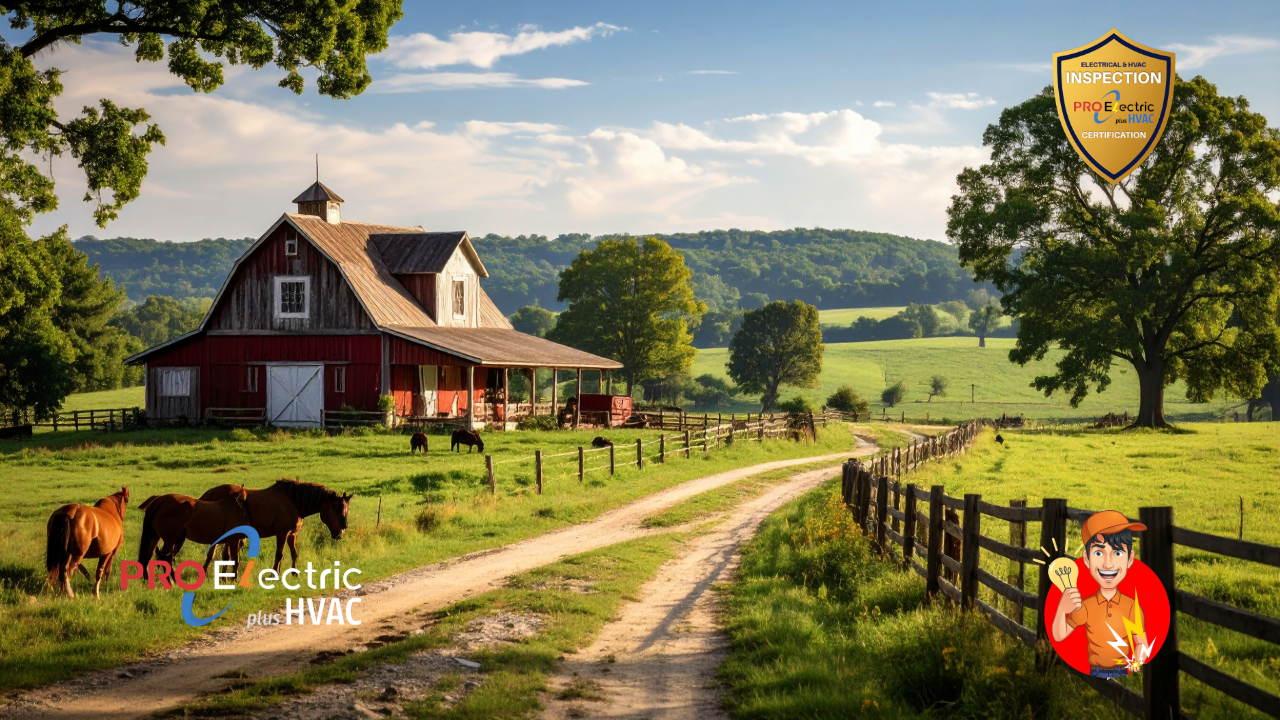
When I work out in Nokesville, I see electrical problems that barely exist anywhere else in Prince William County. Nokesville homes are unique. They’re spread across farmland, wooded acreage, and long gravel driveways. Many of them have: powerful well pumps, multiple outbuildings, large horse barns, heavy security lighting, older underground feeders, oversized HVAC systems with mini-splits, detached garages or workshops, and grain dryers, fence chargers, or agricultural equipment.
These properties are beautiful, but they depend on electrical systems that work far harder than those inside a typical suburban home in Gainesville or Woodbridge. And most of these homes were built decades ago when the electrical needs of rural living were much smaller.
Today, I’m seeing Nokesville electrical panels failing faster than ever. Breakers burn out, main panels overheat, well pumps trip repeatedly, and barn circuits lose voltage under load. Homeowners often don’t know the electrical system is failing until something stops working, usually at the worst time.
The Hidden Stress On Nokesville Electrical Systems
Nokesville homes were built for a simpler lifestyle. But modern rural living uses far more electricity than the builders ever anticipated. Here’s what pushes these systems to the breaking point.
Well Pumps Draw More Power Than People Realize
Nokesville homes aren’t on municipal water. They rely on deep-well pumps, typically between 1 and 2 horsepower, to pump water long distances and pressurize the home.
Well pumps create: large startup surges, continuous heavy draw when filling pressure tanks, voltage drop on long feeder circuits, and rapid breaker wear.
When a pump starts, it can briefly pull three to five times its running amperage. In older panels, this surge heats and damages stabs and weakens breakers. If you hear your pump “thump,” “chug,” or randomly trip the breaker, your electrical system is struggling to keep up with it.
Barns And Outbuildings Are Often Wired Decades Ago
Most Nokesville barns were wired 20 to 40 years ago. Back then, barns needed a few lights, one or two outlets, and maybe a small tack room heater. Today’s barns run: heated troughs, LED floodlights, exhaust fans, pressure washers, large fans, space heaters, dehumidifiers, welders, and security cameras. Many barns run all of that on wiring that was never upgraded.
Undersized feeders, deteriorated conduit, and aluminum underground cables cause heat, voltage drop, and inconsistent power, often leading to nuisance trips or breaker failures in the home’s main panel.
Detached Garages And Workshops Push Panels Beyond Their Rating
Workshops increasingly include: large air compressors, table saws, welders, mini-split ACs, dust collection systems, and 240V equipment. If your garage or shop lights dim when you start a tool, your leading service is overloaded or the feeder is undersized. This is common in older Nokesville homes where the original panel is still only 100 or 150 amps.
Long Distances Cause Voltage Drop
Nokesville has something that other towns don’t: distance. Distance between the panel and the well, the panel and the barn, the panel and the shop, and the panel and the driveway gate. Long wire runs create a voltage drop, especially with aluminum conductors. The farther the electricity has to travel, the harder the panel has to work, and the hotter the breakers run.
Neighborhoods And Areas Where I See These Problems Most
I see heavy electrical failures throughout rural Nokesville, especially on farms along Aden Road, large properties off Fitzwater Drive, older homes near Nokesville Road, acreage near Parkgate Drive, the estates along Fleetwood Drive, properties off Dumfries Road, barns behind Carriage Ford Road, and homes near Wellington Road. These areas rely on older electrical infrastructure, long circuits, and high electrical loads, all of which create real strain on the panel.
Warning Signs Your Nokesville Electrical System Is Overwhelmed
Well pump trips or stutters — If your water stops mid-shower, your electrical panel may be failing.
Flickering lights when the pump or barn circuits start — This means you’re experiencing a voltage drop.
Warm main breaker — The main should never feel warm to the touch.
Random breaker trips — Especially for barns, outdoor lighting, workshops, and HVAC systems.
Barn lights dim when equipment starts — This is a sign of undersized wiring or a failing breaker.
Weak or low voltage in outbuildings — Lights that slowly brighten after starting mean the system is struggling.
Burning smell in the panel — If you smell this, call immediately. You are one step from a severe failure.
What I Find Inside Failing Nokesville Panels
When I open electrical panels in rural properties, I commonly see: burnt bus bars from constant heavy well pump startup loads, oversized breakers where homeowners “fixed trips” with larger breakers (this is dangerous), aluminum wiring with corrosion on older barn and well feeders, weak main breakers from continuous load cycles, undersized 100-amp service despite having barns, garages, multiple HVAC units, EV chargers, and large well pumps, and double-tapped breakers where barn and workshop circuits get tied into whatever breaker has space.
How I Fix Nokesville Rural Electrical Systems
My repair approach for Nokesville is different from what I do in townhomes or suburban communities. I start with a full load evaluation calculating well pump load, barn loads, garage and shop loads, outdoor lighting, HVAC, and EV chargers. From there, the fix typically involves a service upgrade to 200 or 250 amps, a dedicated well pump circuit sized correctly with proper breaker and surge protection, a new feeder to barns or outbuildings with proper gauge and grounding, replacing the overheated panel with a modern unit that has more spaces, surge protection for pump and barn equipment, and correcting all double taps and overloaded circuits.
Upgrading rural electrical systems protects your well pump, barn equipment, HVAC systems, power tools, freezers, sensitive electronics, farm operations, and your home’s safety. It also prevents failures from becoming emergencies.
The Bottom Line
If you live in Nokesville and have a well pump, a barn or shop, long outdoor feeders, flickering lights, a warm panel, frequent breaker trips, or inconsistent voltage in outbuildings, your electrical system is overloaded or deteriorating. I specialize in rural properties. I know exactly how these systems fail and how to repair them safely so your home, water supply, and farm operations stay reliable.
📞 Call 703-225-8222 now or book online for installation guidance.
🔗 Related reading: The well pump trips, barn circuit failures, and panel overloads you see in Nokesville are part of a bigger picture. For a complete look at every sign of a failing electrical system in Prince William County homes, read: signs of a failing electrical system in Prince William County homes.